Ribeiro Ana I, Modic Martina, Cvelbar Uros, Dinescu Gheorghe, Mitu Bogdana, Nikiforov Anton, Leys Christophe, Kuchakova Iryna, De Vrieze Mike, Felgueiras Helena P, Souto António P, Zille Andrea
C2T-Centro de Ciência e Tecnologia Têxtil, Universidade do Minho, Campus de Azurém, 4800-058 Guimarães, Portugal.
Jožef Stefan Institute, Jamova cesta 39, 1000 Ljubljana, Slovenia.
Nanomaterials (Basel). 2020 Mar 26;10(4):607. doi: 10.3390/nano10040607.
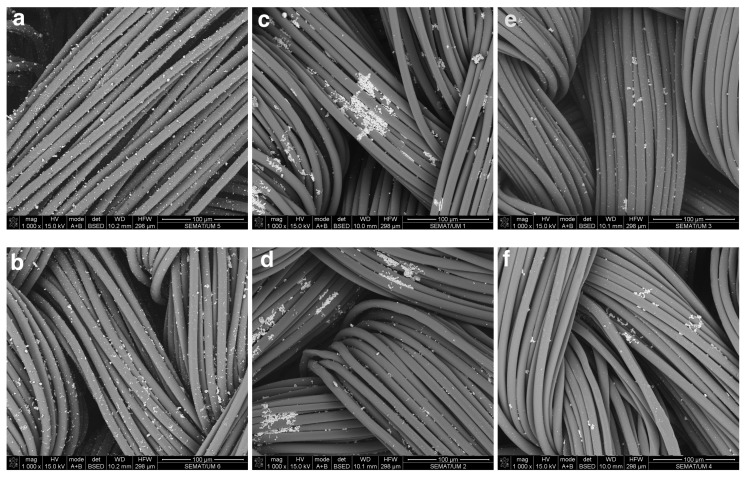
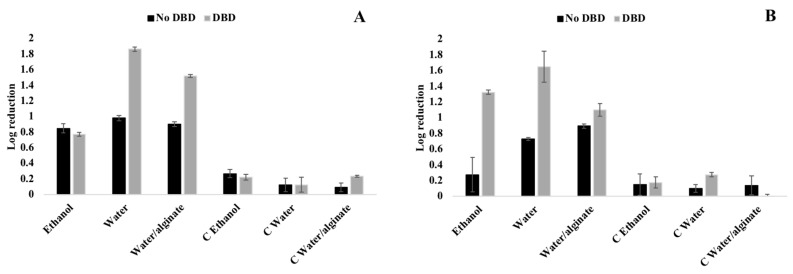
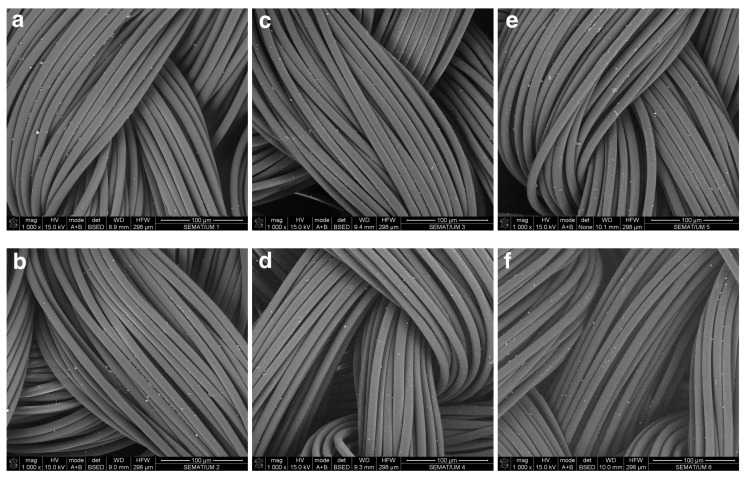
Polyvinylpyrrolidone-coated silver nanoparticles (PVP-AgNPs) dispersed in ethanol, water and water/alginate were used to functionalize untreated and dielectric barrier discharge (DBD) plasma-treated polyamide 6,6 fabric (PA66). The PVP-AgNPs dispersions were deposited onto PA66 by spray and exhaustion methods. The exhaustion method showed a higher amount of deposited AgNPs. Water and water-alginate dispersions presented similar results. Ethanol amphiphilic character showed more affinity to AgNPs and PA66 fabric, allowing better uniform surface distribution of nanoparticles. Antimicrobial effect in showed good results in all the samples obtained by exhaustion method but using spray method only the DBD plasma treated samples displayed antimicrobial activity (log reduction of 5). Despite the better distribution achieved using ethanol as a solvent, water dispersion samples with DBD plasma treatment displayed better antimicrobial activity against bacteria in both exhaustion (log reduction of 1.9) and spray (methods log reduction of 1.6) due to the different oxidation states of PA66 surface interacting with PVP-AgNPs, as demonstrated by X-Ray Photoelectron Spectroscopy (XPS) analysis. Spray method using the water-suspended PVP-AgNPs onto DBD plasma-treated samples is much faster, less agglomerating and uses 10 times less PVP-AgNPs dispersion than the exhaustion method to obtain an antimicrobial effect in both and .
分散于乙醇、水和水/海藻酸盐中的聚乙烯吡咯烷酮包覆银纳米颗粒(PVP-AgNPs)被用于对未处理的和经介质阻挡放电(DBD)等离子体处理的聚酰胺6,6织物(PA66)进行功能化处理。通过喷涂和浸渍法将PVP-AgNPs分散液沉积到PA66上。浸渍法显示出更高的AgNPs沉积量。水和水-海藻酸盐分散液呈现出相似的结果。乙醇的两亲特性显示出对AgNPs和PA66织物具有更高的亲和力,使纳米颗粒在表面分布更均匀。抗菌效果表明,通过浸渍法获得的所有样品都有良好的结果,但使用喷涂法时,只有经DBD等离子体处理的样品具有抗菌活性(对数减少5)。尽管使用乙醇作为溶剂能实现更好的分布,但经DBD等离子体处理的水分散液样品在浸渍(对数减少1.9)和喷涂(对数减少1.6)两种方法中对细菌均显示出更好的抗菌活性,这是由于PA66表面与PVP-AgNPs相互作用的氧化态不同,X射线光电子能谱(XPS)分析证明了这一点。将水悬浮的PVP-AgNPs喷涂到经DBD等离子体处理的样品上的方法更快,团聚更少,并且比浸渍法使用的PVP-AgNPs分散液少10倍就能在两种细菌中获得抗菌效果。