Intramural Research Program, National Institute on Drug Abuse (NIDA), National Institutes of Health, Baltimore, MD 21224.
Intramural Research Program, National Institute on Aging, National Institutes of Health, Baltimore, MD 21224.
Proc Natl Acad Sci U S A. 2020 Apr 14;117(15):8611-8615. doi: 10.1073/pnas.1909340117. Epub 2020 Mar 30.
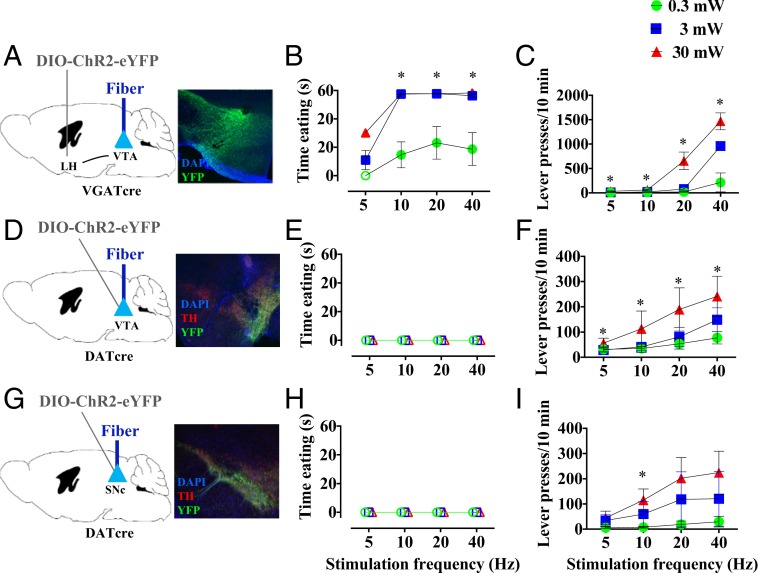
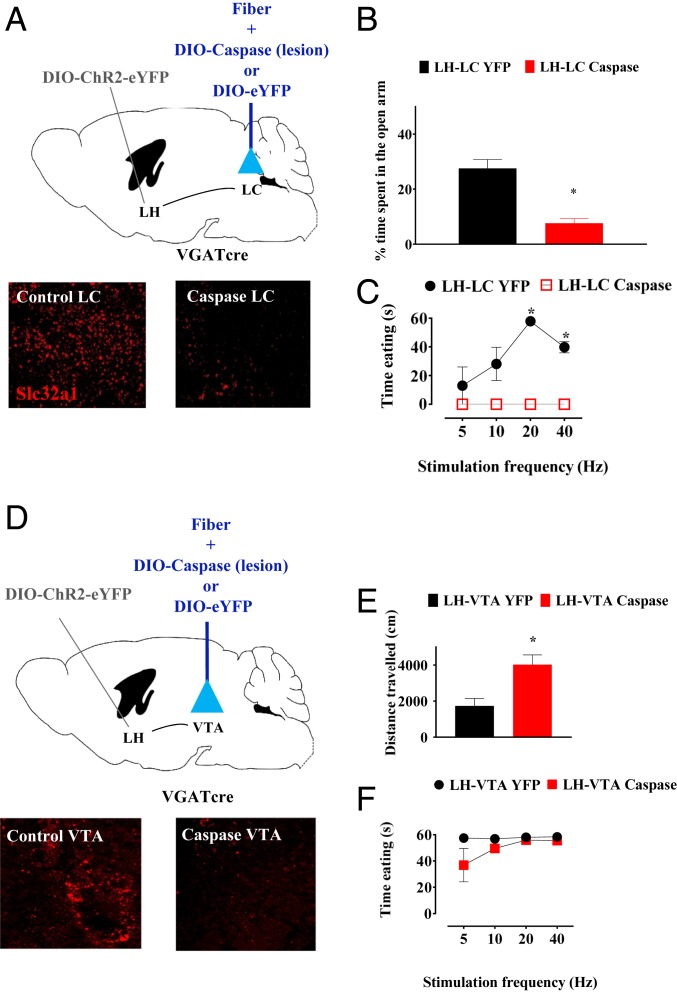
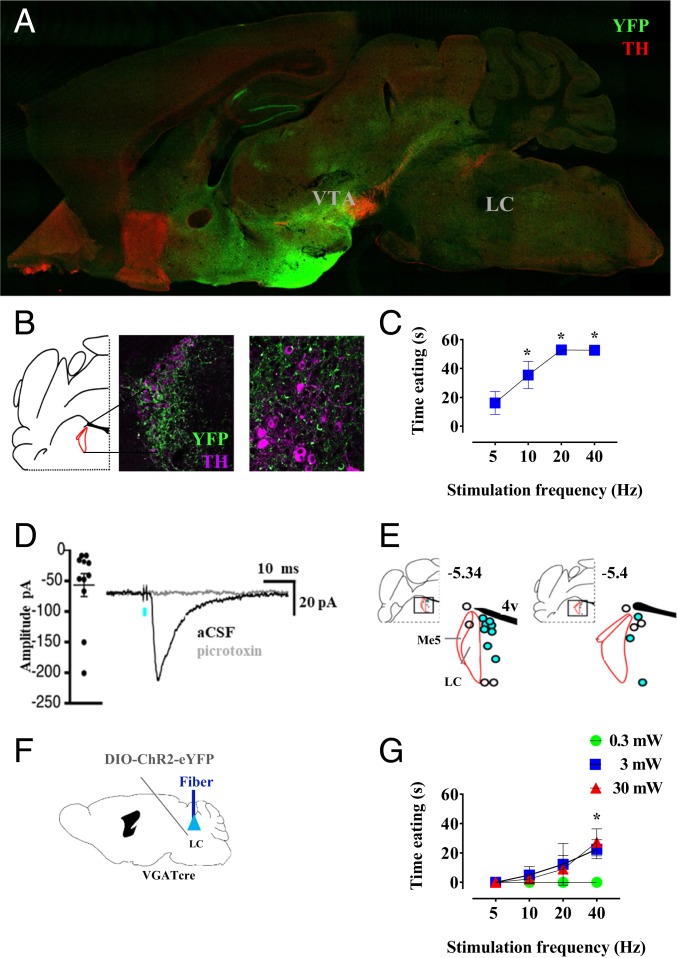
Electrical or optogenetic stimulation of lateral hypothalamic (LH) GABA neurons induces rapid vigorous eating in sated animals. The dopamine system has been implicated in the regulation of feeding. Previous work has suggested that a subset of LH GABA neurons projects to the ventral tegmental area (VTA) and targets GABA neurons, inhibiting them and thereby disinhibiting dopaminergic activity and release. Furthermore, stimulation-induced eating is attenuated by dopamine lesions or receptor antagonists. Here we explored the involvement of dopamine in LH stimulation-induced eating. LH stimulation caused sated mice to pick up pellets of standard chow with latencies that varied based on stimulation intensity; once food was picked up, animals ate for the remainder of the 60-s stimulation period. However, lesion of VTA GABA neurons failed to disrupt this effect. Moreover, direct stimulation of VTA or substantia nigra dopamine cell bodies failed to induce food approach or eating. Looking further, we found that some LH GABA fibers pass through the VTA to more caudal sites, where they synapse onto neurons near the locus coeruleus (LC). Similar eating was induced by stimulation of LH GABA terminals or GABA cell bodies in this peri-LC region. Lesion of peri-LC GABA neurons blocked LH stimulation-induced eating, establishing them as a critical downstream circuit element for LH neurons. Surprisingly, lesions did not alter body weight, suggesting that this system is not involved in the hunger or satiety mechanisms that govern normal feeding. Thus, we present a characterization of brain circuitry that may promote overeating and contribute to obesity.
电刺激或光遗传学刺激外侧下丘脑 (LH) GABA 神经元会在饱腹动物中引发快速而剧烈的进食。多巴胺系统被认为参与了进食的调节。先前的研究表明,LH GABA 神经元的一个亚群投射到腹侧被盖区 (VTA),并靶向 GABA 神经元,抑制它们从而抑制多巴胺能活动和释放。此外,刺激诱导的进食可被多巴胺损伤或受体拮抗剂减弱。在这里,我们探讨了多巴胺在 LH 刺激诱导进食中的作用。LH 刺激使饱腹的小鼠捡起标准食物颗粒,潜伏期取决于刺激强度;一旦食物被捡起,动物会在 60 秒刺激期的剩余时间内进食。然而,VTA GABA 神经元的损伤并没有破坏这种效应。此外,直接刺激 VTA 或黑质多巴胺细胞体不能诱导食物接近或进食。进一步观察,我们发现一些 LH GABA 纤维穿过 VTA 到达更尾侧的部位,在那里它们与蓝斑核 (LC) 附近的神经元形成突触。刺激该 LC 周围区域的 LH GABA 末梢或 GABA 细胞体也能诱导类似的进食。LC 周围 GABA 神经元的损伤阻断了 LH 刺激诱导的进食,这确立了它们作为 LH 神经元的关键下游回路元件。令人惊讶的是,损伤并没有改变体重,这表明该系统不参与控制正常进食的饥饿或饱腹感机制。因此,我们提出了一个可能促进暴饮暴食并导致肥胖的大脑回路的特征描述。