Sargiacomo Camillo, Sotgia Federica, Lisanti Michael P
Translational Medicine, School of Science, Engineering and Environment (SEE), University of Salford, Greater Manchester, United Kingdom.
Aging (Albany NY). 2020 Mar 30;12(8):6511-6517. doi: 10.18632/aging.103001.
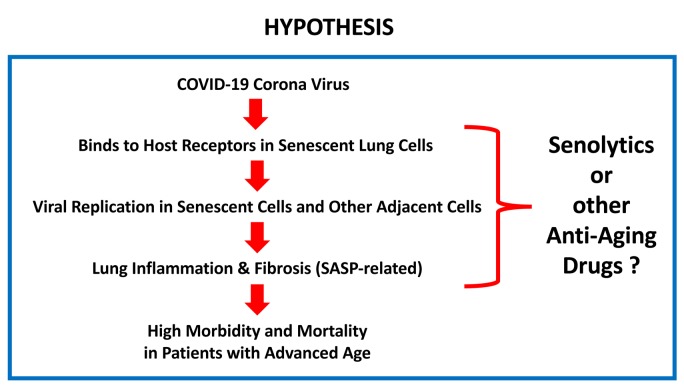
COVID-19, also known as SARS-CoV-2, is a new emerging zoonotic corona virus of the SARS (Severe Acute Respiratory Syndrome) and the MERS (Middle East Respiratory Syndrome) family. COVID-19 originated in China and spread world-wide, resulting in the pandemic of 2020. For some reason, COVID-19 shows a considerably higher mortality rate in patients with advanced chronological age. This begs the question as to whether there is a functional association between COVID-19 infection and the process of chronological aging. Two host receptors have been proposed for COVID-19. One is CD26 and the other is ACE-2 (angiotensin-converting enzyme 2). Interestingly, both CD26 and the angiotensin system show associations with senescence. Similarly, two proposed therapeutics for the treatment of COVID-19 infection are Azithromycin and Quercetin, both drugs with significant senolytic activity. Also, Chloroquine-related compounds inhibit the induction of the well-known senescence marker, Beta-galactosidase. Other anti-aging drugs should also be considered, such as Rapamycin and Doxycycline, as they behave as inhibitors of protein synthesis, blocking both SASP and viral replication. Therefore, we wish to speculate that the fight against COVID-19 disease should involve testing the hypothesis that senolytics and other anti-aging drugs may have a prominent role in preventing the transmission of the virus, as well as aid in its treatment. Thus, we propose that new clinical trials may be warranted, as several senolytic and anti-aging therapeutics are existing FDA-approved drugs, with excellent safety profiles, and would be readily available for drug repurposing efforts. As Azithromycin and Doxycycline are both commonly used antibiotics that inhibit viral replication and IL-6 production, we may want to consider this general class of antibiotics that functionally inhibits cellular protein synthesis as a side-effect, for the treatment and prevention of COVID-19 disease.
新冠病毒(COVID-19),也被称为严重急性呼吸综合征冠状病毒2(SARS-CoV-2),是一种新出现的人畜共患冠状病毒,属于严重急性呼吸综合征(SARS)和中东呼吸综合征(MERS)家族。新冠病毒起源于中国,并在全球范围内传播,导致了2020年的大流行。出于某种原因,新冠病毒在高龄患者中的死亡率要高得多。这就引出了一个问题,即新冠病毒感染与自然衰老过程之间是否存在功能关联。针对新冠病毒已提出了两种宿主受体。一种是CD26,另一种是血管紧张素转换酶2(ACE-2)。有趣的是,CD26和血管紧张素系统都与衰老有关。同样,两种被提议用于治疗新冠病毒感染的药物是阿奇霉素和槲皮素,这两种药物都具有显著的衰老细胞溶解活性。此外,氯喹相关化合物可抑制著名的衰老标志物β-半乳糖苷酶的诱导。还应考虑其他抗衰老药物,如雷帕霉素和强力霉素,因为它们可作为蛋白质合成抑制剂,阻断衰老相关分泌表型(SASP)和病毒复制。因此,我们推测,抗击新冠病毒疾病应包括检验这样一种假设,即衰老细胞溶解剂和其他抗衰老药物在预防病毒传播以及辅助治疗方面可能发挥重要作用。因此,我们建议或许有必要开展新的临床试验,因为几种衰老细胞溶解剂和抗衰老疗法都是美国食品药品监督管理局(FDA)批准的现有药物,具有良好的安全性,并且很容易用于药物再利用研究。由于阿奇霉素和强力霉素都是常用抗生素,可抑制病毒复制和白细胞介素-6的产生,我们或许可以考虑将这类具有抑制细胞蛋白质合成副作用的抗生素用于新冠病毒疾病的治疗和预防。