Brown Joshua D
Center for Drug Evaluation & Safety, Consortium for Medical Marijuana Clinical Outcomes Research, Department of Pharmaceutical Outcomes & Policy, University of Florida College of Pharmacy, Gainesville, FL 32610, USA.
J Clin Med. 2020 Mar 27;9(4):919. doi: 10.3390/jcm9040919.
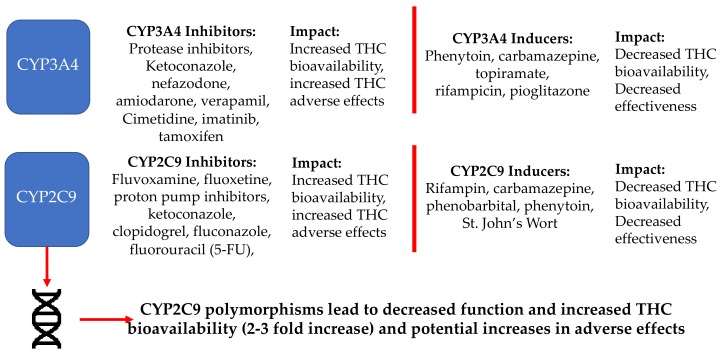
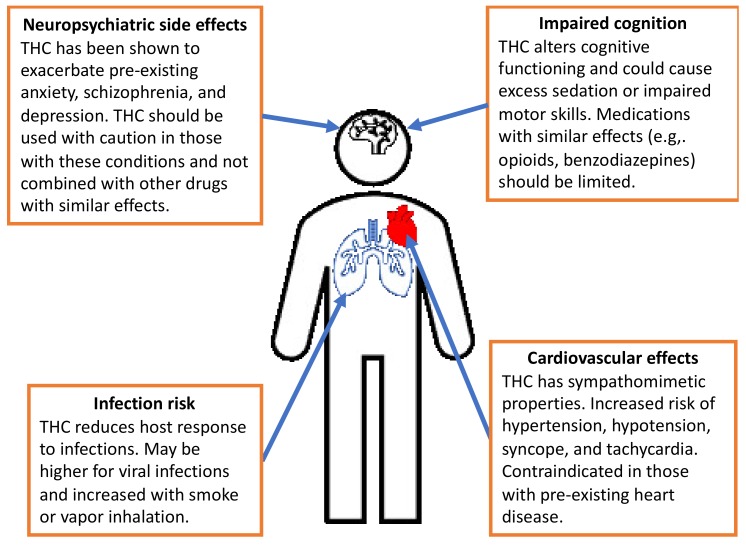
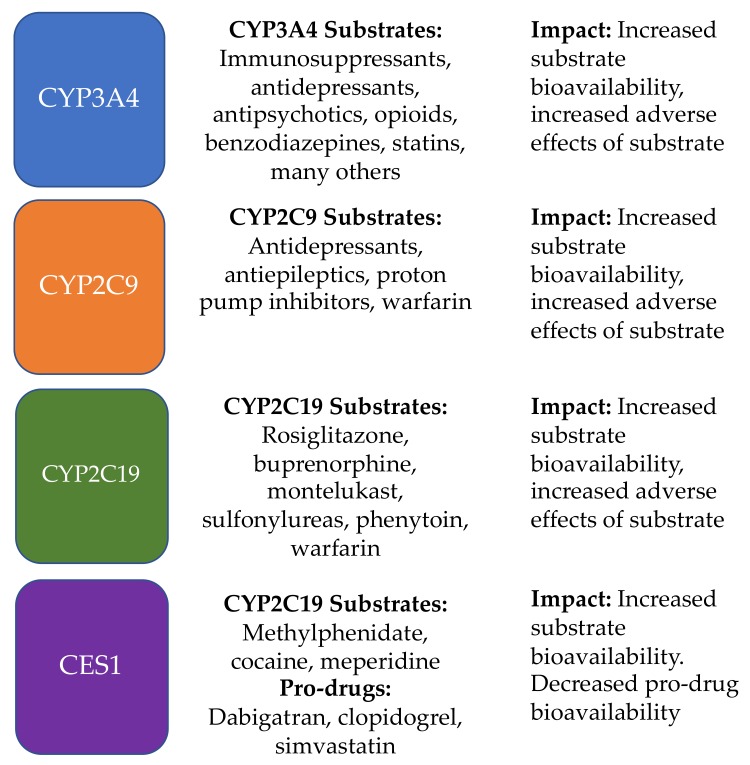
Tetrahydrocannabinol (THC) is the primary psychoactive ingredient in cannabis. While the safety of THC and cannabis has been extrapolated from millennia of recreational use, medical marijuana programs have increased exposure among medically complex individuals with comorbid conditions and many co-prescribed medications. Thus, THC should be recognized as a pharmacologically complex compound with potential for drug-drug interactions and adverse drug events. This review summarizes potential adverse drug events related to THC when combined with other medications. Metabolic drug-drug interactions are primarily due to THC conversion by CYP3A4 and CYP2C9, which can be impacted by several common medications. Further, CYP2C9 polymorphisms are highly prevalent in certain racial groups (up to 35% in Caucasians) and increase the bioavailability of THC. THC also has broad interactions with drug-metabolizing enzymes and can enhance adverse effects of other medications. Pharmacodynamic interactions include neurological effects, impact on the cardiovascular system, and risk of infection. General clinical recommendations for THC use include starting with low doses and titrating to desired effects. However, many interactions may be unavoidable, dose-limiting, or a barrier to THC-based therapy. Future work and research must establish sufficient data resources to capture medical marijuana use for such studies. Meanwhile, clinicians should balance the potential risks of THC and cannabis and the lack of strong evidence of efficacy in many conditions with patient desires for alternative therapy.
四氢大麻酚(THC)是大麻中的主要精神活性成分。虽然THC和大麻的安全性是从数千年的娱乐性使用中推断出来的,但医用大麻项目增加了患有合并症且同时使用多种药物的医疗复杂个体的接触量。因此,THC应被视为一种具有药理复杂性的化合物,具有药物相互作用和药物不良事件的可能性。本综述总结了THC与其他药物联合使用时可能出现的药物不良事件。代谢性药物相互作用主要是由于CYP3A4和CYP2C9对THC的转化,这可能会受到几种常用药物的影响。此外,CYP2C9基因多态性在某些种族群体中高度普遍(白种人中高达35%),并会增加THC的生物利用度。THC还与药物代谢酶有广泛的相互作用,并可增强其他药物的不良反应。药效学相互作用包括神经学效应、对心血管系统的影响以及感染风险。THC使用的一般临床建议包括从低剂量开始并根据需要的效果进行滴定。然而,许多相互作用可能是不可避免的、剂量限制的或是基于THC治疗的障碍。未来的工作和研究必须建立足够的数据资源来收集用于此类研究的医用大麻使用情况。同时,临床医生应在THC和大麻的潜在风险与在许多情况下缺乏有力疗效证据之间,与患者对替代疗法的需求进行权衡。