Nuffield Laboratory of Ophthalmology, Nuffield Department of Clinical Neurosciences & NIHR Oxford Biomedical Research Centre, University of Oxford, Oxford OX3 9DU, UK.
Oxford Eye Hospital, Oxford University Hospitals NHS Foundation Trust, Oxford OX3 9DU, UK.
Int J Mol Sci. 2020 Mar 27;21(7):2329. doi: 10.3390/ijms21072329.
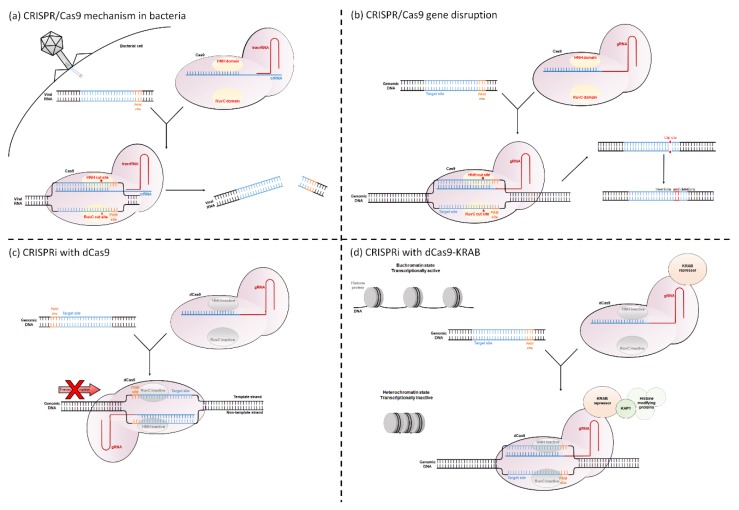
The treatment of dominantly inherited retinal diseases requires silencing of the pathogenic allele. RNA interference to suppress gene expression suffers from wide-spread off-target effects, while CRISPR-mediated gene disruption creates permanent changes in the genome. CRISPR interference uses a catalytically inactive 'dead' Cas9 directed by a guide RNA to block transcription of chosen genes without disrupting the DNA. It is highly specific and potentially reversible, increasing its safety profile as a therapy. Pre-clinical studies have demonstrated the versatility of CRISPR interference for gene silencing both in vivo and in ex vivo modification of iPSCs for transplantation. Applying CRISPR interference techniques for the treatment of autosomal dominant inherited retinal diseases is promising but there are few in vivo studies to date. This review details how CRISPR interference might be used to treat retinal diseases and addresses potential challenges for clinical translation.
显性遗传性视网膜疾病的治疗需要沉默致病基因。RNA 干扰抑制基因表达会产生广泛的脱靶效应,而 CRISPR 介导的基因编辑会在基因组中造成永久性的改变。CRISPR 干扰利用一种由向导 RNA 指导的无催化活性的“失活”Cas9 来阻断选定基因的转录,而不会破坏 DNA。它具有高度特异性和潜在的可逆性,增加了其作为治疗方法的安全性。临床前研究已经证明,CRISPR 干扰在体内和体外 iPSC 的基因沉默方面具有多功能性,可用于移植的修饰。应用 CRISPR 干扰技术治疗常染色体显性遗传性视网膜疾病具有广阔的前景,但迄今为止,体内研究很少。本综述详细介绍了 CRISPR 干扰如何用于治疗视网膜疾病,并探讨了其临床转化的潜在挑战。