Tao Ran, McHale Glen, Reboud Julien, Cooper Jonathan M, Torun Hamdi, Luo JingTing, Luo Jikui, Yang Xin, Zhou Jian, Canyelles-Pericas Pep, Wu Qiang, Fu Yongqing
Faculty of Engineering and Environment, Northumbria University, Newcastle upon Tyne NE1 8ST, United Kingdom.
Shenzhen Key Laboratory of Advanced Thin Films and Applications, College of Physics and Energy, Shenzhen University, 518060 Shenzhen, P. R. China.
Nano Lett. 2020 May 13;20(5):3263-3270. doi: 10.1021/acs.nanolett.0c00005. Epub 2020 Apr 7.
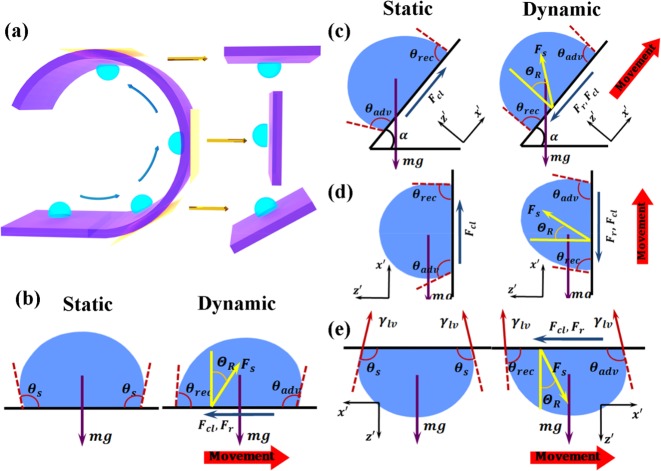
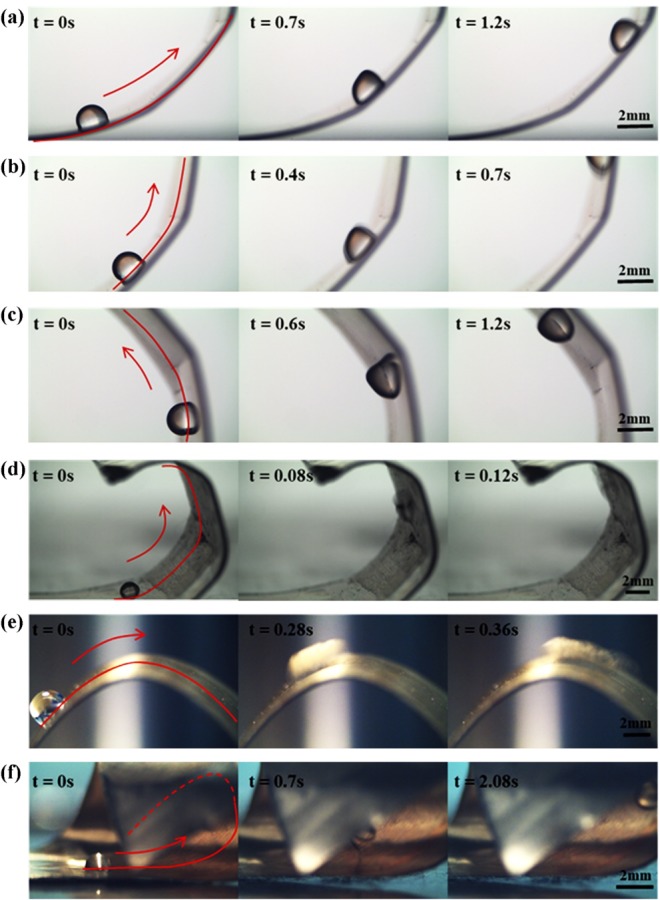
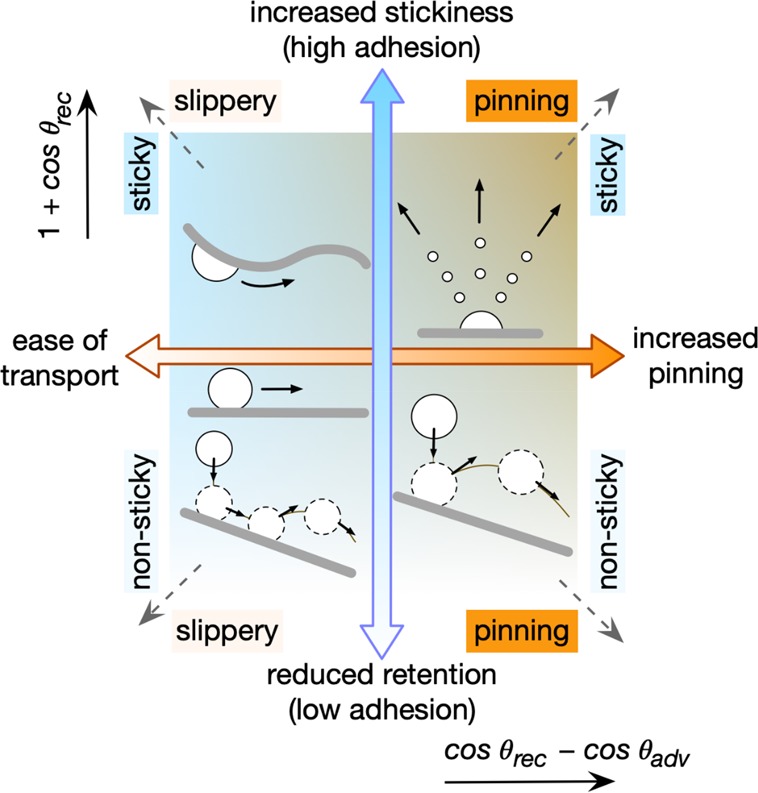
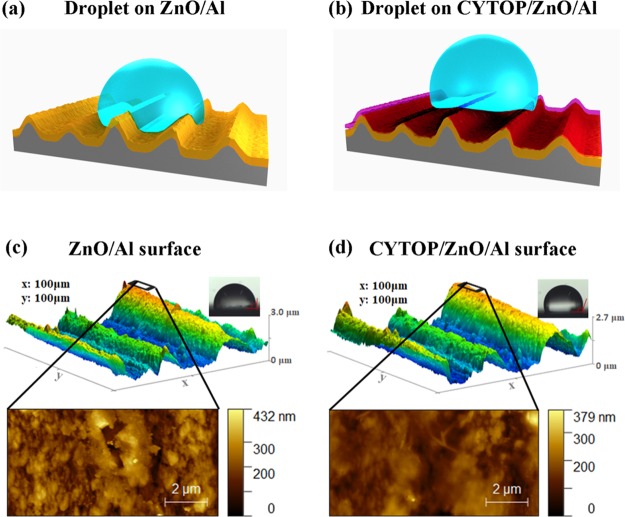
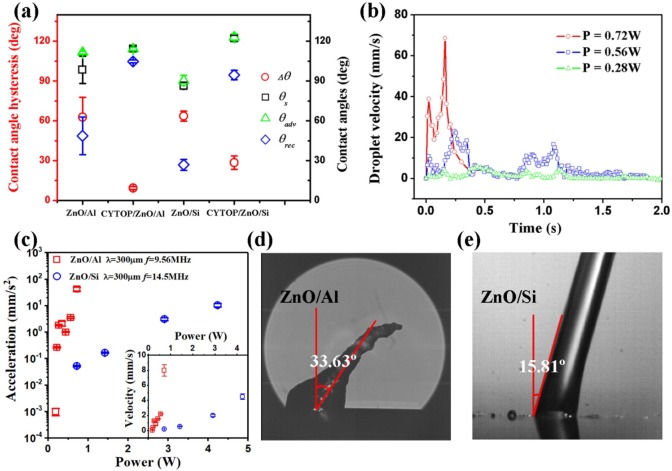
The ability to actuate liquids remains a fundamental challenge in smart microsystems, such as those for soft robotics, where devices often need to conform to either natural or three-dimensional solid shapes, in various orientations. Here, we propose a hierarchical nanotexturing of piezoelectric films as active microfluidic actuators, exploiting a unique combination of both topographical and chemical properties on flexible surfaces, while also introducing design concepts of shear hydrophobicity and tensile hydrophilicity. In doing so, we create nanostructured surfaces that are, at the same time, both slippery (low in-plane pinning) and sticky (high normal-to-plane liquid adhesion). By enabling fluid transportation on such arbitrarily shaped surfaces, we demonstrate efficient fluid motions on inclined, vertical, inverted, or even flexible geometries in three dimensions. Such surfaces can also be deformed and then reformed into their original shapes, thereby paving the way for advanced microfluidic applications.
在智能微系统中,驱动液体的能力仍然是一个基本挑战,例如在软机器人领域,其设备常常需要适应各种方向的自然形状或三维固体形状。在此,我们提出一种作为有源微流体致动器的压电薄膜分层纳米纹理化方法,利用柔性表面上独特的地形和化学性质组合,同时引入剪切疏水性和拉伸亲水性的设计概念。通过这样做,我们创建了同时具有光滑(低平面内钉扎)和粘性(高平面法向液体附着力)的纳米结构表面。通过在这种任意形状的表面上实现流体传输,我们展示了在倾斜、垂直、倒置甚至三维柔性几何形状上的高效流体运动。这种表面还可以变形,然后重新形成其原始形状,从而为先进的微流体应用铺平道路。