Corrêa Cláudia Rosana Trevisani, Oliveira-Arbex Ana Paula, David Érica Boarato, Guimarães Semíramis
Centro Paula Souza, ETEC Darcy Pereira de Moraes, Itapetininga, São Paulo, Brazil.
Universidade Estadual Paulista, Instituto de Biociências, Departamento de Parasitologia, Botucatu, São Paulo, Brazil.
Rev Inst Med Trop Sao Paulo. 2020 Mar 30;62:e20. doi: 10.1590/S1678-9946202062020. eCollection 2020.
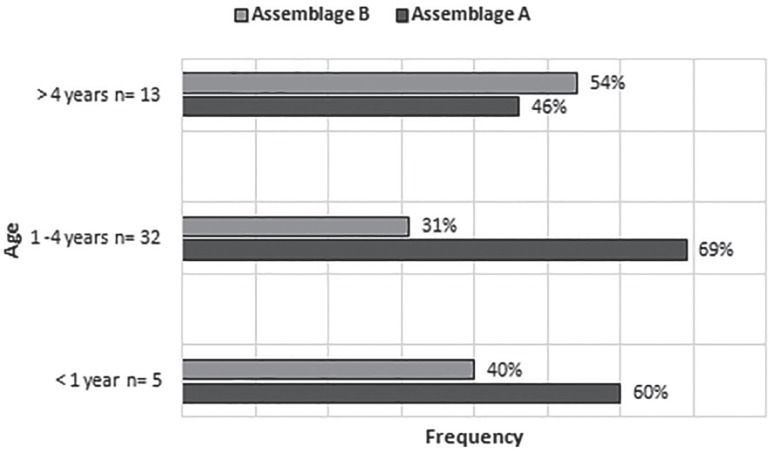
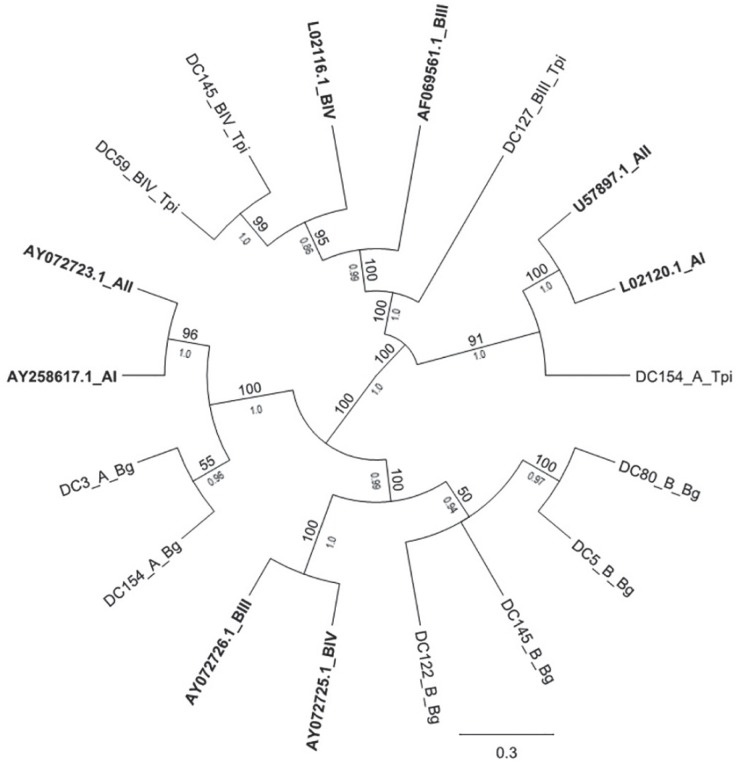
Giardia duodenalis is one of the most important and widespread gastrointestinal parasites in the world. Despite its relevance as a causative agent of diarrhea, asymptomatic giardiasis occurs frequently, especially in low resources settings in which children are exposed to many risk factors. Based on microscopic examination and the polymerase chain reaction (PCR) amplification and sequencing of beta-giardin (bg), triose phosphate isomerase (tpi) and glutamate dehydrogenase (gdh) genes, we assessed G. duodenalis occurrence and genetic diversity in isolates of children attending a daycare center and living in low income families, in an economically successful region. Considering both, microscopic examination and PCR/sequencing methods, the overall prevalence of Giardia infection was 51.4%, with the highest frequency in children aged 1-4 years old (p<0.05). Genotyping of 50 isolates revealed that the assemblage A was found in 60% of the samples (30/50), followed by the assemblage B in 38% (19/50) and 2% of mixed-assemblage infections (1/50). At the sub-assemblage level, isolates genotyped as A were AII and among isolates B, BIII and BIV were identified. Both assemblages A and B were detected in children of all age groups, however assemblage A was more prevalent. The detection of anthroponotic assemblages and sub-assemblages (AII, BIII and BIV) reinforces human-to-human transmission, mainly in children of all age groups when they have not yet received toilet training, making them more vulnerable to infection.
十二指肠贾第虫是世界上最重要且分布广泛的胃肠道寄生虫之一。尽管它作为腹泻的病原体具有重要意义,但无症状贾第虫病却经常发生,尤其是在资源匮乏的环境中,儿童面临许多风险因素。基于显微镜检查以及β-贾第蛋白(bg)、磷酸丙糖异构酶(tpi)和谷氨酸脱氢酶(gdh)基因的聚合酶链反应(PCR)扩增和测序,我们评估了在一个经济发达地区,一家日托中心且生活在低收入家庭的儿童分离株中十二指肠贾第虫的感染情况及遗传多样性。综合显微镜检查和PCR/测序方法,贾第虫感染的总体患病率为51.4%,在1 - 4岁儿童中感染频率最高(p<0.05)。对50个分离株进行基因分型显示,60%的样本(30/50)中发现了A群,其次是B群,占38%(19/50),混合群感染占2%(1/50)。在亚群水平上,基因分型为A的分离株为AII,在B群分离株中,鉴定出了BIII和BIV。A群和B群在所有年龄组的儿童中均有检测到,但A群更为普遍。人兽共患群和亚群(AII、BIII和BIV)的检测强化了人际传播,主要发生在所有尚未接受如厕训练的年龄组儿童中,这使他们更容易受到感染。