Ignacio Caroline Ferraz, Silva Milena Enderson Chagas da, Handam Natasha Berendonk, Alencar Maria de Fatima Leal, Sotero-Martins Adriana, Barata Martha Macedo de Lima, Moraes Antonio Henrique Almeida de
Fundação Oswaldo Cruz, Instituto Oswaldo Cruz, Laboratório de Inovações em Terapias, Ensino e Bioprodutos, Rio de Janeiro, Rio de Janeiro, Brazil.
Fundação Oswaldo Cruz, Escola Nacional de Saúde Pública Sérgio Arouca, Departamento de Saneamento e Saúde Ambiental, Rio de Janeiro, Rio de Janeiro, Brazil.
Rev Inst Med Trop Sao Paulo. 2017 Aug 7;59:e56. doi: 10.1590/S1678-9946201759056.
A cross-sectional study covering an agglomeration of urban slums was conducted between 2015 and 2016 using participants observation, a socioeconomic survey, and the spontaneous sedimentation method with three slides per sample to analyze fresh stool specimens ( n =595) searching for intestinal parasites.
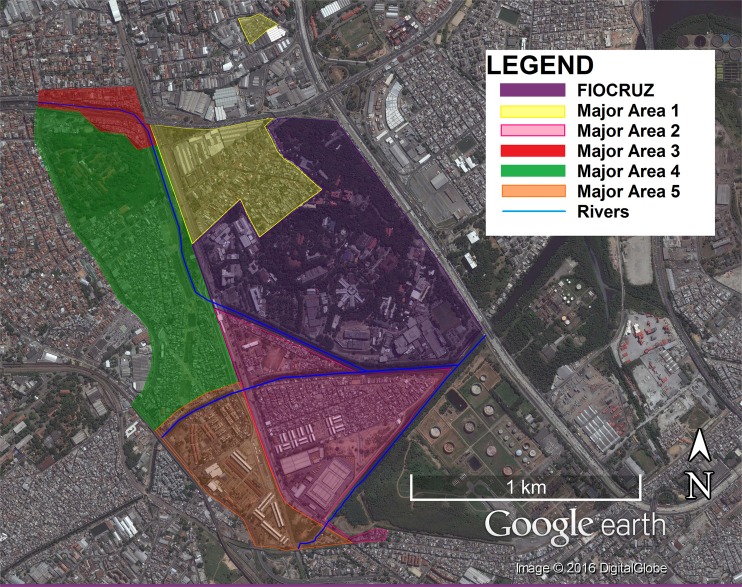
Endolimax nana ( n =95, 16.0%) and Entamoeba coli ( n =65, 10.9%) were the most frequently identified agents, followed by Giardia intestinalis ( n =24, 4.0%) and Ascaris lumbricoides ( n =11, 1.8%). Coinfections caused by E. nana and E. histolytica/dispar and by Entamoeba coli/A. lumbricoides were significant. The use of piped water as drinking water, the presence of A. lumbricoides , and contamination with coliform bacteria and Escherichia coli were more common in major area (MA) 1. Children (0-19 years) had a greater chance of living in poverty (OR 3.36; 95% CI: 2.50- 4.52; p <0.001) which was pervasive. The predominance of protozoa parasites suggests that a one-size-fits-all approach focusing on preventive chemotherapy for soil-transmitted helminths is not appropriate for all communities in developing countries. It is important that both residents and health professionals consider the socioenvironmental conditions of urban slums when assessing intestinal parasitic infections for disease control and health promotion initiatives.
2015年至2016年期间,在一个城市贫民窟聚集区开展了一项横断面研究,采用参与观察法、社会经济调查法以及自发沉淀法(每个样本用三张载玻片)对新鲜粪便标本(n = 595)进行分析,以查找肠道寄生虫。
微小内蜒阿米巴(n = 95,16.0%)和结肠内阿米巴(n = 65,10.9%)是最常检测到的病原体,其次是肠贾第虫(n = 24,4.0%)和蛔虫(n = 11,1.8%)。微小内蜒阿米巴与溶组织内阿米巴/迪斯帕内阿米巴以及结肠内阿米巴与蛔虫导致的混合感染较为显著。在主要区域1,使用管道水作为饮用水、存在蛔虫、被大肠菌群和大肠杆菌污染的情况更为常见。儿童(0 - 19岁)生活贫困的几率更高(比值比3.36;95%置信区间:2.50 - 4.52;p < 0.001),且这种情况普遍存在。原生动物寄生虫占主导地位表明,针对土壤传播蠕虫采用一刀切的预防性化疗方法并不适用于发展中国家的所有社区。居民和卫生专业人员在评估肠道寄生虫感染以开展疾病控制和健康促进举措时,考虑城市贫民窟的社会环境条件非常重要。