College of Integrative Medicine, Anhui University of Chinese Medicine, Hefei, Anhui 230012, P.R. China.
Anhui Institute of Pediatric Research, Anhui Provincial Children's Hospital, Hefei, Anhui 230051, P.R. China.
Mol Med Rep. 2020 Jun;21(6):2466-2474. doi: 10.3892/mmr.2020.11035. Epub 2020 Mar 20.
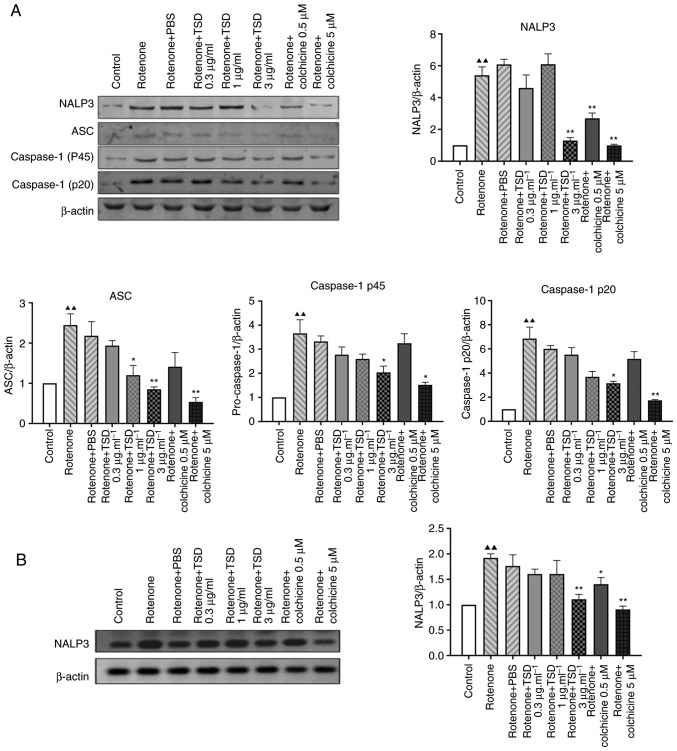
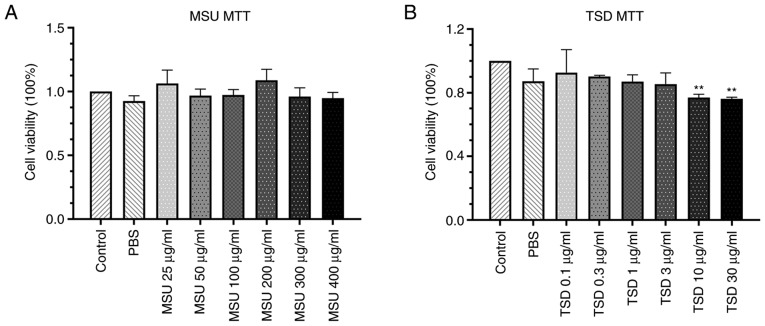
Total saponins extracted from Dioscorea collettii (TSD), extracts of the Chinese herb Dioscorea, are thought to exhibit therapeutic benefit in gouty arthritis. However, its exact mechanism remains unclear. The current study aimed to elucidate the underlying mechanisms by investigating the effects of TSD on the inflammation induced by monosodium urate (MSU) crystals in THP‑1 macrophages. The viability of THP‑1 macrophages was examined using the MTT assay and the levels of inflammatory cytokines, including interleukin (IL)‑1β, IL‑18 and tumor necrosis factor (TNF)‑α, released by the cells were quantitatively measured using ELISA kits. The results revealed that the protein level of cluster of differentiation 11b increased in THP‑1 cells treated with 100 ng/ml phorbol ester, suggesting that monocytic THP‑1 cells were successfully differentiated into macrophages. TSD decreased the levels of inflammatory cytokines, including TNF‑α, IL‑18 and IL‑1β, secreted by THP‑1 macrophages. As the release of IL‑1β and IL‑18 is dependent on the NLR family pyrin domain containing 3 (NALP3) inflammasome and caspase‑1, the current study investigated the effect of TSD on the aforementioned proteins. The results revealed that TSD decreased the protein levels of NALP3 and apoptosis‑associated speck‑like, which serve important roles in the assembly of the NALP3 inflammasome. Furthermore, NALP3 inflammasome‑related proteins were also decreased by TSD in rotenone induced THP‑1 macrophages, TSD inhibited the activation of caspase‑1 and rotenone‑induced NALP3 inflammasome activation in THP‑1 macrophages. The results obtained in the current study revealed that TSD attenuated MSU crystal‑induced inflammation by inhibiting rotenone‑induced activation of the NALP3 inflammasome and caspase‑1, suggesting that these two proteins may be novel targets for the treatment of gouty arthritis.
从穿龙薯蓣(Dioscorea collettii)中提取的总皂苷(TSD),一种中药薯蓣的提取物,被认为对痛风性关节炎具有治疗益处。然而,其确切的机制尚不清楚。本研究旨在通过研究 TSD 对单核细胞白血病 THP-1 巨噬细胞中尿酸单钠(MSU)晶体诱导的炎症的影响,阐明其潜在机制。采用 MTT 法检测 THP-1 巨噬细胞活力,ELISA 试剂盒定量检测细胞释放的炎症细胞因子,包括白细胞介素(IL)-1β、IL-18 和肿瘤坏死因子(TNF)-α。结果表明,用 100ng/ml 佛波酯处理 THP-1 细胞后,CD11b 蛋白水平增加,表明单核细胞 THP-1 细胞已成功分化为巨噬细胞。TSD 降低了 THP-1 巨噬细胞分泌的炎症细胞因子 TNF-α、IL-18 和 IL-1β的水平。由于 IL-1β和 IL-18 的释放依赖于 NALP3 炎性小体和半胱天冬酶-1,本研究还研究了 TSD 对上述蛋白的影响。结果表明,TSD 降低了 NALP3 和凋亡相关斑点样蛋白的蛋白水平,它们在 NALP3 炎性小体的组装中发挥重要作用。此外,TSD 还降低了鱼藤酮诱导的 THP-1 巨噬细胞中 NALP3 炎性小体相关蛋白的水平,TSD 抑制了 caspase-1 的激活和鱼藤酮诱导的 THP-1 巨噬细胞中 NALP3 炎性小体的激活。本研究结果表明,TSD 通过抑制鱼藤酮诱导的 NALP3 炎性小体和半胱天冬酶-1的激活来减轻 MSU 晶体诱导的炎症,提示这两种蛋白可能是治疗痛风性关节炎的新靶点。