Department of Psychiatry and Behavioral Sciences, SUNY Upstate Medical University, Syracuse, NY, USA.
Department of Medical Epidemiology and Biostatistics, Karolinska Institutet, Stockholm, Sweden.
J Child Psychol Psychiatry. 2020 Dec;61(12):1370-1379. doi: 10.1111/jcpp.13226. Epub 2020 Apr 1.
Children with attention-deficit/hyperactivity disorder (ADHD) have a high risk for substance use disorders (SUDs). Early identification of at-risk youth would help allocate scarce resources for prevention programs.
Psychiatric and somatic diagnoses, family history of these disorders, measures of socioeconomic distress, and information about birth complications were obtained from the national registers in Sweden for 19,787 children with ADHD born between 1989 and 1993. We trained (a) a cross-sectional random forest (RF) model using data available by age 17 to predict SUD diagnosis between ages 18 and 19; and (b) a longitudinal recurrent neural network (RNN) model with the Long Short-Term Memory (LSTM) architecture to predict new diagnoses at each age.
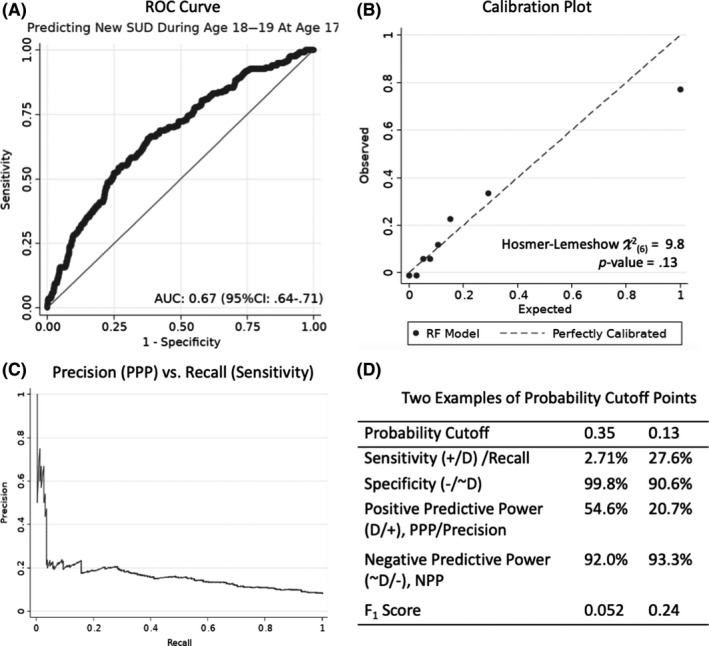
The area under the receiver operating characteristic curve (AUC) was 0.73(95%CI 0.70-0.76) for the random forest model (RF). Removing prior diagnosis from the predictors, the RF model was still able to achieve significant AUCs when predicting all SUD diagnoses (0.69, 95%CI 0.66-0.72) or new diagnoses (0.67, 95%CI: 0.64, 0.71) during age 18-19. For the model predicting new diagnoses, model calibration was good with a low Brier score of 0.086. Longitudinal LSTM model was able to predict later SUD risks at as early as 2 years age, 10 years before the earliest diagnosis. The average AUC from longitudinal models predicting new diagnoses 1, 2, 5 and 10 years in the future was 0.63.
Population registry data can be used to predict at-risk comorbid SUDs in individuals with ADHD. Such predictions can be made many years prior to age of the onset, and their SUD risks can be monitored using longitudinal models over years during child development. Nevertheless, more work is needed to create prediction models based on electronic health records or linked population registers that are sufficiently accurate for use in the clinic.
患有注意力缺陷/多动障碍(ADHD)的儿童有很高的物质使用障碍(SUD)风险。及早识别高危青少年将有助于为预防计划分配稀缺资源。
从瑞典全国登记处获得了 1989 年至 1993 年间出生的 19787 名患有 ADHD 的儿童的精神和躯体诊断、这些疾病的家族史、社会经济困难的衡量标准以及出生并发症的信息。我们训练了(a)一个使用 17 岁之前的数据的横截面随机森林(RF)模型,以预测 18 至 19 岁之间的 SUD 诊断;以及(b)具有长期短期记忆(LSTM)架构的纵向递归神经网络(RNN)模型,以预测每个年龄的新诊断。
随机森林模型(RF)的接收者操作特征曲线下面积(AUC)为 0.73(95%CI 0.70-0.76)。从预测因子中去除先前的诊断,RF 模型仍能够在预测所有 SUD 诊断(0.69,95%CI 0.66-0.72)或 18-19 岁期间的新诊断(0.67,95%CI:0.64,0.71)时获得显著的 AUC。对于预测新诊断的模型,模型校准良好,Brier 分数低至 0.086。纵向 LSTM 模型能够在最早诊断前 10 年,早在 2 岁时预测后来的 SUD 风险。预测未来 1、2、5 和 10 年新诊断的纵向模型的平均 AUC 为 0.63。
人口登记数据可用于预测患有 ADHD 的个体的并发 SUD 高危人群。这种预测可以在发病前多年进行,并且可以使用儿童发育期间的纵向模型多年来监测他们的 SUD 风险。然而,需要做更多的工作来创建基于电子健康记录或链接的人口登记的预测模型,这些模型的准确性足以在临床中使用。