Ren Zhanbing, Hu Linlin, Yu Jane Jie, Yu Qian, Chen Sitong, Ma Yudan, Lin Jingyuan, Yang Lin, Li Xiaoyun, Zou Liye
Department of physical education, Shenzhen University, Shenzhen 518061, China.
Department of Sports Science and Physical Education, The Chinese University of Hong Kong, Shatin, New Territories, Hong Kong, 999077, China.
Children (Basel). 2020 Mar 20;7(3):23. doi: 10.3390/children7030023.
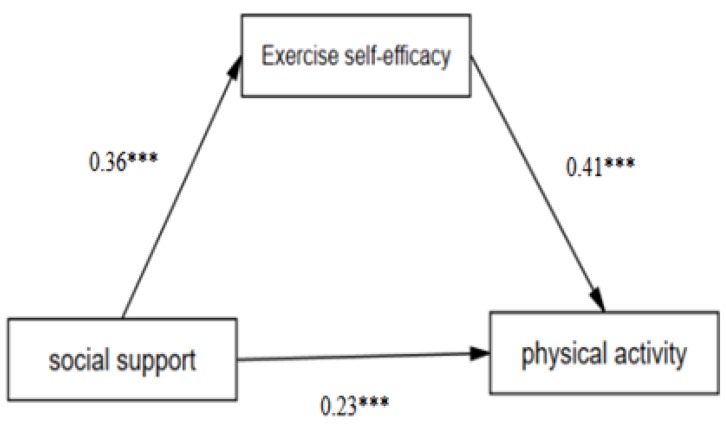
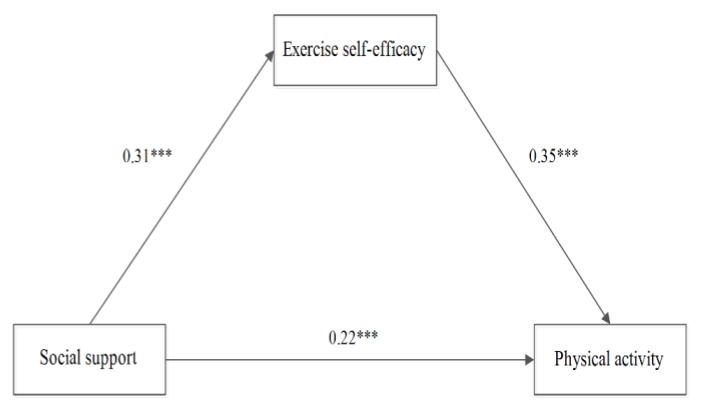
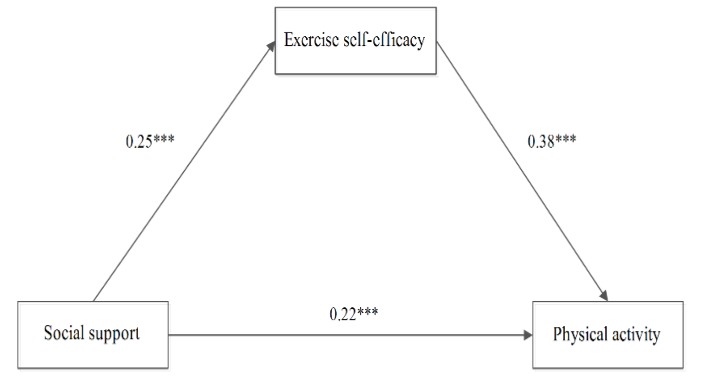
The purpose of this study was to examine the associations of social support and self-efficacy with physical Activity (PA) and the mediating effect of self-efficacy on the relationship between social support and PA in Chinese adolescents. Participants included a total of 2341 Chinese adolescents (aged 12.75 ± 1.46 years). Self-reported instruments, including the physical activity questionnaire for adolescents, the social support revalued scale and the exercise self-efficacy scale, were used to measure physical activity, social support and exercise self-efficacy. Results showed that social support (r = 0.29, < 0.05) and exercise self-efficacy (r = 0.43, < 0.05) were significant and positive predictors of PA among Chinese adolescents, and exercise self-efficacy was a significant mediator in the relationship between social support and PA (standardized effect size = 0.15, < 0.001). Such findings were evident with similar patterns in both male and female adolescents. The findings of this study have indicated the importance of social support and exercise self-efficacy on PA promotion in adolescents, which will aid the development of effective interventions in this population.
本研究旨在探讨社会支持和自我效能感与身体活动(PA)之间的关联,以及自我效能感在中国青少年社会支持与PA关系中的中介作用。研究对象包括总共2341名中国青少年(年龄12.75±1.46岁)。采用自我报告工具,包括青少年身体活动问卷、社会支持重新评估量表和运动自我效能量表,来测量身体活动、社会支持和运动自我效能感。结果显示,社会支持(r = 0.29,<0.05)和运动自我效能感(r = 0.43,<0.05)是中国青少年PA的显著正向预测因素,并且运动自我效能感在社会支持与PA的关系中是一个显著的中介变量(标准化效应量=0.15,<0.001)。在男性和女性青少年中均呈现出类似模式,这些发现很明显。本研究结果表明社会支持和运动自我效能感对促进青少年PA的重要性,这将有助于制定针对该人群的有效干预措施。