Huang Yu, Wu Qingqing, Wang Ping, Xu Yan, Wang Lei, Zhao Yusui, Yao Dingming, Xu Yue, Lv Qiaohong, Xu Shuiyang
Zhejiang Provincial Center for Disease Control and Prevention, Hangzhou, China.
Jiashan Prefectural Center for Disease Control and Prevention, Jiashan, China.
J Med Internet Res. 2020 May 12;22(5):e18718. doi: 10.2196/18718.
In early 2020, over 80,000 cases of coronavirus disease (COVID-19) were confirmed in China. Public prevention and control measures, along with efforts from all sectors of society, were undertaken to control and eliminate disease transmission.
This paper describes Chinese citizens' response to the epidemic, the preventive measures they implemented to avoid being infected, and the public strategies that were carried out by the government, health workers, etc. We also discuss the efficacy of these measures in controlling the epidemic in China.
Information on the responses and behaviors of Chinese citizens were collected through a cross-sectional, internet-based survey using Dingxiang Doctor's public account on WeChat. Information on public strategies implemented by all sectors of society to control the epidemic and data on new COVID-19 cases were collected from the internet, mainly from government websites. Standard descriptive statistics and multivariate logistic regression analyses were conducted to analyze the data.
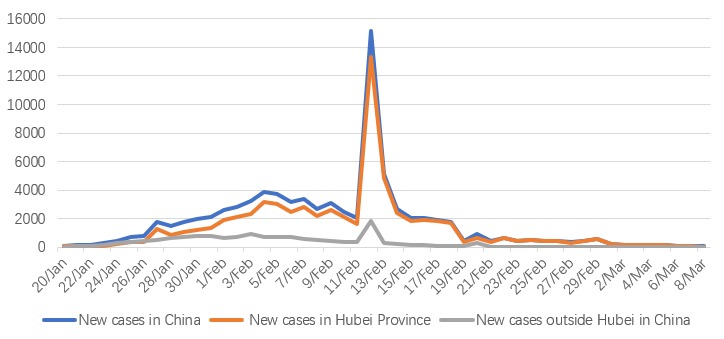
A total of 10,304 participants responded to the survey, with 10,198 valid responses; 74.1% (n=7557) were female and 25.9% (n=2641) were male. Overall, 98.2% (n=10,013) of participants paid high or very high attention to the epidemic, with WeChat being their main information source (n=9400, 92.2%). Over half the participants (n=5878, 57.7%) were confident that the epidemic could be curbed in China; 92.4% (n=9427) opened windows for ventilation more frequently than usual; 97.9% (n=9986) used masks in public; 95.7% (n=9759) avoided large crowds and stayed at home as much as possible; and 97.9% (n=9988) washed their hands more often than usual. Women were more likely to practice these behaviors than men (P<.001). With a series of strict public control measures, like nationwide health education campaigns, holiday extensions, the Examine and Approve Policy on the resumption of work, close management of working and living quarters, a health QR (Quick Response) code system, community screening, and social distancing policies, the number of new cases have decreased dramatically since February 12, 2020.
The methods employed by Chinese citizens and authorities have effectively curtailed the spread of COVID-19, demonstrating that this pandemic can be brought under control as long as the right measures are taken.
2020年初,中国确诊了8万多例冠状病毒病(COVID-19)病例。全社会采取了公共防控措施以及各部门的努力来控制和消除疾病传播。
本文描述了中国公民对疫情的反应、他们为避免感染而采取的预防措施,以及政府、医护人员等实施的公共策略。我们还讨论了这些措施在中国控制疫情方面的效果。
通过丁香医生微信公众号进行的一项基于互联网的横断面调查,收集了中国公民的反应和行为信息。社会各界为控制疫情实施的公共策略信息以及COVID-19新增病例数据主要从互联网上收集,主要来自政府网站。进行了标准描述性统计和多变量逻辑回归分析以分析数据。
共有10304名参与者回复了调查,其中有效回复10198份;74.1%(n = 7557)为女性,25.9%(n = 2641)为男性。总体而言,98.2%(n = 10013)的参与者对疫情高度或非常高度关注,微信是他们的主要信息来源(n = 9400,92.2%)。超过一半的参与者(n = 5878,57.7%)相信疫情在中国能够得到遏制;92.4%(n = 9427)比平时更频繁地开窗通风;97.9%(n = 9986)在公共场合佩戴口罩;95.7%(n = 9759)避免前往人群密集处并尽可能居家;97.9%(n = 9988)比平时更频繁地洗手。女性比男性更有可能采取这些行为(P <.001)。通过一系列严格的公共管控措施,如全国范围的健康教育活动、延长假期、复工审批政策、工作和生活区域的封闭管理、健康二维码系统、社区筛查以及社交距离政策,自2020年2月12日以来,新增病例数量大幅下降。
中国公民和政府部门采用的方法有效遏制了COVID-19的传播,表明只要采取正确措施,这场大流行是可以得到控制的。