Department of Psychiatry, Warneford Hospital, University of Oxford, Oxford, UK.
Centre for Statistics in Medicine, NDORMS, University of Oxford, Oxford, UK.
Alzheimers Res Ther. 2020 Apr 6;12(1):38. doi: 10.1186/s13195-020-00606-5.
Inflammatory processes have been shown to play a role in dementia. To understand this role, we selected two anti-inflammatory drugs (methotrexate and sulfasalazine) to study their association with dementia risk.
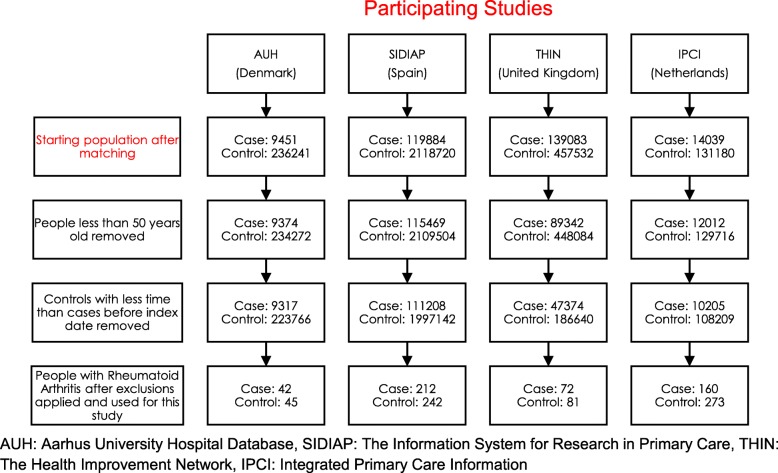
A retrospective matched case-control study of patients over 50 with rheumatoid arthritis (486 dementia cases and 641 controls) who were identified from electronic health records in the UK, Spain, Denmark and the Netherlands. Conditional logistic regression models were fitted to estimate the risk of dementia.
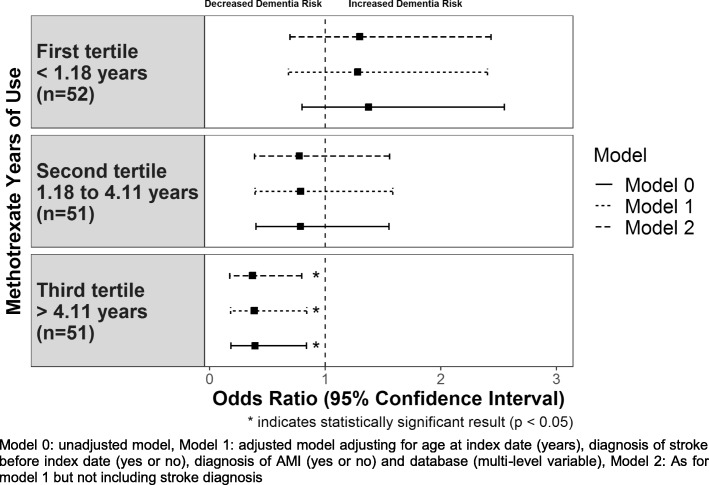
Prior methotrexate use was associated with a lower risk of dementia (OR 0.71, 95% CI 0.52-0.98). Furthermore, methotrexate use with therapy longer than 4 years had the lowest risk of dementia (odds ratio 0.37, 95% CI 0.17-0.79). Sulfasalazine use was not associated with dementia (odds ratio 0.88, 95% CI 0.57-1.37).
Further studies are still required to clarify the relationship between prior methotrexate use and duration as well as biological treatments with dementia risk.
炎症过程已被证明在痴呆症中起作用。为了了解这一作用,我们选择了两种抗炎药物(甲氨蝶呤和柳氮磺胺吡啶)来研究它们与痴呆风险的关联。
这是一项回顾性的、基于匹配病例对照的研究,研究对象为来自英国、西班牙、丹麦和荷兰电子健康记录中的 50 岁以上的类风湿关节炎患者(486 例痴呆病例和 641 例对照)。使用条件逻辑回归模型来估计痴呆的风险。
先前使用甲氨蝶呤与痴呆风险降低相关(比值比 0.71,95%可信区间 0.52-0.98)。此外,使用甲氨蝶呤治疗时间超过 4 年的患者痴呆风险最低(比值比 0.37,95%可信区间 0.17-0.79)。柳氮磺胺吡啶的使用与痴呆无关(比值比 0.88,95%可信区间 0.57-1.37)。
仍需要进一步的研究来阐明先前使用甲氨蝶呤的时间和生物治疗与痴呆风险之间的关系。