Kumperscak Hojka Gregoric, Gricar Alja, Ülen Ina, Micetic-Turk Dusanka
Pediatric Clinic, University Medical Center Maribor, Maribor, Slovenia.
Faculty of Medicine, University of Maribor, Maribor, Slovenia.
Front Psychiatry. 2020 Mar 17;11:181. doi: 10.3389/fpsyt.2020.00181. eCollection 2020.
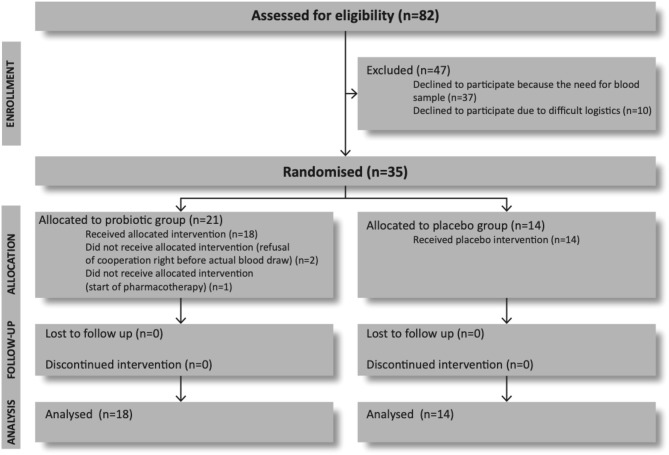
This double-blind pilot randomized placebo-controlled trial examined the possible effect of the probiotic strain GG ATCC53103 (LGG) on symptoms of attention-deficit/hyperactivity disorder (ADHD), health-related quality of life (QoL), and serum levels of cytokines in children and adolescents with ADHD. This trial evaluated 32 drug-naive children and adolescents aged between four and 17 years with a diagnosis of ADHD. The study subjects were randomly assigned to either the group that received LGG or the group that received the placebo. Assessments, comprising ; ; and the serum cytokines; were compared between the groups at the baseline and after 3 months. Thirty-five participants were randomized, with 32 completing the study (91.4% retention). There was a significant improvement in the PedsQL Child Self-Report Total Score after 3 months of treatment in the probiotic ( = 0.021, d = 0.53), whereas there was no significant improvement in the placebo group ( = 0.563, d = 0.04). The results of psychometric parameters assessed by parents and teachers were not so straightforward. There were statistically significant differences in the levels of serum cytokines between the groups after the 3-month treatment period: IL-6 in both the probiotic ( = 0.004, d = 0.73) and the placebo groups ( = 0.035, d = 0.94); IL-10 ( = 0.035, d = 0.6); IL-12 p70 ( = 0.025, d = 0.89); and TNF-α ( = 0.046, d = 0.64) in the probiotic group only. Children and adolescents with ADHD who received LGG supplementation reported better health-related QoL compared to their peers who received the placebo. This suggests that LGG supplementation could be beneficial. But results with psychometric tests conducted by parents and teachers as well as differences in the levels of inflammatory cytokines were ambiguous. Based on these results, we propose some study modifications: a longer observation period (6-12 months); inclusion of more children's self-report assessments; recruitment of non-drug naive patients and the possible omission of serum cytokines measurements. Medical Ethics Committee (UKC-MB-KME-19-06/16).
这项双盲试点随机安慰剂对照试验,研究了益生菌菌株GG ATCC53103(LGG)对患有注意力缺陷多动障碍(ADHD)的儿童和青少年的ADHD症状、健康相关生活质量(QoL)以及血清细胞因子水平的可能影响。该试验评估了32名年龄在4至17岁之间、未经药物治疗且被诊断为ADHD的儿童和青少年。研究对象被随机分为接受LGG的组或接受安慰剂的组。在基线和3个月后,对两组之间包括……和血清细胞因子在内的评估进行了比较。35名参与者被随机分组,32名完成了研究(保留率91.4%)。益生菌治疗3个月后,儿童生活质量量表儿童自我报告总分有显著改善(P = 0.021,d = 0.53),而安慰剂组无显著改善(P = 0.563,d = 0.04)。家长和教师评估的心理测量参数结果并非如此直接。3个月治疗期后,两组之间血清细胞因子水平存在统计学显著差异:益生菌组和安慰剂组的IL - 6(P = 0.004,d = 0.73;P = 0.035,d = 0.94);益生菌组的IL - 10(P = 0.035,d = 0.6)、IL - 12 p70(P = 0.025,d = 0.89)和TNF - α(P = 0.046,d = 0.64)。与接受安慰剂的同龄人相比,接受LGG补充剂的ADHD儿童和青少年报告的健康相关QoL更好。这表明补充LGG可能有益。但家长和教师进行的心理测量测试结果以及炎症细胞因子水平的差异并不明确。基于这些结果,我们提出了一些研究改进建议:更长的观察期(6 - 12个月);纳入更多儿童自我报告评估;招募非未经药物治疗的患者以及可能省略血清细胞因子测量。医学伦理委员会(UKC - MB - KME - 19 - 06/16) 。 (注:原文中“comprising ; ; and the serum cytokines”部分内容缺失,翻译时保留原文形式)