Li Wing-Jin, Narancic Tanja, Kenny Shane T, Niehoff Paul-Joachim, O'Connor Kevin, Blank Lars M, Wierckx Nick
Institute of Applied Microbiology-iAMB, Aachen Biology and Biotechnology-ABBt, RWTH Aachen University, Aachen, Germany.
UCD Earth Institute and School of Biomolecular and Biomedical Science, University College Dublin, Dublin, Ireland.
Front Microbiol. 2020 Mar 17;11:382. doi: 10.3389/fmicb.2020.00382. eCollection 2020.
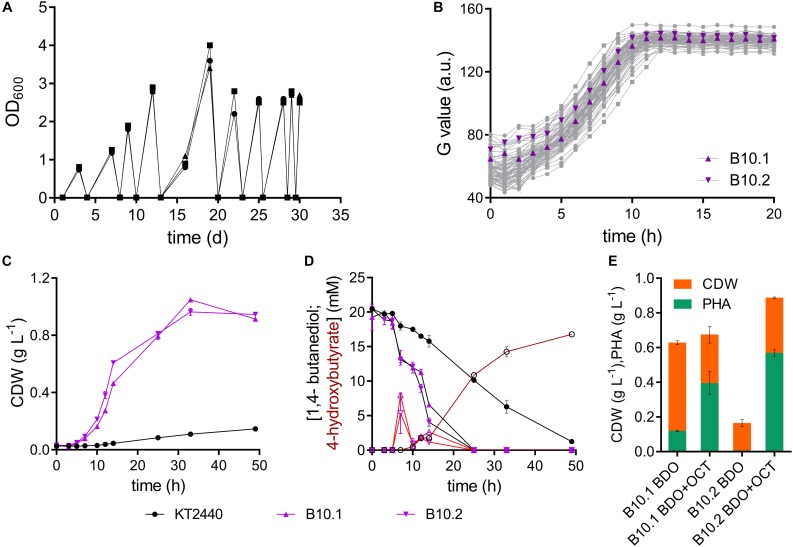
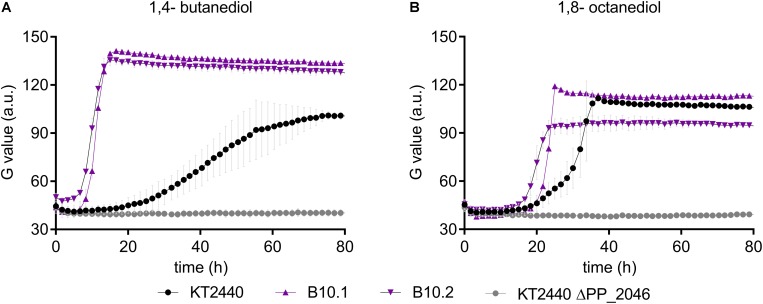
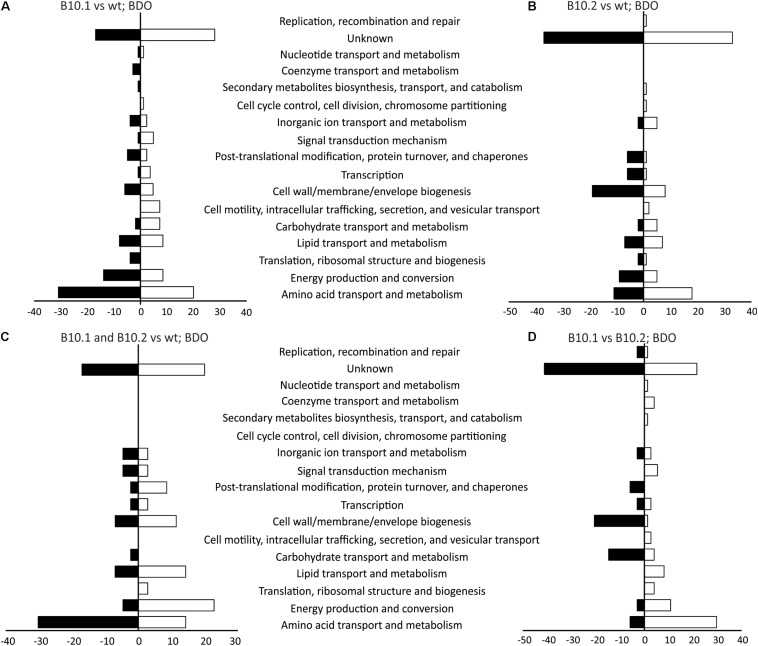
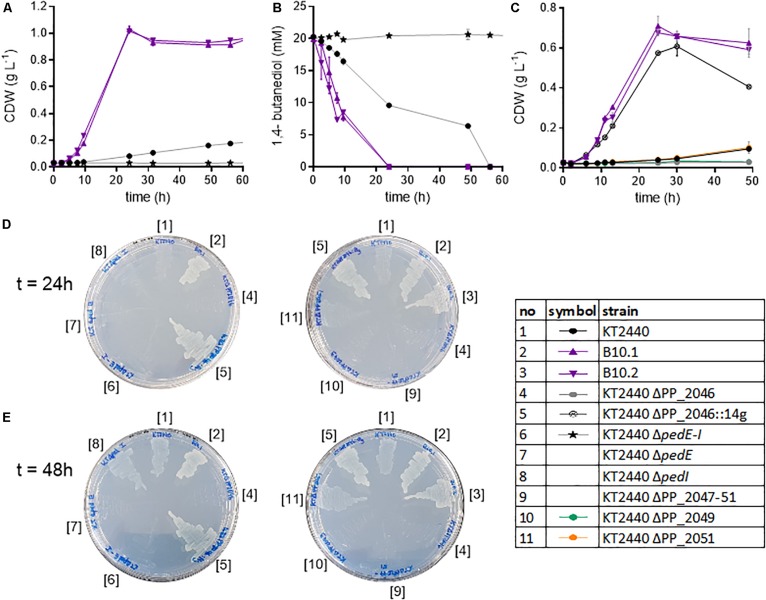
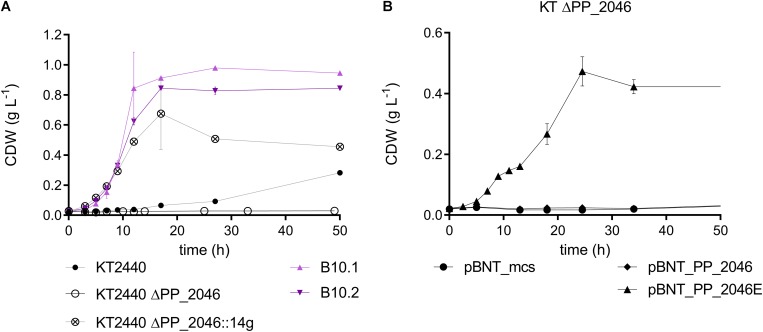
Plastics, in all forms, are a ubiquitous cornerstone of modern civilization. Although humanity undoubtedly benefits from the versatility and durability of plastics, they also cause a tremendous burden for the environment. Bio-upcycling is a promising approach to reduce this burden, especially for polymers that are currently not amenable to mechanical recycling. Wildtype KT2440 is able to grow on 1,4-butanediol as sole carbon source, but only very slowly. Adaptive laboratory evolution (ALE) led to the isolation of several strains with significantly enhanced growth rate and yield. Genome re-sequencing and proteomic analysis were applied to characterize the genomic and metabolic basis of efficient 1,4-butanediol metabolism. Initially, 1,4-butanediol is oxidized to 4-hydroxybutyrate, in which the highly expressed dehydrogenase enzymes encoded within the PP_2674-2680 gene cluster play an essential role. The resulting 4-hydroxybutyrate can be metabolized through three possible pathways: (i) oxidation to succinate, (ii) CoA activation and subsequent oxidation to succinyl-CoA, and (iii) beta oxidation to glycolyl-CoA and acetyl-CoA. The evolved strains were both mutated in a transcriptional regulator (PP_2046) of an operon encoding both beta-oxidation related genes and an alcohol dehydrogenase. When either the regulator or the alcohol dehydrogenase is deleted, no 1,4-butanediol uptake or growth could be detected. Using a reverse engineering approach, PP_2046 was replaced by a synthetic promotor (14g) to overexpress the downstream operon (PP_2047-2051), thereby enhancing growth on 1,4-butanediol. This work provides a deeper understanding of microbial 1,4-butanediol metabolism in , which is also expandable to other aliphatic alpha-omega diols. It enables the more efficient metabolism of these diols, thereby enabling biotechnological valorization of plastic monomers in a bio-upcycling approach.
各种形式的塑料是现代文明无处不在的基石。尽管人类无疑从塑料的多功能性和耐用性中受益,但它们也给环境带来了巨大负担。生物升级循环是减轻这种负担的一种有前途的方法,特别是对于目前不适合机械回收的聚合物。野生型KT2440能够以1,4 - 丁二醇作为唯一碳源生长,但速度非常缓慢。适应性实验室进化(ALE)导致分离出几种生长速率和产量显著提高的菌株。应用基因组重测序和蛋白质组学分析来表征高效1,4 - 丁二醇代谢的基因组和代谢基础。最初,1,4 - 丁二醇被氧化为4 - 羟基丁酸,其中PP_2674 - 2680基因簇中编码的高表达脱氢酶发挥了重要作用。产生的4 - 羟基丁酸可以通过三种可能的途径代谢:(i)氧化为琥珀酸,(ii)辅酶A活化并随后氧化为琥珀酰辅酶A,以及(iii)β氧化为乙醇酰辅酶A和乙酰辅酶A。进化后的菌株在一个操纵子的转录调节因子(PP_2046)中都发生了突变,该操纵子编码与β氧化相关的基因和一种醇脱氢酶。当调节因子或醇脱氢酶被删除时,无法检测到1,4 - 丁二醇的摄取或生长。使用逆向工程方法,用合成启动子(14g)取代PP_2046以过表达下游操纵子(PP_2047 - 2051),从而增强在1,4 - 丁二醇上的生长。这项工作为微生物中1,4 - 丁二醇代谢提供了更深入的理解,这也可扩展到其他脂肪族α,ω - 二醇。它使这些二醇能够更有效地代谢,从而通过生物升级循环方法实现塑料单体的生物技术增值。