van der Linden Sophie D, Gehring Karin, Rutten Geert-Jan M, Kop Willem J, Sitskoorn Margriet M
Department of Neurosurgery, Elisabeth-TweeSteden Hospital, The Netherlands.
Department of Cognitive Neuropsychology, Tilburg University, The Netherlands.
Neurooncol Pract. 2020 Jan;7(1):77-85. doi: 10.1093/nop/npz023. Epub 2019 Jun 27.
Fatigue is a common symptom in patients with brain tumors, but comprehensive studies on fatigue in patients with meningioma specifically are lacking. This study examined the prevalence and correlates of fatigue in meningioma patients.
Patients with grade I meningioma completed the Multidimensional Fatigue Inventory (MFI-20) before and 1 year after neurosurgery. The MFI consists of 5 subscales: General Fatigue, Physical Fatigue, Mental Fatigue, Reduced Motivation, and Reduced Activity. Patients' scores were compared with normative data. Preoperative fatigue was compared with postoperative fatigue. Correlations with sex, age, education, tumor hemisphere, preoperative tumor volume, antiepileptic drugs (AEDs), symptoms of anxiety/depression, and self-reported cognitive complaints were explored.
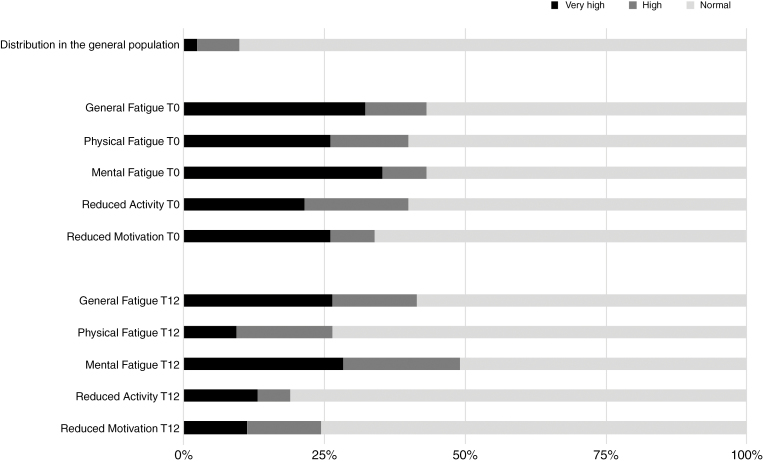
Questionnaires were completed by 65 patients preoperatively, and 53 patients postoperatively. Of 34 patients, data from both time points were available. Patients had significantly higher fatigue levels on all subscales compared to normative values at both time points. Mean scores on General Fatigue, Physical Fatigue, and Mental Fatigue remained stable over time and improvements were observed on Reduced Motivation and Reduced Activity. Preoperatively, the prevalence of high fatigue (-score ≥ 1.3) varied between 34% for Reduced Motivation and 43% for General Fatigue/Mental Fatigue. The postoperative prevalence ranged from 19% for Reduced Activity to 49% on Mental Fatigue. Fatigue was associated with cognitive complaints, anxiety and depression, but not with education, tumor lateralization, tumor volume, or AEDs.
Fatigue is a common and persistent symptom in patients with meningioma undergoing neurosurgery. Findings emphasize the need for more research and appropriate care targeting fatigue for meningioma patients.
疲劳是脑肿瘤患者的常见症状,但针对脑膜瘤患者疲劳情况的全面研究尚属缺乏。本研究调查了脑膜瘤患者疲劳的患病率及其相关因素。
I级脑膜瘤患者在神经外科手术前及术后1年完成多维疲劳量表(MFI-20)。MFI由5个分量表组成:总体疲劳、身体疲劳、精神疲劳、动力下降和活动减少。将患者的得分与常模数据进行比较。比较术前和术后的疲劳情况。探讨疲劳与性别、年龄、教育程度、肿瘤所在脑半球、术前肿瘤体积、抗癫痫药物(AEDs)、焦虑/抑郁症状以及自我报告的认知主诉之间的相关性。
65例患者术前完成了问卷调查,53例患者术后完成了问卷调查。在34例患者中,获得了两个时间点的数据。与两个时间点的常模值相比,患者在所有分量表上的疲劳水平均显著更高。总体疲劳、身体疲劳和精神疲劳的平均得分随时间保持稳定,动力下降和活动减少方面有改善。术前,高疲劳(得分≥1.3)的患病率在动力下降方面为34%,在总体疲劳/精神疲劳方面为43%。术后患病率从活动减少方面的19%到精神疲劳方面的49%不等。疲劳与认知主诉、焦虑和抑郁相关,但与教育程度、肿瘤定位、肿瘤体积或AEDs无关。
疲劳是接受神经外科手术的脑膜瘤患者的常见且持续存在的症状。研究结果强调需要针对脑膜瘤患者疲劳问题开展更多研究并提供适当护理。