Sieber Stefan, Michaelis Martin, Gühring Hans, Lindemann Sven, Gigout Anne
Osteoarthritis Research, Merck KGaA, Darmstadt, Germany.
Biores Open Access. 2020 Mar 31;9(1):106-115. doi: 10.1089/biores.2020.0009. eCollection 2020.
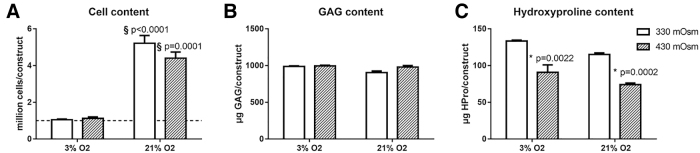
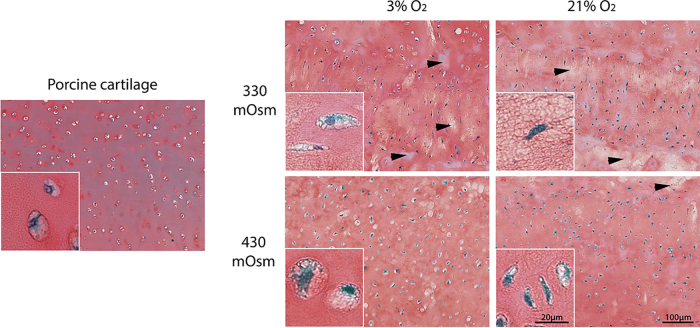
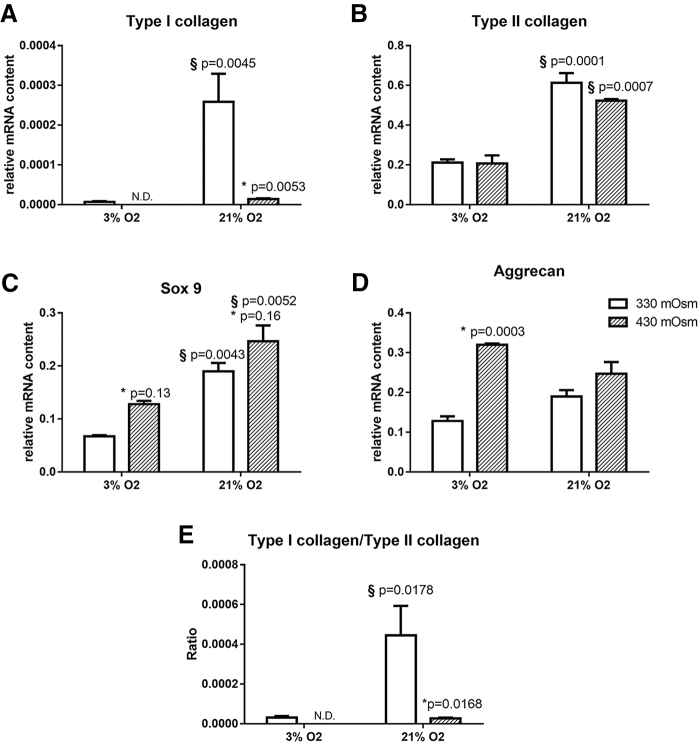
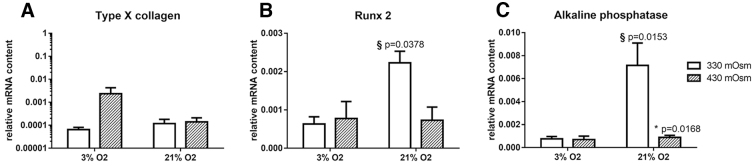
For cartilage repair or evaluation of new therapeutic approaches , the generation of functional cartilage tissue is of crucial importance and can only be achieved if the phenotype of the chondrocytes is preserved. Three-dimensional (3D) cell culture is broadly used for this purpose. However, adapting culture parameters like the oxygen tension or the osmolarity to their physiological values is often omitted. Indeed, articular cartilage is an avascular tissue subjected to reduced oxygen tension and presenting and increased osmolarity compared with most other tissues. In this study, we aimed at evaluating the effect of a physiological oxygen tension (3% instead of 21%) and physiological osmolarity (430 vs. 330 mOsm in nonadjusted DMEM) and the combination of both on the cell proliferation, matrix production, and the phenotype of porcine chondrocytes in a scaffold-free 3D culture system. We observed that a physiological osmolarity had no effect on cell proliferation and matrix production but positively influences the chondrocyte phenotype. A physiological oxygen level prevented cell proliferation but resulted in an increased matrix content/million cells and had a positive influence on the chondrocyte phenotype as well. The strongest benefit was reached with the combination of both physiological osmolarity and oxygen levels; with these conditions, type I collagen expression became undetectable. In addition, at 3% O the chondrocytes-matrix constructs were found to more closely resemble native cartilage regarding the matrix-to-cell ratio. In conclusion, this study clearly demonstrates the benefit of using physiological oxygen tension and osmolarity in cartilage tissue engineering with the combination of both showing the strongest benefit on the chondrocyte phenotype.
对于软骨修复或新治疗方法的评估而言,功能性软骨组织的生成至关重要,并且只有在软骨细胞表型得以保留的情况下才能实现。三维(3D)细胞培养广泛用于此目的。然而,常常忽略将培养参数如氧张力或渗透压调整至其生理值。实际上,与大多数其他组织相比,关节软骨是一种无血管组织,其氧张力降低且渗透压升高。在本研究中,我们旨在评估生理氧张力(3%而非21%)、生理渗透压(未调整的DMEM中为430与330 mOsm)以及二者组合对无支架3D培养系统中猪软骨细胞的细胞增殖、基质产生和表型的影响。我们观察到生理渗透压对细胞增殖和基质产生没有影响,但对软骨细胞表型有积极影响。生理氧水平可阻止细胞增殖,但导致每百万细胞的基质含量增加,并且对软骨细胞表型也有积极影响。生理渗透压和氧水平二者组合带来的益处最为显著;在这些条件下,I型胶原蛋白表达变得不可检测。此外,在3% O₂时,软骨细胞 - 基质构建体在基质与细胞比例方面被发现更类似于天然软骨。总之,本研究清楚地证明了在软骨组织工程中使用生理氧张力和渗透压的益处,二者组合对软骨细胞表型显示出最强的益处。