Department of Dental Clinical Specialities. ORALMED Research Group. School of Dentistry, Complutense University of Madrid, Plaza Ramón y Cajal s/n, 28040 Madrid, Spain.
Int J Environ Res Public Health. 2020 Apr 5;17(7):2478. doi: 10.3390/ijerph17072478.
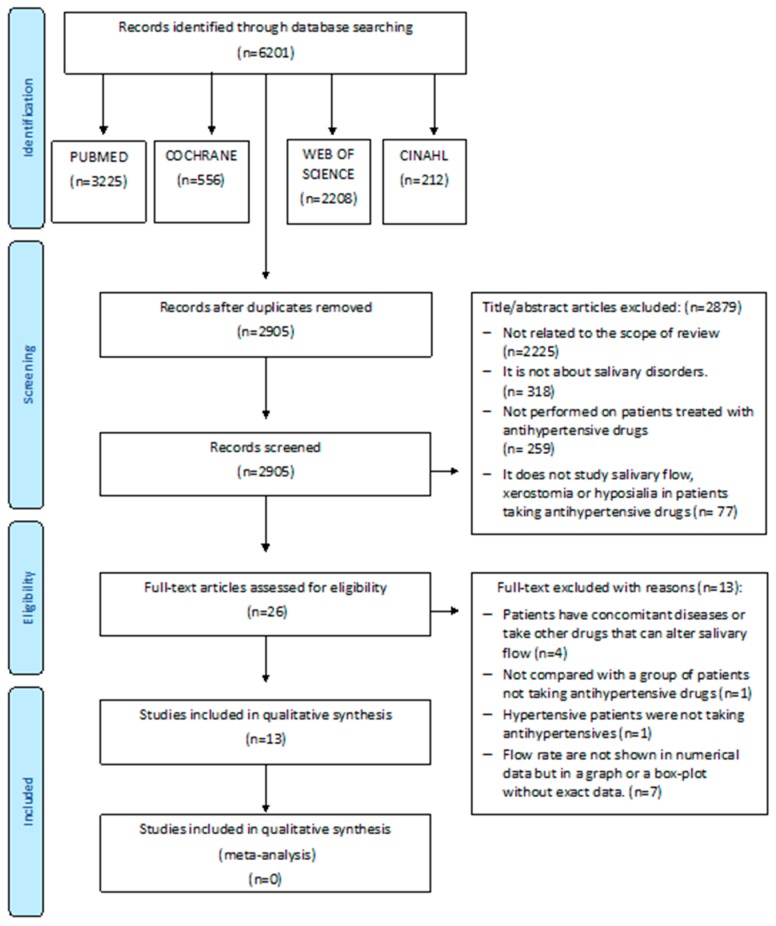
The aims of this systematic review are (1) to compare the prevalence of xerostomia and hyposalivation between patients taking antihypertensive drugs with a control group (CG), (2) to compare salivary flow rate between patients treated with a CG, and (3) to identify which antihypertensives produce xerostomia. This systematic review was carried out according to the preferred reporting items for systematic reviews and meta-analyses (PRISMA) guidelines. To evaluate methodological quality of the eligible studies Cochrane Collaboration tool for assessing the risk of bias for clinical trials and the modified Newcastle-Ottawa scale case-control studies were used. The databases were searched for studies up to November 19th 2019. The search strategy yielded 6201 results and 13 publications were finally included (five clinical trials and eight case-control studies). The results of the included studies did not provide evidence to state that patients taking antihypertensives suffer more xerostomia or hyposalivation than patients not taking them. With regard to salivary flow, only two clinical studies showed a significant decrease in salivary flow and even one showed a significant increase after treatment. The case-control studies showed great variability in salivary flow, but in this case most studies showed how salivary flow is lower in patients medicated with antihypertensive drugs. The great variability of antihypertensive drugs included, the types of studies and the outcomes collected made it impossible to study which antihypertensive drug produces more salivary alterations. The quality assessment showed how each of the studies was of low methodological quality. Therefore, future studies about this topic are necessary to confirm whether antihypertensive drugs produce salivary alterations.
(1)比较服用抗高血压药物的患者与对照组(CG)之间口干症和唾液分泌减少的发生率;(2)比较 CG 治疗患者的唾液流速;(3)确定哪些抗高血压药会导致口干症。本系统评价按照系统评价和荟萃分析的首选报告项目(PRISMA)指南进行。为了评估合格研究的方法学质量,使用 Cochrane 协作工具评估临床试验的偏倚风险和改良的 Newcastle-Ottawa 量表病例对照研究。数据库搜索截止到 2019 年 11 月 19 日的研究。搜索策略产生了 6201 个结果,最终纳入了 13 篇文献(5 项临床试验和 8 项病例对照研究)。纳入研究的结果没有提供证据表明服用抗高血压药物的患者比未服用抗高血压药物的患者更容易出现口干症或唾液分泌减少。关于唾液流率,只有两项临床研究显示唾液流率显著下降,甚至有一项研究显示治疗后唾液流率显著增加。病例对照研究显示唾液流率存在很大的变异性,但在这种情况下,大多数研究表明,服用抗高血压药物的患者的唾液流率较低。纳入的抗高血压药物种类繁多,研究类型和收集的结果各不相同,因此无法研究哪种抗高血压药会导致更多的唾液改变。质量评估显示,每项研究的方法学质量都较低。因此,需要进一步研究这个主题,以确定抗高血压药物是否会导致唾液改变。