Department of Dermatology, School of Clinical Medicine, Tsinghua University, Beijing 100084, China.
Department of Plastic, Reconstructive and Aesthetic Surgery, Nippon Medical School, Tokyo 113-8603, Japan.
Int J Mol Sci. 2020 Apr 6;21(7):2542. doi: 10.3390/ijms21072542.
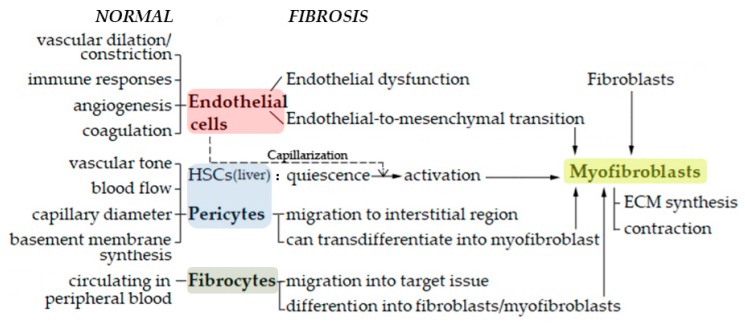
Soft tissue fibrosis in important organs such as the heart, liver, lung, and kidney is a serious pathological process that is characterized by excessive connective tissue deposition. It is the result of chronic but progressive accumulation of fibroblasts and their production of extracellular matrix components such as collagens. Research on pathological scars, namely, hypertrophic scars and keloids, may provide important clues about the mechanisms that drive soft tissue fibrosis, in particular the vascular involvement. This is because these dermal fibrotic lesions bear all of the fibrotic characteristics seen in soft tissue fibrosis. Moreover, their location on the skin surface means they are readily observable and directly treatable and therefore more accessible to research. We will focus here on the roles that blood vessel-associated cells play in cutaneous scar pathology and assess from the literature whether these cells also contribute to other soft tissue fibroses. These cells include endothelial cells, which not only exhibit aberrant functions but also differentiate into mesenchymal cells in pathological scars. They also include pericytes, hepatic stellate cells, fibrocytes, and myofibroblasts. This article will review with broad strokes the roles that these cells play in the pathophysiology of different soft tissue fibroses. We hope that this brief but wide-ranging overview of the vascular involvement in fibrosis pathophysiology will aid research into the mechanisms underlying fibrosis and that this will eventually lead to the development of interventions that can prevent, reduce, or even reverse fibrosis formation and/or progression.
重要器官(如心脏、肝脏、肺和肾脏)中的软组织纤维化是一种严重的病理过程,其特征是过度的结缔组织沉积。它是成纤维细胞及其产生的细胞外基质成分(如胶原)慢性但进行性积累的结果。对病理性瘢痕(即增生性瘢痕和瘢痕疙瘩)的研究可能为驱动软组织纤维化的机制提供重要线索,特别是血管参与。这是因为这些真皮纤维化病变具有在软组织纤维化中所见的所有纤维化特征。此外,它们位于皮肤表面,因此易于观察和直接治疗,因此更便于研究。我们将在这里重点关注与血管相关的细胞在皮肤瘢痕病理学中的作用,并从文献中评估这些细胞是否也有助于其他软组织纤维化。这些细胞包括内皮细胞,内皮细胞不仅表现出异常功能,而且在病理性瘢痕中还分化为间充质细胞。它们还包括周细胞、肝星状细胞、纤维细胞和成肌纤维细胞。本文将广泛综述这些细胞在不同软组织纤维化病理生理学中的作用。我们希望,对纤维化病理生理学中血管参与的简要但广泛的概述将有助于研究纤维化的机制,并最终导致能够预防、减少甚至逆转纤维化形成和/或进展的干预措施的开发。