Paix Benoît, Carriot Nathan, Barry-Martinet Raphaëlle, Greff Stéphane, Misson Benjamin, Briand Jean-François, Culioli Gérald
EA 4323, Matériaux Polymères Interfaces Environnement Marin, Université de Toulon, Toulon, France.
UMR 7263, Aix Marseille Université, CNRS, IRD, Avignon Université, Institut Méditerranéen de Biodiversité et d'Ecologie Marine et Continentale, Station Marine d'Endoume, Marseille, France.
Front Microbiol. 2020 Mar 25;11:494. doi: 10.3389/fmicb.2020.00494. eCollection 2020.
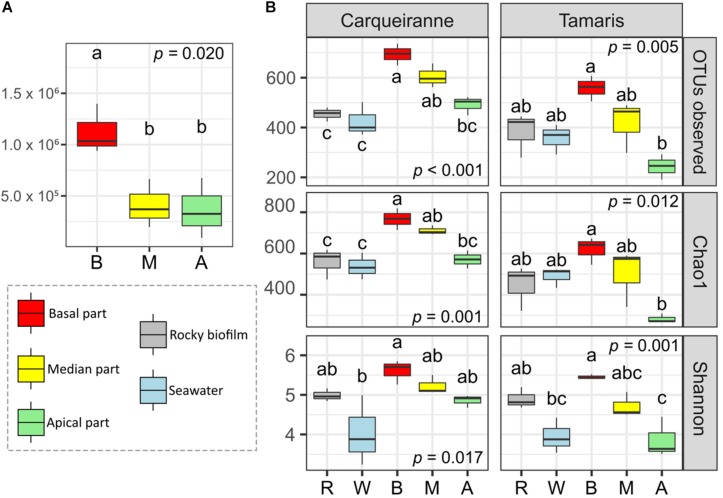
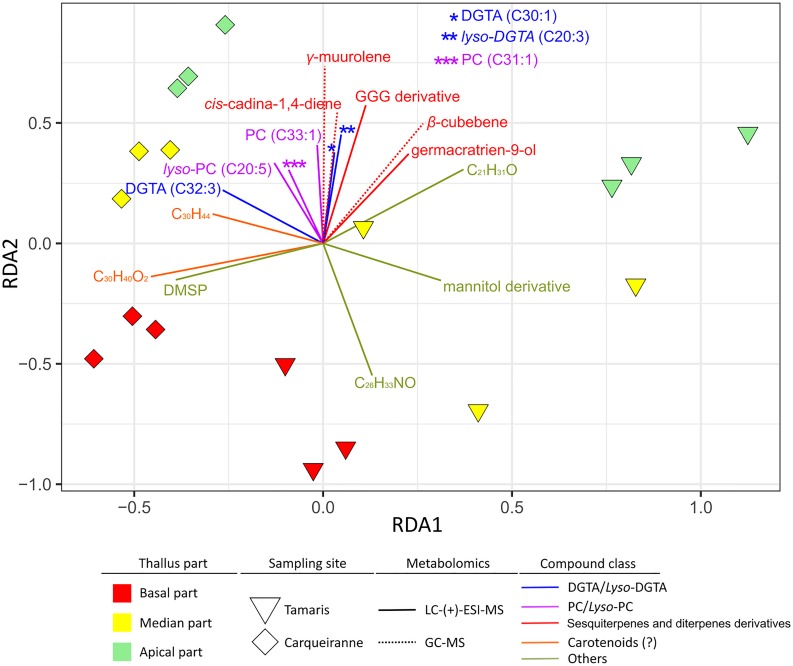
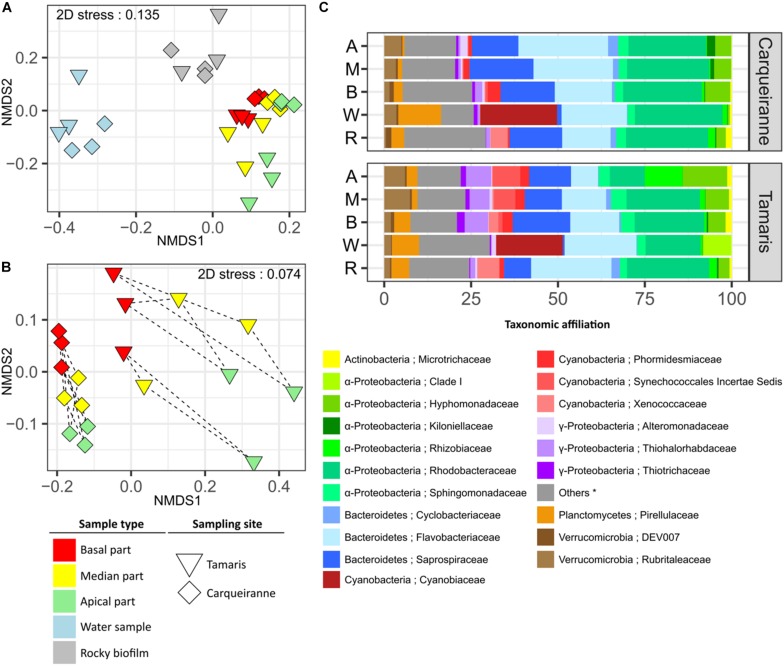
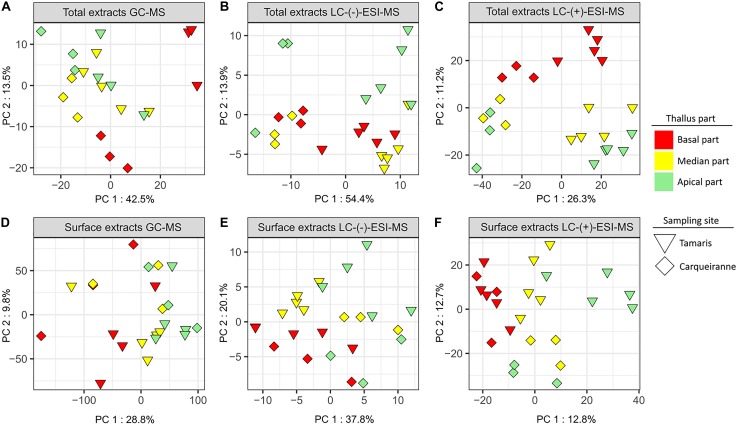
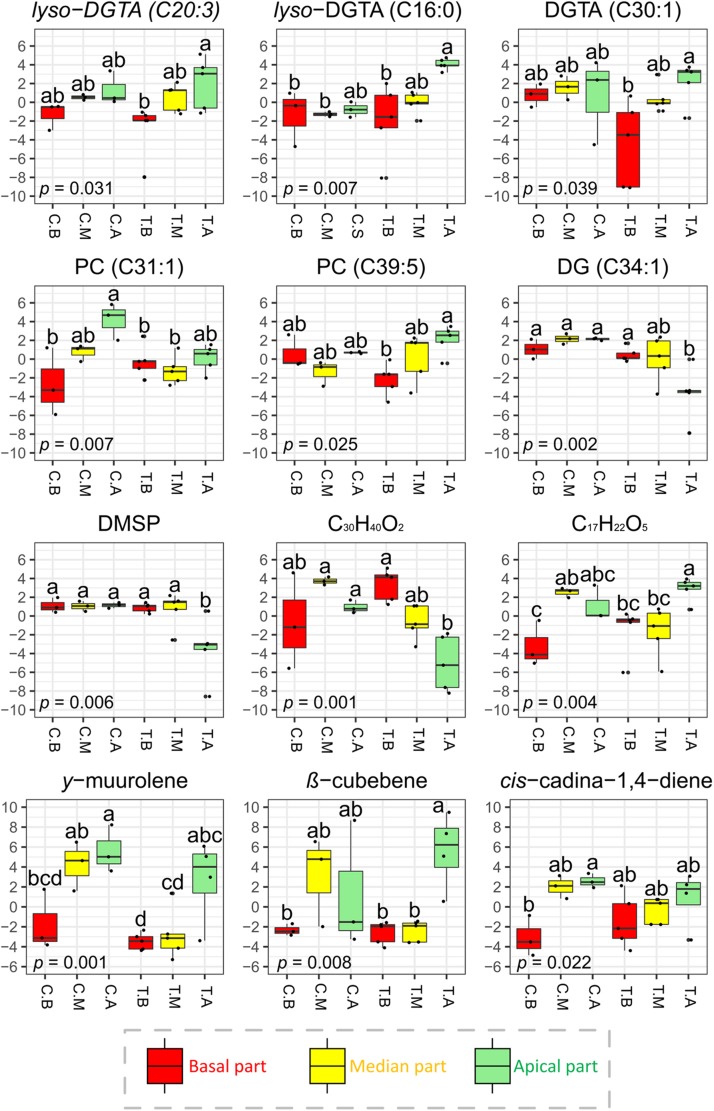
Marine macroalgae constitute an important living resource in marine ecosystems and complex ecological interactions occur at their surfaces with microbial communities. In this context, the present study aimed to investigate how the surface metabolome of the algal holobiont could drive epiphytic microbiota variations at the thallus scale. First, a clear discrimination was observed between algal surface, planktonic and rocky prokaryotic communities. These data strengthened the hypothesis of an active role of the algal host in the selection of epiphytic communities. Moreover, significant higher epibacterial density and α-diversity were found at the basal algal parts compared to the apical ones, suggesting a maturation gradient of the community along the thallus. In parallel, a multiplatform mass spectrometry-based metabolomics study, using molecular networking to annotate relevant metabolites, highlighted a clear chemical differentiation at the algal surface along the thallus with similar clustering as for microbial communities. In that respect, higher amounts of sesquiterpenes, phosphatidylcholines (PCs), and diacylglycerylhydroxymethyl-,,-trimethyl-β-alanines (DGTAs) were observed at the apical regions while dimethylsulfoniopropionate (DMSP) and carotenoids were predominantly found at the basal parts of the thalli. A weighted UniFrac distance-based redundancy analysis linking the metabolomics and metabarcoding datasets indicated that these surface compounds, presumably of algal origin, may drive the zonal variability of the epibacterial communities. As only few studies were focused on microbiota and metabolome variation along a single algal thallus, these results improved our understanding about seaweed holobionts. Through this multi-omics approach at the thallus scale, we suggested a plausible scenario where the chemical production at the surface of , mainly induced by the algal physiology, could explain the specificity and the variations of the surface microbiota along the thallus.
海洋大型藻类是海洋生态系统中的重要生物资源,其表面与微生物群落存在复杂的生态相互作用。在此背景下,本研究旨在探究藻类共生体的表面代谢组如何在叶状体尺度上驱动附生微生物群的变化。首先,在藻类表面、浮游和岩石原核生物群落之间观察到明显的区分。这些数据强化了藻类宿主在附生群落选择中发挥积极作用的假设。此外,与顶端部分相比,在藻类基部发现附生细菌密度和α多样性显著更高,这表明群落沿叶状体存在成熟梯度。同时,一项基于多平台质谱的代谢组学研究,利用分子网络注释相关代谢物,突出了藻类表面沿叶状体存在明显的化学分化,其聚类与微生物群落相似。在这方面,在顶端区域观察到较高含量的倍半萜、磷脂酰胆碱(PCs)和二酰甘油羟甲基 - 三甲基 - β - 丙氨酸(DGTAs),而二甲基巯基丙酸内盐(DMSP)和类胡萝卜素主要存在于叶状体的基部。基于加权UniFrac距离的冗余分析将代谢组学和元条形码数据集联系起来,表明这些可能源自藻类的表面化合物可能驱动附生细菌群落的区域变异性。由于只有少数研究关注单一藻类叶状体上的微生物群和代谢组变化,这些结果增进了我们对海藻共生体的理解。通过这种在叶状体尺度上的多组学方法,我们提出了一个合理的设想,即主要由藻类生理诱导的表面化学产物可以解释叶状体表面微生物群的特异性和变化。