Zhu Zhigang, Yang Lin, Yu Yongxian, Zhang Lijing, Tao Shengyang
Department of Chemistry, Dalian University of Technology, Dalian 116024, P. R. China.
National Engineering Research Center of Seafood, School of Food Science and Technology, Dalian Polytechnic University, Dalian 116034, P. R. China.
ACS Omega. 2020 Mar 27;5(13):7666-7674. doi: 10.1021/acsomega.0c00511. eCollection 2020 Apr 7.
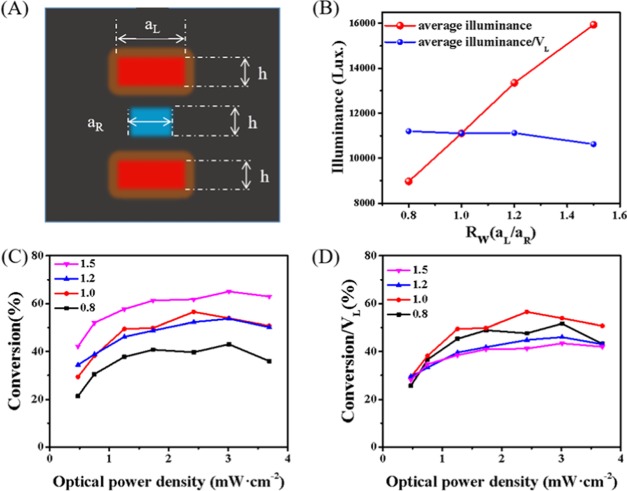
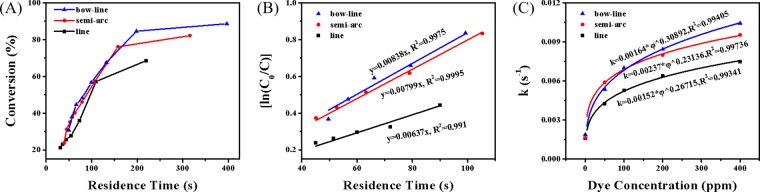
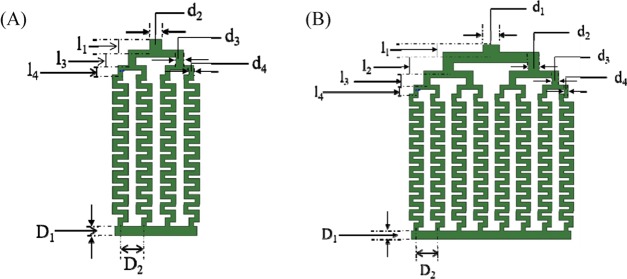
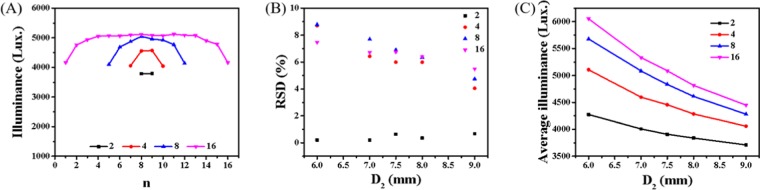
The integration of light-converting media and microflow chemistry renders new opportunities for high-efficient utilization of solar energy to drive chemical reactions. Recently, we proposed a design of fluorescent fluid photochemical microreactor (FFPM) with a separate light channel and reaction channel, which displays excellent advantages in energy efficiency, flexibility, and general use. However, the limitations of the scalability of the microchannel reactor are still a big challenge to be overcome. Herein, we illustrate the scalability of such an FFPM via a 2 numbering-up strategy by 3D printing technology. Channel shape, number, and interchannel spacing have been optimized, and the serpentine FFPM shows the best scalability with an excellent conversion rate and massive throughput. Reactors with up to eight channels have been fabricated and displayed conversions comparable to that obtained in a single-channel reactor, which provides a feasible strategy and an optimized structure model for batch production of fine chemicals.
光转换介质与微流化学的结合为高效利用太阳能驱动化学反应带来了新机遇。最近,我们提出了一种具有独立光通道和反应通道的荧光流体光化学微反应器(FFPM)设计,该设计在能源效率、灵活性和通用性方面展现出优异优势。然而,微通道反应器的可扩展性限制仍是一个有待克服的巨大挑战。在此,我们通过三维打印技术采用2倍放大策略阐述了这种FFPM的可扩展性。通道形状、数量和通道间距已得到优化,蛇形FFPM表现出最佳的可扩展性,具有优异的转化率和大量的通量。已制造出多达八个通道的反应器,其转化率与单通道反应器相当,这为精细化学品的批量生产提供了一种可行策略和优化的结构模型。