Department of Clinical Laboratory, Shandong Provincial Hospital Affiliated to Shandong First Medical University, Jinan, China.
Front Public Health. 2021 Dec 15;9:755252. doi: 10.3389/fpubh.2021.755252. eCollection 2021.
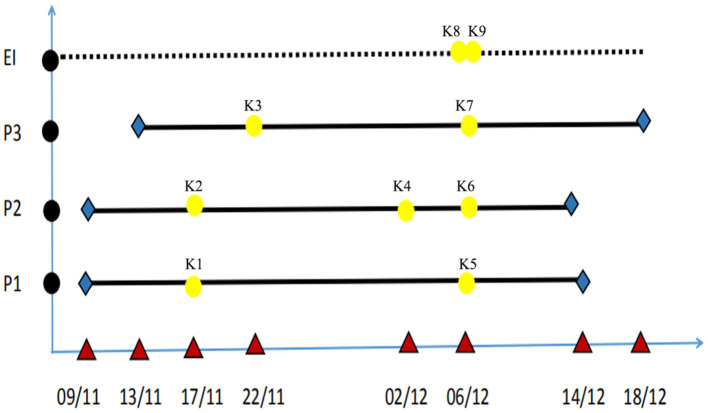
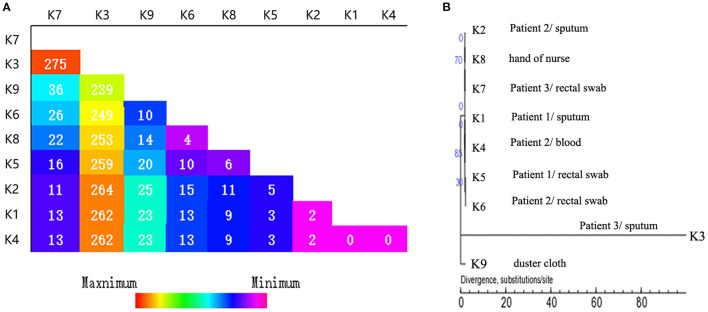
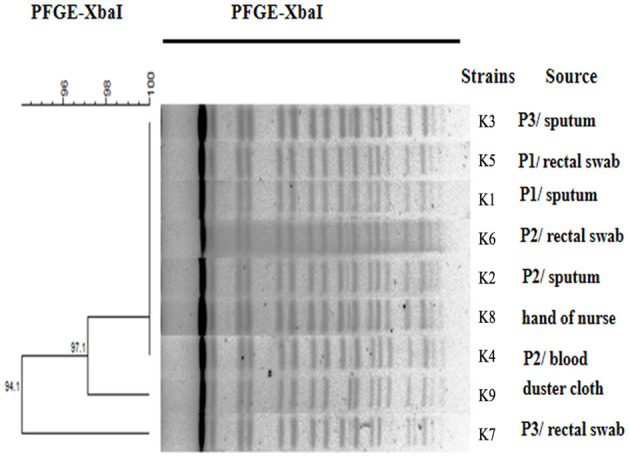
The purpose of this study is to use whole genome sequencing (WGS) combined with epidemiological data to track a hospital infection of the carbapenem-resistant (CRKP), which affected 3 neonatal patients in the neonatal intensive care unit (NICU). The minimum inhibitory concentrations for the antimicrobial agents were determined according to the guidelines of the Clinical and Laboratory Standards Institute. Beta-lactamases were investigated using the polymerase chain reaction and DNA sequencing. The transferability of the plasmid was investigated by a conjugation experiment. The clonal relationships were evaluated using multilocus sequence typing (MLST) and pulsed-field gel electrophoresis (PFGE). WGS and single nucleotide polymorphisms (SNPs) analysis were performed on the CRKP isolates to investigate how the infection might progress. Nine CRKP isolates were obtained from the NICU, seven from three patients, one from a duster cloth and one from the hand of a nurse, they all harbored IMP-4. Other resistance genes including KPC-2, IMP-4, SHV-1, TEM-1, CTX-M-15, and DHA-1 were also detected. PFGE analysis showed that IMP-4-producing were clonally related, and MLST assigned them to a new sequence type 2253. The SNP variations throughout the genome divided the 9 strains into three clades. Clade 1 comprised 7 strains (K1- K2 and K4-K8), whereas clade 2 and 3 consisted of only one strain each: K3 and K9, respectively.The sputum isolate K3 from patient 3 was the most distinct one differing from the other eight isolates by 239-275 SNPs. This is a report of using WGS to track a hospital infecion of IMP-4-producing ST2253 among neonates. Nosocomial surveillance systems are needed to limit the spread of the infection caused by these pathogens resulting from the environmental exposure in NICUs.
本研究旨在利用全基因组测序(WGS)结合流行病学数据,追踪一起发生在新生儿重症监护病房(NICU)的耐碳青霉烯肠杆菌科细菌(CRKP)医院感染事件,该事件影响了 3 名新生儿患者。根据临床和实验室标准协会的指南,确定了抗菌药物的最低抑菌浓度。使用聚合酶链反应和 DNA 测序检测β-内酰胺酶。通过接合实验研究质粒的可转移性。使用多位点序列分型(MLST)和脉冲场凝胶电泳(PFGE)评估克隆关系。对 CRKP 分离株进行 WGS 和单核苷酸多态性(SNP)分析,以研究感染的进展情况。从 NICU 获得了 9 株 CRKP 分离株,其中 7 株来自 3 名患者,1 株来自集群布,1 株来自护士的手,它们都携带 IMP-4。还检测到其他耐药基因,包括 KPC-2、IMP-4、SHV-1、TEM-1、CTX-M-15 和 DHA-1。PFGE 分析显示,IMP-4 产生菌具有克隆相关性,MLST 将其分为一个新的序列型 2253。整个基因组的 SNP 变异将 9 株菌分为 3 个分支。分支 1 包括 7 株菌(K1-K2 和 K4-K8),而分支 2 和 3 各只有 1 株菌:K3 和 K9。来自患者 3 的 K3 痰分离株与其他 8 株分离株的差异最大,相差 239-275 个 SNP。这是一份关于利用 WGS 追踪新生儿中产 IMP-4 的 ST2253 肠杆菌科细菌医院感染的报告。需要建立医院感染监测系统,以限制因 NICU 环境暴露而导致的这些病原体引起的感染传播。