Unitaid, World Health Organization, Geneva, Switzerland.
The Joint TB/HIV Global Fund -ActionAid, Lilongwe, Malawi.
PLoS One. 2020 Apr 14;15(4):e0229248. doi: 10.1371/journal.pone.0229248. eCollection 2020.
Neonatal sepsis is a leading cause of mortality, yet the recommended inpatient treatment options are inaccessible to most families in low-income settings. In 2015, the World Health Organization released a guideline for outpatient treatment of young infants (0-59 days of age) with possible serious bacterial infection (PSBI) with simplified antibiotic regimens when referral was not feasible. If implemented widely, this guideline could prevent many deaths. Our implementation research evaluated the feasibility and acceptability of implementing the WHO guideline through the existing health system in Malawi.
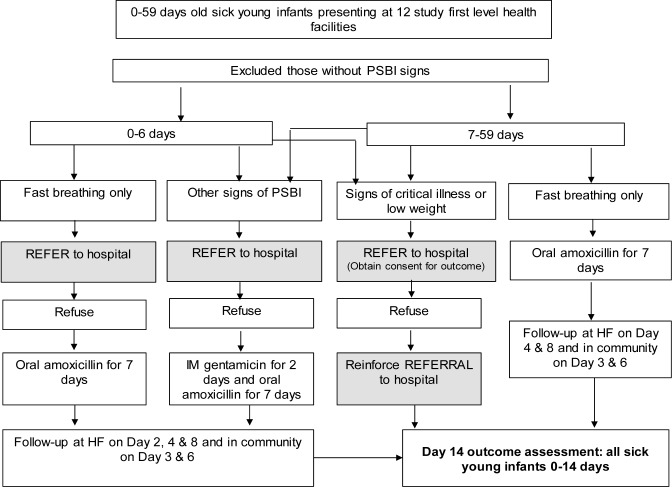
A prospective cohort study was conducted in 12 first-level health facilities in Ntcheu district. Trained health workers identified and treated young infants with PSBI signs with injection gentamicin for 2 days and oral amoxicillin for 7 days, whereas those with only fast breathing were treated with oral amoxicillin for 7 days. Health Surveillance Assistants (HSAs) were trained to promote care-seeking and to conduct home visits on day 3 and 6 to assess infants under treatment, encourage treatment adherence and remind the caregiver to return for facility follow up. Infants receiving outpatient treatment were followed up at health facility on day 4 and 8. The primary outcome was proportion of outpatient cases completing treatment per protocol.
A total of 358 infants received outpatient treatment (202 clinical severe infection, 156 only fast breathing) from February to September 2017. Of these, 92.7% (332/358) met criteria for treatment completion and 88.8% (318/358) completed the day 4 follow-up. Twelve (3.4%) young infants clinically failed treatment with no reported deaths in those treated at outpatient level. This treatment failure rate was lower than those reported for the simplified regimens tested in the SATT (8-10%) and AFRINEST (5-8%) equivalency trials. More than half of infants (58.1%; 208/358) received HSA follow-up visits on days 3 and 6.
Study results demonstrate the feasibility of outpatient treatment for sick young infants when referral is not feasible in Malawi, which will inform scale-up in other parts of Malawi and countries with similar health system constraints.
新生儿败血症是导致死亡的主要原因,但在低收入环境中,大多数家庭无法获得推荐的住院治疗方案。2015 年,世界卫生组织发布了一份针对无法转诊的 0-59 天龄患有可能严重细菌感染的婴幼儿的门诊治疗指南,其中包括简化抗生素方案。如果广泛实施,该指南可以预防许多死亡。我们的实施研究评估了通过马拉维现有卫生系统实施世卫组织指南的可行性和可接受性。
在恩特切乌区的 12 个一级卫生机构进行了一项前瞻性队列研究。经过培训的卫生工作者使用注射用庆大霉素治疗 2 天,口服阿莫西林治疗 7 天,治疗有 PSBI 迹象的婴幼儿;仅呼吸急促的婴儿则接受 7 天的口服阿莫西林治疗。健康监测助理(HSAs)接受培训,以促进寻求医疗服务,并在第 3 天和第 6 天进行家访,以评估接受治疗的婴儿,鼓励坚持治疗并提醒护理人员返回医疗机构进行随访。接受门诊治疗的婴儿在第 4 天和第 8 天在卫生机构接受随访。主要结局是按方案完成治疗的门诊病例比例。
2017 年 2 月至 9 月,共有 358 名婴儿接受门诊治疗(202 例临床严重感染,156 例仅呼吸急促)。其中,92.7%(332/358)符合治疗完成标准,88.8%(318/358)完成了第 4 天的随访。在接受门诊治疗的婴儿中,有 12 例(3.4%)临床治疗失败,无报告死亡病例。该治疗失败率低于 SATT(8-10%)和 AFRINEST(5-8%)等效试验中报告的简化方案。超过一半的婴儿(58.1%;208/358)在第 3 天和第 6 天接受了 HSA 随访。
研究结果表明,在马拉维无法转诊的情况下,对患病婴幼儿进行门诊治疗是可行的,这将为马拉维其他地区和具有类似卫生系统限制的国家提供扩大规模的信息。