He Qibin, Niu Jianlei, Gao Naiping, Zhu Tong, Wu Jiazheng
Institute of Refrigeration and Thermal Engineering, School of Mechanical Engineering, Tongji University, Siping Road 1239#, Shanghai, China.
Department of Building Services Engineering, The Hong Kong Polytechnic University, Hung Hom, Kowloon, Hong Kong.
Build Environ. 2011 Feb;46(2):397-408. doi: 10.1016/j.buildenv.2010.08.003. Epub 2010 Aug 18.
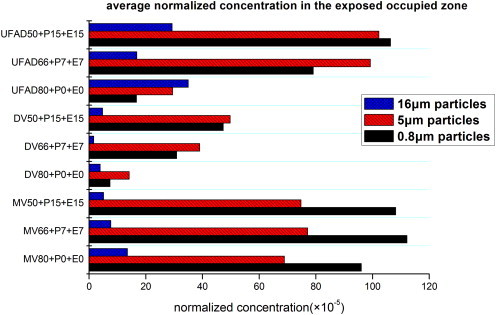
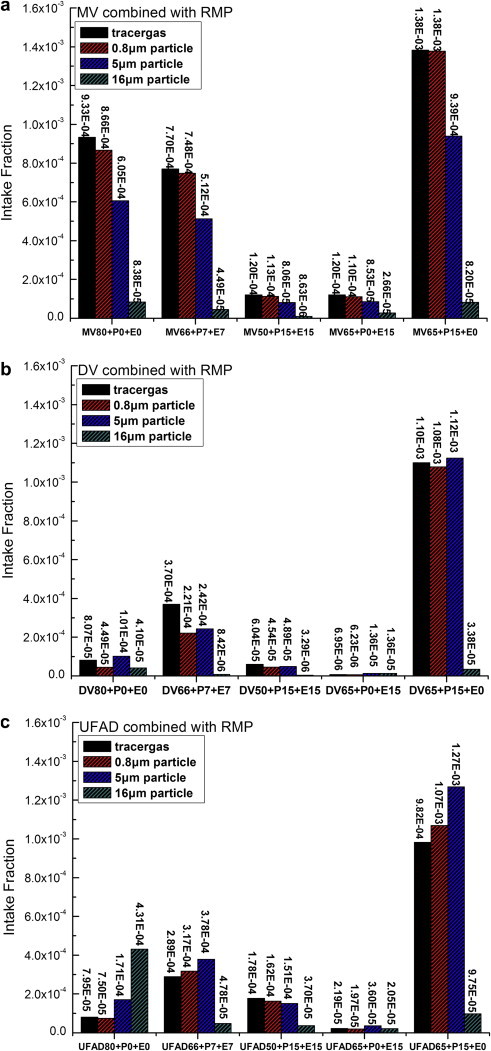
This paper investigated the transmission of respiratory droplets between two seated occupants equipped with one type of personalized ventilation (PV) device using round movable panel (RMP) in an office room. The office was ventilated by three different total volume (TV) ventilation strategies, i.e. mixing ventilation (MV), displacement ventilation (DV), and under-floor air distribution (UFAD) system respectively as background ventilation methods. Concentrations of particles with aerodynamic diameters of 0.8 μm, 5 μm, and 16 μm as well as tracer gas were numerically studied in the Eulerian frame. Two indexes, i.e. intake fraction (IF) and concentration uniformity index were introduced to evaluate the performance of ventilation systems. It was found that without PV, DV performed best concern protecting the exposed manikin from the pollutants exhaled by the polluting manikin. In MV when the exposed manikin opened RMP the inhaled air quality could always be improved. In DV and UFAD application of RMP might sometimes, depending on the personalized airflow rate, increase the exposure of the others to the exhaled droplets of tracer gas, 0.8 μm particles, and 5 μm particles from the infected occupants. Application of PV could reduce for all the three TV systems of 0.8 μm and 5 μm particles. PV enhanced mixing degree of particles under DV and UFAD based conditions much stronger than under MV based ones. PV could increase the average concentration in the occupied zone of the exposed manikin as well as provide clean personalized airflow. Whether inhaled air quality could be improved depended on the balance of pros and cons of PV.
本文研究了在办公室内,两名就座人员配备一种使用圆形活动面板(RMP)的个性化通风(PV)设备时呼吸道飞沫的传播情况。办公室分别采用三种不同的总风量(TV)通风策略进行通风,即混合通风(MV)、置换通风(DV)和地板送风(UFAD)系统作为背景通风方式。在欧拉框架下,对空气动力学直径为0.8μm、5μm和16μm的颗粒浓度以及示踪气体进行了数值研究。引入了两个指标,即吸入分数(IF)和浓度均匀性指数,以评估通风系统的性能。研究发现,在没有PV的情况下,就保护暴露的人体模型免受污染人体模型呼出污染物的影响而言,DV表现最佳。在MV中,当暴露的人体模型打开RMP时,吸入空气质量总能得到改善。在DV和UFAD中,RMP的应用有时可能会,取决于个性化气流速率,增加其他人暴露于受感染人员呼出的示踪气体、0.8μm颗粒和5μm颗粒飞沫的风险。PV的应用可以降低所有三种TV系统中0.8μm和5μm颗粒的[未明确的相关指标值]。在DV和UFAD条件下,PV增强颗粒混合程度的效果比在MV条件下强得多。PV可以提高暴露人体模型所在区域的平均浓度,并提供清洁的个性化气流。吸入空气质量是否能得到改善取决于PV的利弊平衡。