Dangi Tanushree, Jain Amita
Postgraduate Department of Microbiology, CSM Medical University, Lucknow, 226003 Uttar Pradesh India.
Proc Natl Acad Sci India Sect B Biol Sci. 2012;82(1):111-121. doi: 10.1007/s40011-011-0009-6. Epub 2012 Jan 18.
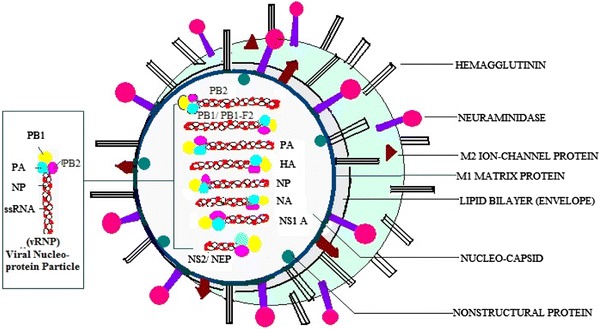
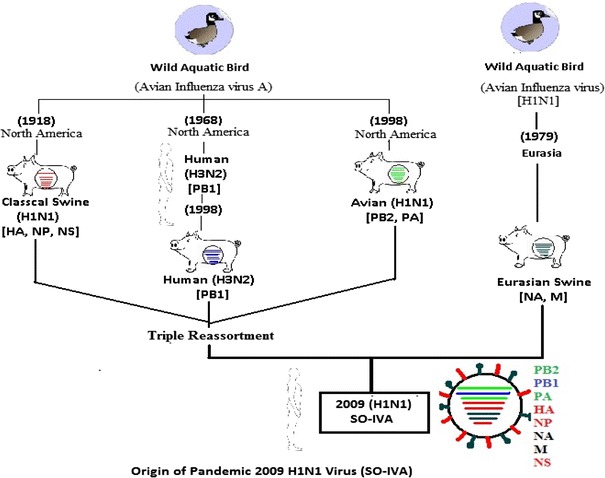
Influenza is a major public health concern, infecting 5-15% of the global population annually. Influenza virus belongs to family Orthomyxoviridae, and has three types A, B and C. Infection by influenza virus A is most common and severe, generally found in humans. It spreads rapidly and affects human population across large geographical region within short period of time with varying degree of pathology from mild to severe. Wild aquatic birds and other animal species like birds, pigs, ferret, horses, seals, whales, mink, giant anteaters, cats and dogs are the reservoir for the influenza A virus. Influenza B and C viruses have very limited host range and appear predominantly in humans. Influenza virus gains pandemic potential through genetic reassortment called "genetic shift" with complete renewal of surface antigen and a small but gradual genetic change by mutations which make it to adapt efficiently in human population called "genetic drift". Although, the epidemiology related to influenza infection has been studied from several years but some facts associated to disease transmission has poorly understood. This article reviews the important aspects of virological, epidemiological and clinical features related to influenza virus for better understanding of disease transmission and its pathogenesis.
流感是一个主要的公共卫生问题,每年感染全球5%-15%的人口。流感病毒属于正粘病毒科,有A、B、C三种类型。甲型流感病毒感染最为常见和严重,通常在人类中发现。它传播迅速,在短时间内影响大面积地理区域的人群,病理程度从轻度到重度不等。野生水禽和其他动物物种,如鸟类、猪、雪貂、马、海豹、鲸鱼、水貂、食蚁兽、猫和狗是甲型流感病毒的储存宿主。乙型和丙型流感病毒的宿主范围非常有限,主要出现在人类中。流感病毒通过称为“基因重配”的基因重组获得大流行潜力,表面抗原完全更新,通过突变发生小而渐进的基因变化,使其能够在人群中有效适应,称为“基因漂变”。尽管多年来一直在研究与流感感染相关的流行病学,但与疾病传播相关的一些事实仍知之甚少。本文综述了与流感病毒相关的病毒学、流行病学和临床特征的重要方面,以便更好地理解疾病传播及其发病机制。