Bae Eun Bit, Lee Jun Ho, Song Jae-Jin
Interdisciplimentary Program in Neuroscience, Seoul National University, Seoul, South Korea.
Laboratory of Electrophysiology, Department of Otorhinolaryngology, Center of Medical Research Innovation, Seoul National University Hospital, Seoul, South Korea.
Front Neurol. 2020 Mar 27;11:160. doi: 10.3389/fneur.2020.00160. eCollection 2020.
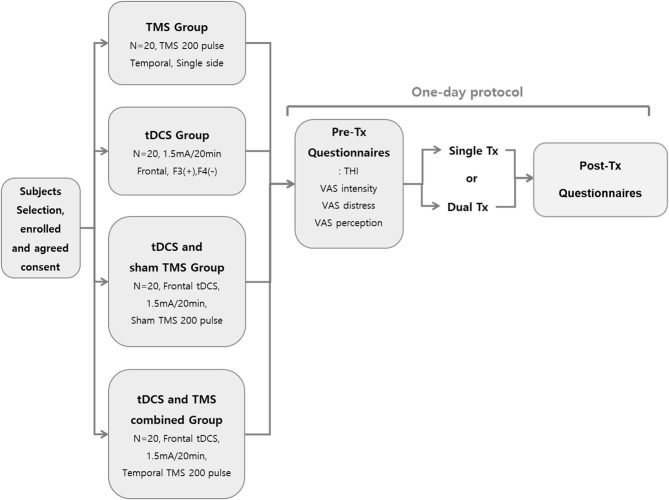
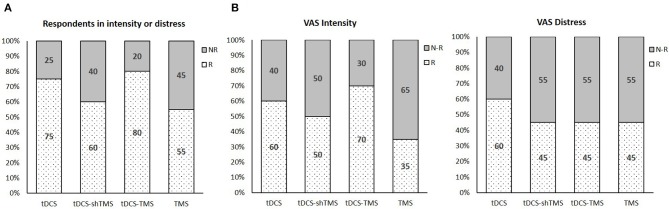
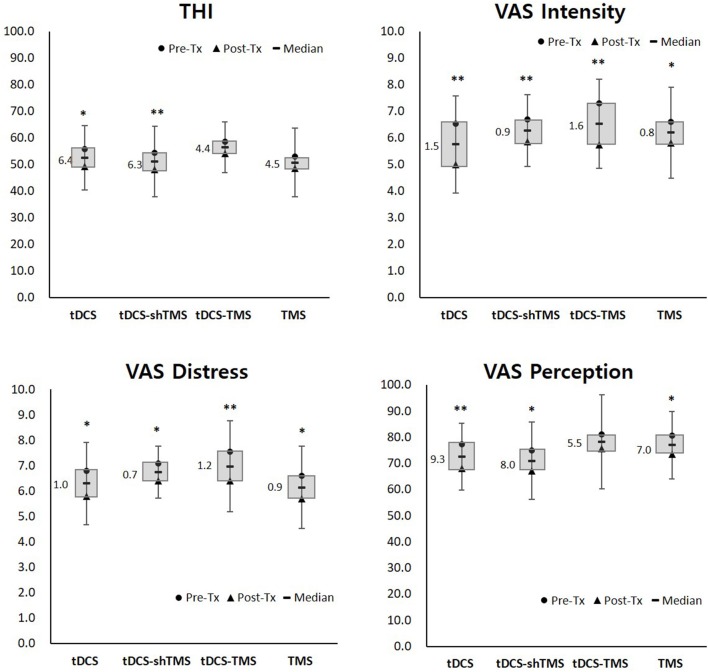
To treat motor and psychiatric disorders, transcranial direct current stimulation (tDCS) and transcranial magnetic stimulation (TMS) are used in clinics worldwide. We combined these two types of neuromodulation technique to increase the effective response of a single session of neuromodulation in subjective tinnitus. Eighty tinnitus subjects were split into four different treatment groups: tDCS, tDCS with sham TMS, tDCS-TMS, and TMS group. Subjects were given 1.5 mA tDCS on the bi-frontal area and TMS stimulated the contralateral single side of the temporo-parietal cortex with 200 pulses at 1 Hz stimulation. Comparing pre-treatment questionnaire scores to post-treatment questionnaire scores, all four groups showed statistically significant improvements. Although there was no significant difference among group comparison, the largest mean difference was shown in the combined group, especially for tinnitus intensity and tinnitus-related distress. Responders in the combined group were the highest for VAS intensity, with a maximum of 80% of twenty subjects. To summarize, dual-neuromodulation responders could consist of responders of frontal tDCS and temporal TMS. In addition, abnormal activity in the frontal or temporal area of the responders is presumed to be modulated by treatment and will be suggested as the target areas in future studies.
为了治疗运动和精神障碍,经颅直流电刺激(tDCS)和经颅磁刺激(TMS)在全球范围内的临床中得到应用。我们将这两种神经调节技术相结合,以提高单次神经调节对主观性耳鸣的有效反应。80名耳鸣患者被分为四个不同的治疗组:tDCS组、tDCS加假TMS组、tDCS-TMS组和TMS组。受试者在双额叶区域接受1.5 mA的tDCS,TMS以1 Hz的频率刺激颞顶叶皮质的对侧单侧,共200个脉冲。将治疗前问卷评分与治疗后问卷评分进行比较,所有四个组均显示出统计学上的显著改善。尽管组间比较没有显著差异,但联合组的平均差异最大,尤其是在耳鸣强度和耳鸣相关困扰方面。联合组中视觉模拟量表(VAS)强度的反应者比例最高,20名受试者中最高可达80%。总之,双重神经调节反应者可能包括额叶tDCS和颞叶TMS的反应者。此外,反应者额叶或颞叶区域的异常活动被推测可通过治疗得到调节,并将在未来研究中被建议作为目标区域。