Espinosa María José Cárdenas, Blanco Andrea Colina, Schmidgall Tabea, Atanasoff-Kardjalieff Anna Katharina, Kappelmeyer Uwe, Tischler Dirk, Pieper Dietmar H, Heipieper Hermann J, Eberlein Christian
Department of Environmental Biotechnology, Helmholtz Centre for Environmental Research - UFZ, Leipzig, Germany.
Interdisciplinary Ecological Center, TU Bergakademie Freiberg, Freiberg, Germany.
Front Microbiol. 2020 Mar 27;11:404. doi: 10.3389/fmicb.2020.00404. eCollection 2020.
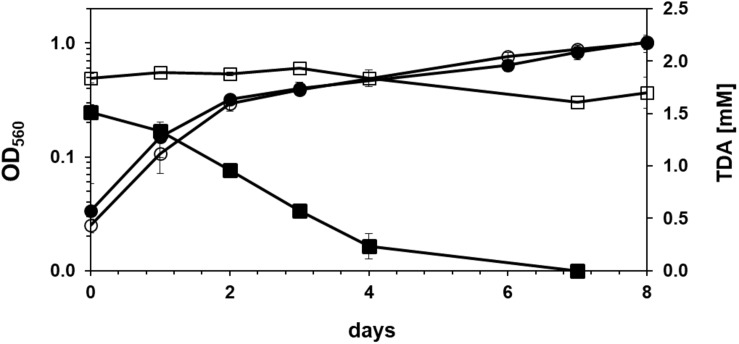
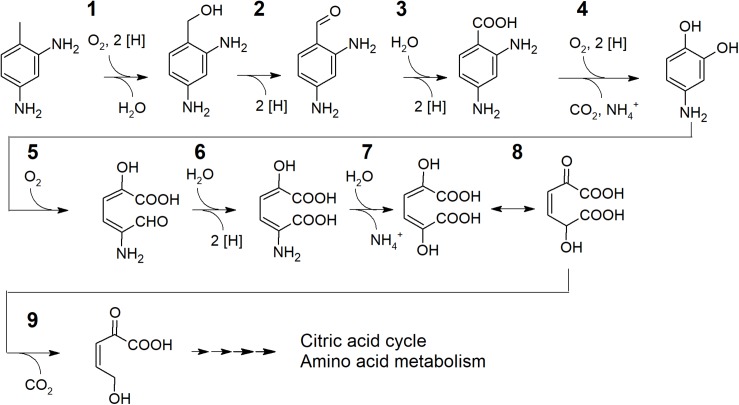
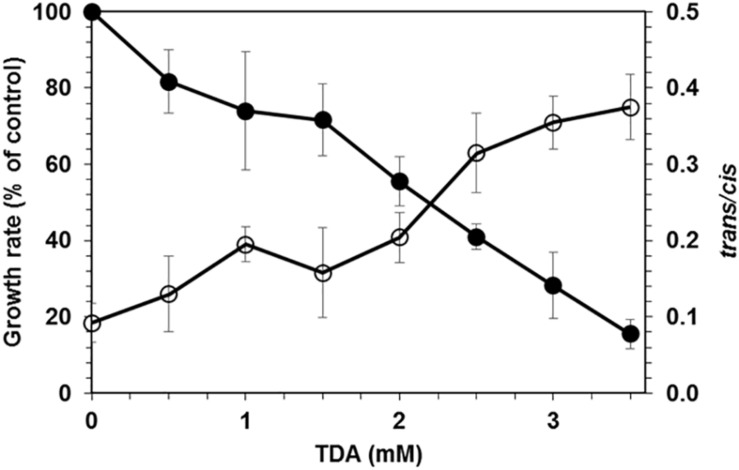
The fate of plastic waste and a sustainable use of synthetic polymers is one of the major challenges of the twenty first century. Waste valorization strategies can contribute to the solution of this problem. Besides chemical recycling, biological degradation could be a promising tool. Among the high diversity of synthetic polymers, polyurethanes are widely used as foams and insulation materials. In order to examine bacterial biodegradability of polyurethanes, a soil bacterium was isolated from a site rich in brittle plastic waste. The strain, identified as sp. by 16S rRNA gene sequencing and membrane fatty acid profile, was able to grow on a PU-diol solution, a polyurethane oligomer, as the sole source of carbon and energy. In addition, the strain was able to use 2,4-diaminotoluene, a common precursor and putative degradation intermediate of polyurethanes, respectively, as sole source of energy, carbon, and nitrogen. Whole genome sequencing of the strain revealed the presence of numerus catabolic genes for aromatic compounds. Growth on potential intermediates of 2,4-diaminotoluene degradation, other aromatic growth substrates and a comparison with a protein data base of oxygenases present in the genome, led to the proposal of a degradation pathway.
塑料垃圾的命运以及合成聚合物的可持续利用是21世纪的主要挑战之一。废物增值策略有助于解决这一问题。除了化学回收,生物降解可能是一种很有前景的方法。在种类繁多的合成聚合物中,聚氨酯被广泛用作泡沫和绝缘材料。为了研究聚氨酯的细菌生物降解性,从一个富含易碎塑料垃圾的地点分离出一种土壤细菌。通过16S rRNA基因测序和膜脂肪酸谱鉴定该菌株为 sp.,它能够在聚氨酯二醇溶液(一种聚氨酯低聚物)作为唯一碳源和能源的条件下生长。此外,该菌株能够分别以2,4 -二氨基甲苯(聚氨酯的常见前体和假定降解中间体)作为唯一的能量、碳和氮源。该菌株的全基因组测序揭示了存在许多用于芳香族化合物的分解代谢基因。在2,4 -二氨基甲苯降解的潜在中间体、其他芳香族生长底物上的生长情况以及与基因组中存在的加氧酶蛋白质数据库的比较,促成了一条降解途径的提出。