Gessert Nils, Nielsen Maximilian, Shaikh Mohsin, Werner René, Schlaefer Alexander
Institute of Medical Technology, Hamburg University of Technology, Hamburg, Germany.
DAISYlab, Forschungszentrum Medizintechnik Hamburg, Hamburg, Germany.
MethodsX. 2020 Mar 19;7:100864. doi: 10.1016/j.mex.2020.100864. eCollection 2020.
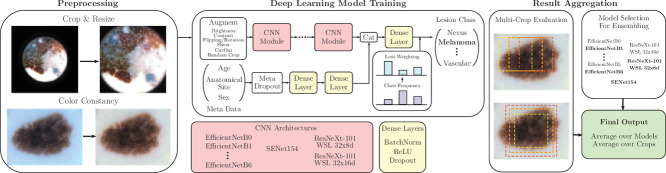
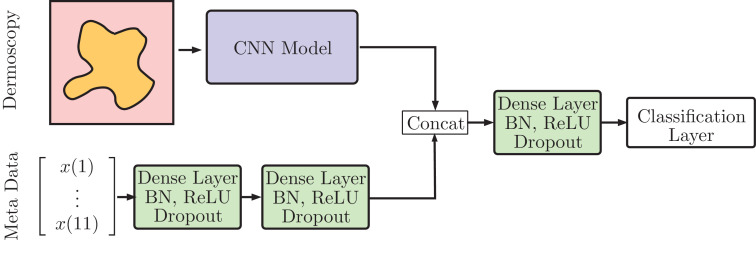
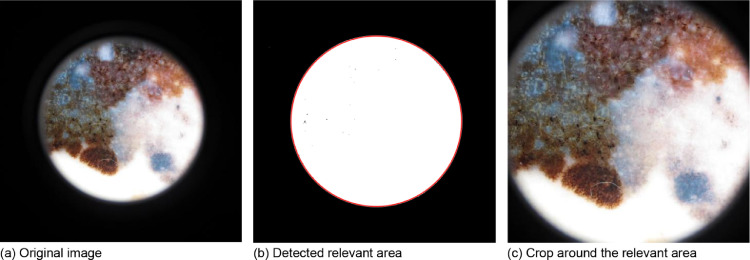
In this paper, we describe our method for the ISIC 2019 Skin Lesion Classification Challenge. The challenge comes with two tasks. For task 1, skin lesions have to be classified based on dermoscopic images. For task 2, dermoscopic images and additional patient meta data are used. Our deep learning-based method achieved first place for both tasks. The are several problems we address with our method. First, there is an unknown class in the test set which we cover with a data-driven approach. Second, there is a severe class imbalance that we address with loss balancing. Third, there are images with different resolutions which motivates two different cropping strategies and multi-crop evaluation. Last, there is patient meta data available which we incorporate with a dense neural network branch. • We address skin lesion classification with an ensemble of deep learning models including EfficientNets, SENet, and ResNeXt WSL, selected by a search strategy. • We rely on multiple model input resolutions and employ two cropping strategies for training. We counter severe class imbalance with a loss balancing approach. • We predict an additional, unknown class with a data-driven approach and we make use of patient meta data with an additional input branch.
在本文中,我们描述了我们用于2019年国际皮肤影像协作组织(ISIC)皮肤病变分类挑战赛的方法。该挑战赛包含两项任务。对于任务1,必须基于皮肤镜图像对皮肤病变进行分类。对于任务2,则使用皮肤镜图像和额外的患者元数据。我们基于深度学习的方法在两项任务中均获得了第一名。我们的方法解决了几个问题。首先,测试集中存在一个未知类别,我们用一种数据驱动的方法来处理。其次,存在严重的类别不平衡问题,我们通过损失平衡来解决。第三,存在分辨率不同的图像,这促使我们采用两种不同的裁剪策略和多裁剪评估。最后,有可用的患者元数据,我们通过一个密集神经网络分支将其纳入。
• 我们用包括高效网络(EfficientNets)、SENet和WSL的ResNeXt等深度学习模型的集成来处理皮肤病变分类,这些模型是通过一种搜索策略选择的。
• 我们依赖多种模型输入分辨率,并采用两种裁剪策略进行训练。我们用一种损失平衡方法来应对严重的类别不平衡。
• 我们用一种数据驱动的方法预测一个额外的未知类别,并通过一个额外的输入分支利用患者元数据。