Turjamaa Riitta, Salpakari Johanna, Koskinen Liisa
School of Health Care, Savonia University of Applied Sciences, 70210 Kuopio, Finland.
Clinical Nurse Specialist, Kuopio University Hospital, 70210 Kuopio, Finland.
Healthcare (Basel). 2020 Apr 13;8(2):95. doi: 10.3390/healthcare8020095.
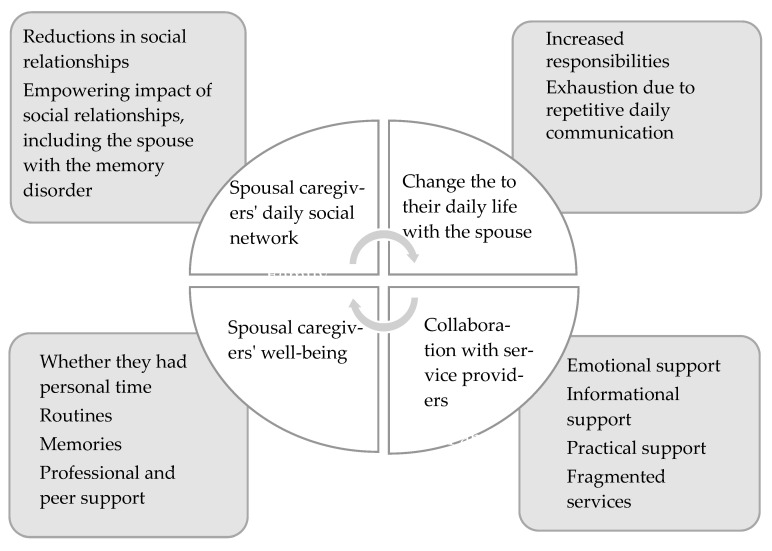
Memory disorders have become a major public, social, and health concern among the aging population, and many of those who are affected are cared for at home by their spouse. The aim of this qualitative study was to describe the individual experiences of 10 older caregivers who were looking after a spouse with a memory disorder in 2016. Data were collected from volunteers who were recruited from a memory clinic at a Finnish health center using the thematic interview method and processed using inductive content analysis. The participants were six female and four male caregivers who had been married for over 10 years. The results indicated that caring for a spouse with a memory disorder involved a number of factors. These included the impact of social networks and changes in their everyday life, collaboration with service providers, and the caregivers' well-being. However, our study showed that caregivers felt that the formal multiprofessional services they received were fragmented, which means that they were less likely to provide a holistic approach to caregivers' situations. Better multiprofessional cooperation is needed in the community, including services such as memory clinics, home care and practical services, day centers, and short-term respite in care homes.
在老年人群体中,记忆障碍已成为一个主要的公共、社会和健康问题,许多受影响者由其配偶在家照料。这项定性研究的目的是描述2016年10名照料患有记忆障碍配偶的老年照料者的个人经历。数据收集自从芬兰健康中心的记忆诊所招募的志愿者,采用主题访谈法进行收集,并使用归纳性内容分析法进行处理。参与者为6名女性和4名男性照料者,他们的婚姻关系已超过10年。结果表明,照料患有记忆障碍的配偶涉及多个因素。这些因素包括社交网络的影响及其日常生活的变化、与服务提供者的合作以及照料者的幸福感。然而,我们的研究表明,照料者觉得他们所获得的正式多专业服务是零散的,这意味着这些服务不太可能对照料者的情况提供全面的应对方法。社区需要更好的多专业合作,包括记忆诊所、居家护理和实用服务、日间护理中心以及养老院短期喘息服务等。