The Forsyth Institute, Cambridge, MA, United States.
School of Dentistry, University of Adelaide, Adelaide, SA, Australia.
Front Immunol. 2020 Mar 31;11:511. doi: 10.3389/fimmu.2020.00511. eCollection 2020.
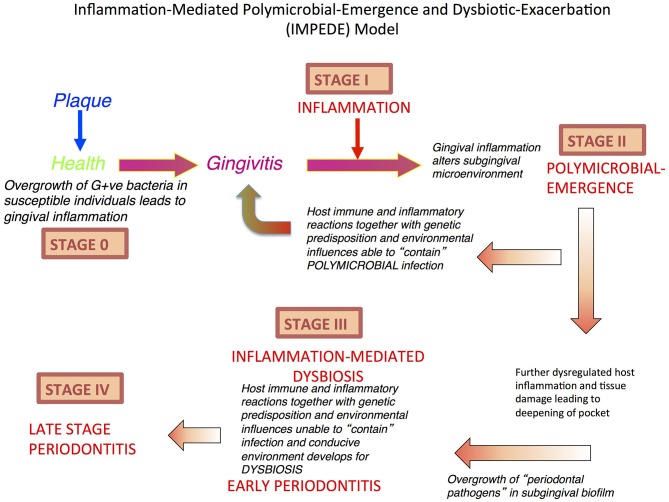
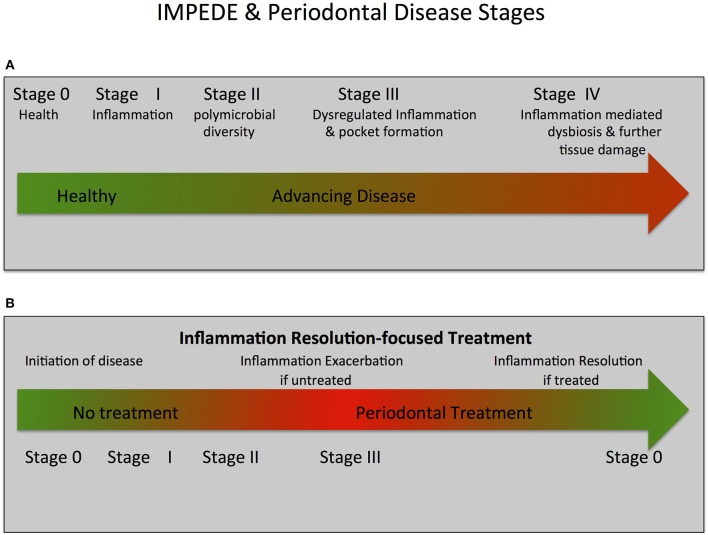
The nexus between periodontal inflammation and the polymicrobial biofilm in the gingival sulcus is critical to understanding the pathobiology of periodontitis. Both play a major role in the etiology and pathogenesis of periodontal diseases and each reinforces the other. However, this nexus is also at the center of a significant conundrum for periodontology. For all mucosal polymicrobial biofilms, the most confounding issue is the paradoxical relationship between inflammation, infection, and disease. Despite significant advances made in both periodontal microbiology and periodontal pathobiology, the issue of which comes first, the inflammatory response or the change to a dysbiotic subgingival microbiota, is still debated. In this paper, we present a model for the pathogenesis of periodontitis based on the central role of inflammation and how this modulates the polymicrobial biofilm within the context of the continuum of health, gingivitis, and periodontitis. We propose a new model termed "Inflammation-Mediated Polymicrobial-Emergence and Dysbiotic-Exacerbation" (IMPEDE), which is designed to integrate into and complement the 2017 World Workshop Classification of Periodontitis.
牙周炎的发病机制与龈沟内牙周炎多微生物生物膜之间存在关联,理解牙周炎的病理生物学特性至关重要。两者在牙周病的病因学和发病机制中都起着主要作用,并且相互加强。然而,这种关联也是牙周病学的一个重大难题的核心。对于所有的黏膜多微生物生物膜,最令人困惑的问题是炎症、感染和疾病之间的矛盾关系。尽管牙周微生物学和牙周病理生物学都取得了重大进展,但炎症反应还是微生物群落失调的龈下菌群改变先发生,这个问题仍存在争议。在本文中,我们提出了一个基于炎症的中心作用的牙周炎发病机制模型,以及这种作用如何在健康、牙龈炎和牙周炎连续体的背景下调节多微生物生物膜。我们提出了一个新的模型,称为“炎症介导的多微生物出现和生态失调恶化”(IMPEDE),旨在整合并补充 2017 年牙周炎世界工作分类。