Papaspyropoulos Angelos, Tsolaki Magdalini, Foroglou Nicolas, Pantazaki Anastasia A
Laboratory of Biochemistry, Department of Chemistry, Aristotle University of Thessaloniki, Thessaloniki, Greece.
1st Department of Neurology, AHEPA University Hospital, Thessaloniki, Greece.
Front Pharmacol. 2020 Mar 31;11:396. doi: 10.3389/fphar.2020.00396. eCollection 2020.
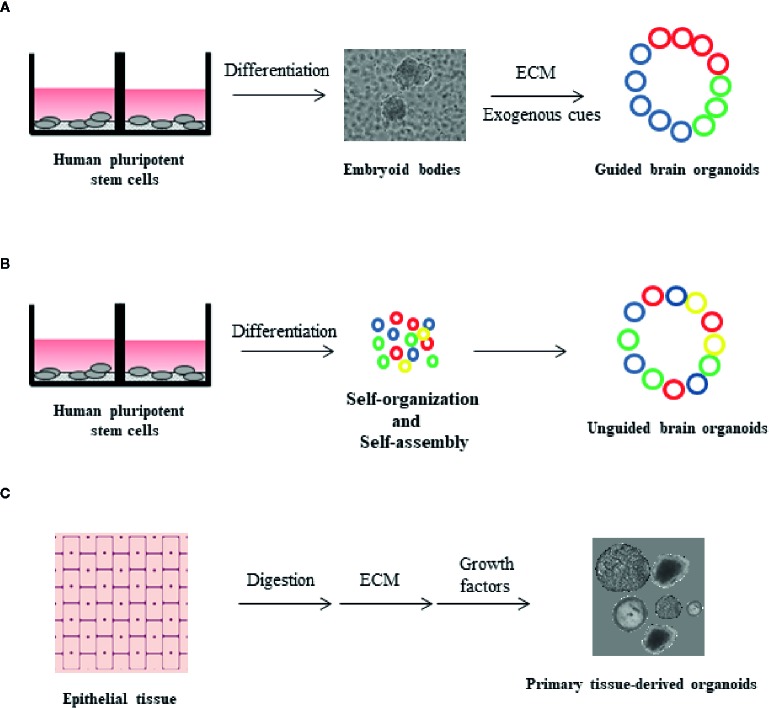
Human neurodegenerative diseases, such as Alzheimer's disease (AD), are not easily modeled due to the inaccessibility of brain tissue and the level of complexity required by existing cell culture systems. Three-dimensional (3D) brain organoid systems generated from human pluripotent stem cells (hPSCs) have demonstrated considerable potential in recapitulating key features of AD pathophysiology, such as amyloid plaque- and neurofibrillary tangle-like structures. A number of AD brain organoid models have also been used as platforms to assess the efficacy of pharmacological agents in disease progression. However, despite the fact that stem cell-derived brain organoids mimic early aspects of brain development, they fail to model complex cell-cell interactions pertaining to different regions of the human brain and aspects of natural processes such as cell differentiation and aging. Here, we review current advances and limitations accompanying several hPSC-derived organoid methodologies, as well as recent attempts to utilize them as therapeutic platforms. We additionally discuss comparative benefits and disadvantages of the various hPSC-derived organoid generation protocols and differentiation strategies. Lastly, we provide a comparison of hPSC-derived organoids to primary tissue-derived organoids, examining the future potential and advantages of both systems in modeling neurodegenerative disorders, especially AD.
人类神经退行性疾病,如阿尔茨海默病(AD),由于脑组织难以获取以及现有细胞培养系统所需的复杂程度,不容易建立模型。由人类多能干细胞(hPSC)生成的三维(3D)脑类器官系统在重现AD病理生理学的关键特征方面已展现出相当大的潜力,如淀粉样斑块和神经原纤维缠结样结构。许多AD脑类器官模型也已被用作评估药物制剂对疾病进展疗效的平台。然而,尽管干细胞衍生的脑类器官模拟了大脑发育的早期方面,但它们无法模拟与人类大脑不同区域相关的复杂细胞间相互作用以及诸如细胞分化和衰老等自然过程的方面。在这里,我们综述了几种hPSC衍生类器官方法的当前进展和局限性,以及最近将它们用作治疗平台的尝试。我们还讨论了各种hPSC衍生类器官生成方案和分化策略的相对优缺点。最后,我们将hPSC衍生的类器官与原代组织衍生的类器官进行了比较,探讨了这两种系统在模拟神经退行性疾病,尤其是AD方面的未来潜力和优势。