Department of Psychology, Norwegian University of Science and Technology, Trondheim, Norway.
Department of Physical Medicine and Rehabilitation, St. Olavs Hospital, Trondheim University Hospital, Trondheim, Norway.
Sleep. 2020 Oct 13;43(10). doi: 10.1093/sleep/zsaa078.
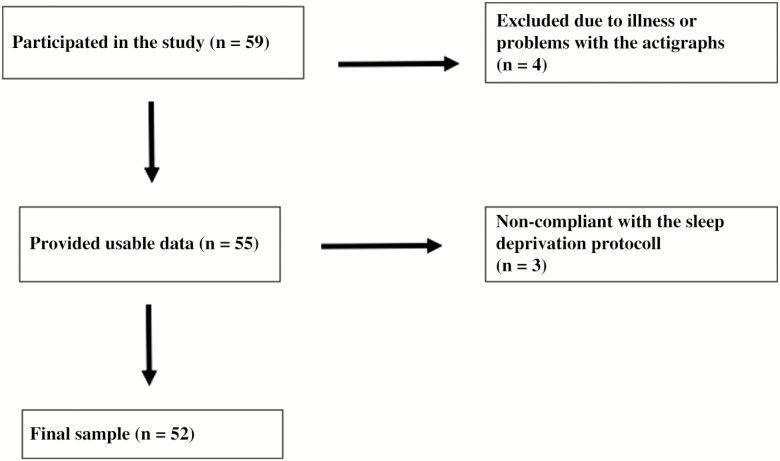
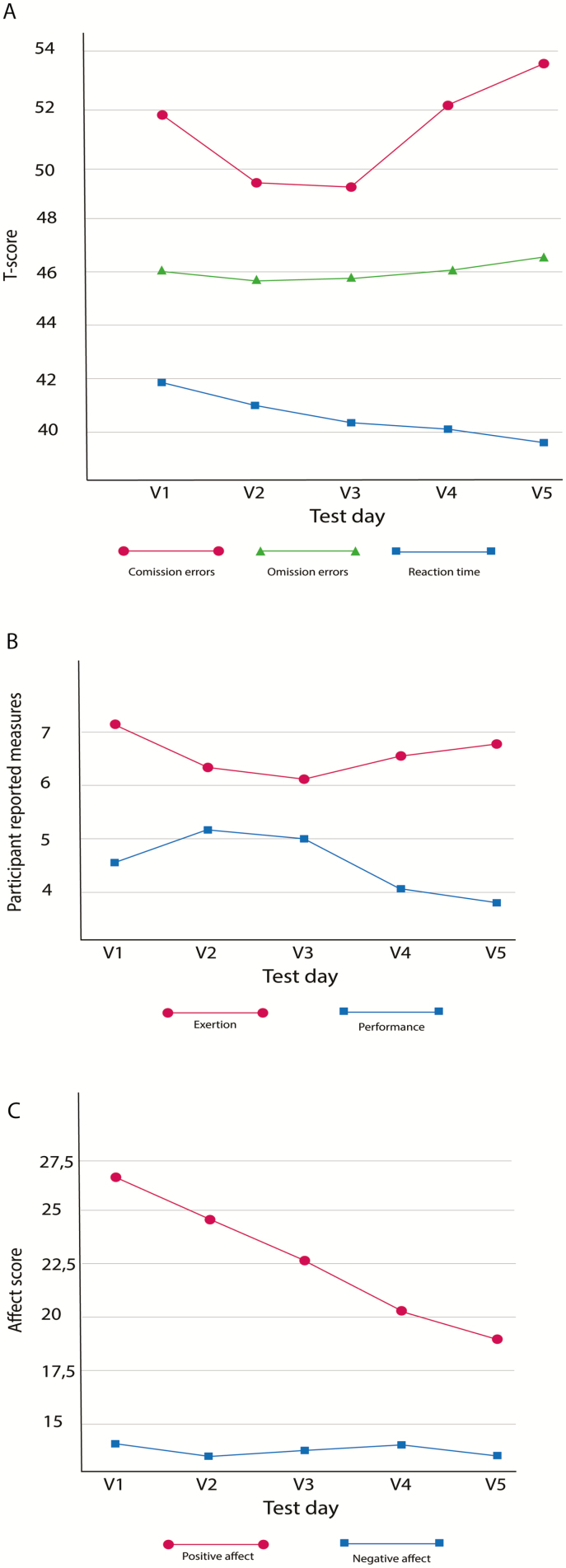
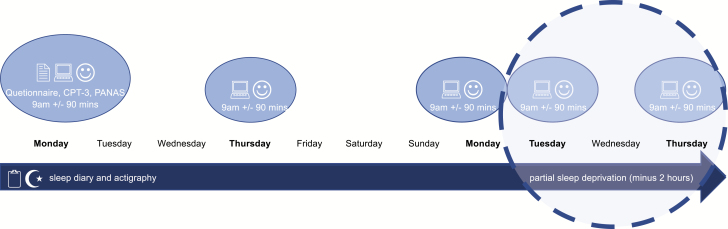
The effects of mild-moderate partial sleep deprivation on affective and cognitive functioning were evaluated in a naturalistic home environment, mimicking short sleep typically caused by demands from work or society. A total of 52 healthy individuals aged 18-35 was included in an 11-day study protocol. Participants slept at home, and sleep patterns were observed using actigraphs and sleep diaries. After maintaining habitual sleep for 7 days, the participants were asked to sleep 2 hours less than their average sleep duration for the last three nights of the study protocol. A not-X continuous performance test was administered at 9 am (± 90 minutes) on days 1, 4, 8 (habitual sleep), 9 and 11 (sleep deprivation). Performance-based measures included response accuracy and speed. Participant-reported measures included how well the participants felt they performed and how exhausted they were from taking the test, as well as positive and negative affect. There was a significant change in reaction time, number of commission errors, subjective performance, subjective exertion, and positive affect across the visits. Specifically, there was a linear decrease in reaction time, performance, and positive affect throughout the study, and a significant quadratic trend for commissions and exertion (first decreasing, then increasing after sleep deprivation). The univariate tests for omissions and negative affect were not significant. We conclude that sleeping 1.5-2 hours less than usual leads to faster response speed, but more commission errors and decreased positive affect. This indicates that individuals become more impulsive and experience less positive affect after a period of short sleep.
在自然的家庭环境中评估了轻度至中度部分睡眠剥夺对情感和认知功能的影响,模拟了由于工作或社会需求而导致的典型短暂睡眠。共有 52 名年龄在 18-35 岁的健康个体纳入了为期 11 天的研究方案。参与者在家中睡觉,并使用活动记录仪和睡眠日记观察睡眠模式。在保持习惯睡眠 7 天后,要求参与者在研究方案的最后三晚比他们的平均睡眠时间少睡 2 小时。在第 1、4、8 天(习惯睡眠)、9 和 11 天(睡眠剥夺)的上午 9 点(±90 分钟)进行非-X 连续表现测试。基于表现的测量包括反应准确性和速度。参与者报告的测量包括他们感觉自己的表现如何以及参加测试时的疲劳程度,以及积极和消极的影响。在整个访问过程中,反应时间、错误数量、主观表现、主观用力和积极影响都发生了显著变化。具体来说,在整个研究过程中,反应时间、表现和积极影响呈线性下降,而错误和用力呈二次趋势(睡眠剥夺后先下降后增加)。对遗漏和消极影响的单变量检验没有显著意义。我们得出结论,比平时少睡 1.5-2 小时会导致反应速度更快,但错误更多,积极影响降低。这表明,在短时间睡眠后,个体变得更加冲动,体验到的积极情绪减少。