Khan Asmat Ullah, Qu Rongmei, Ouyang Jun, Dai Jingxing
Guangdong Provincial Key Laboratory of Medical Biomechanics, Department of Anatomy, School of Basic Medical Science, Southern Medical University, Guangzhou, China.
Front Physiol. 2020 Apr 3;11:239. doi: 10.3389/fphys.2020.00239. eCollection 2020.
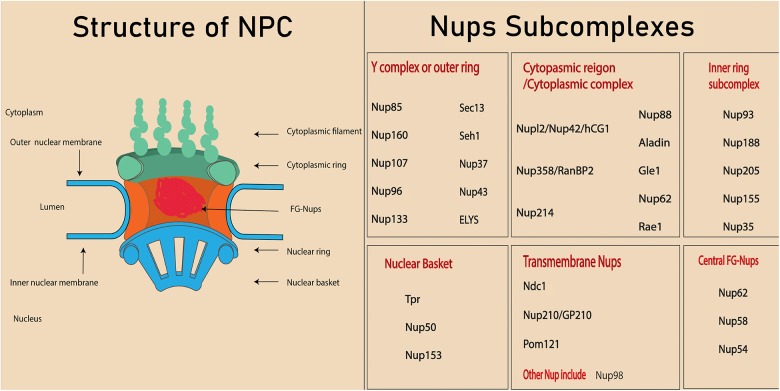
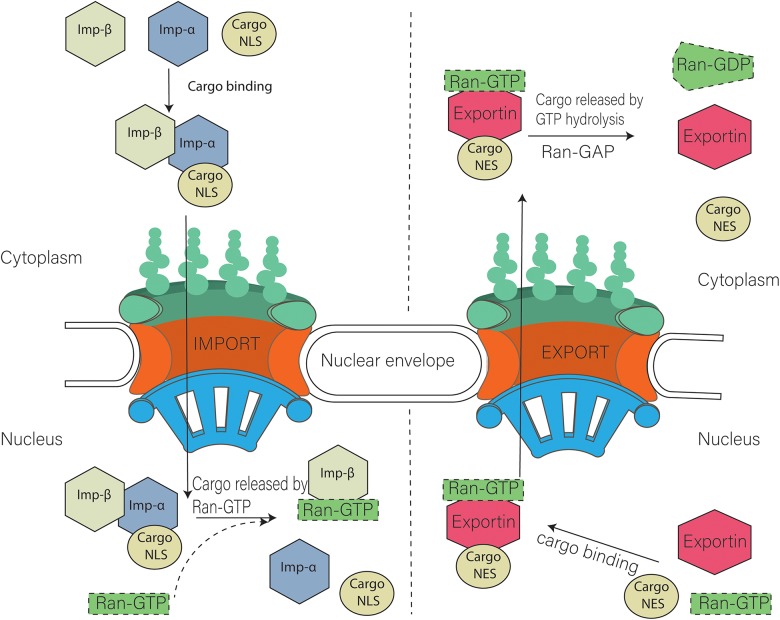
Bidirectional molecular movements between the nucleus and cytoplasm take place through nuclear pore complexes (NPCs) embedded in the nuclear membrane. These macromolecular structures are composed of several nucleoporins, which form seven different subcomplexes based on their biochemical affinity. These nucleoporins are integral components of the complex, not only allowing passive transport but also interacting with importin, exportin, and other molecules that are required for transport of protein in various cellular processes. Transport of different proteins is carried out either dependently or independently on transport receptors. As well as facilitating nucleocytoplasmic transport, nucleoporins also play an important role in cell differentiation, possibly by their direct gene interaction. This review will cover the general role of nucleoporins (whether its dependent or independent) and nucleocytoplasmic transport receptors in cell differentiation.
细胞核与细胞质之间的双向分子运动通过嵌入核膜的核孔复合体(NPC)进行。这些大分子结构由几种核孔蛋白组成,它们根据生化亲和力形成七种不同的亚复合体。这些核孔蛋白是复合体的组成部分,不仅允许被动运输,还与输入蛋白、输出蛋白以及各种细胞过程中蛋白质运输所需的其他分子相互作用。不同蛋白质的运输要么依赖于运输受体,要么独立于运输受体进行。除了促进核质运输外,核孔蛋白还可能通过其直接的基因相互作用在细胞分化中发挥重要作用。本综述将涵盖核孔蛋白(无论其是否依赖)和核质运输受体在细胞分化中的一般作用。