Pham Tam T, Ivaska Kaisa K, Hannukainen Jarna C, Virtanen Kirsi A, Lidell Martin E, Enerbäck Sven, Mäkelä Keijo, Parkkola Riitta, Piirola Sauli, Oikonen Vesa, Nuutila Pirjo, Kiviranta Riku
Turku PET Centre, University of Turku, Turku, Finland.
Institute of Biomedicine, University of Turku, Turku, Finland.
J Clin Endocrinol Metab. 2020 Jul 1;105(7):2300-10. doi: 10.1210/clinem/dgaa216.
Bone marrow (BM) in adult long bones is rich in adipose tissue, but the functions of BM adipocytes are largely unknown. We set out to elucidate the metabolic and molecular characteristics of BM adipose tissue (BMAT) in humans.
Our aim was to determine if BMAT is an insulin-sensitive tissue, and whether the insulin sensitivity is altered in obesity or type 2 diabetes (T2DM).
This was a cross-sectional and longitudinal study.
The study was conducted in a clinical research center.
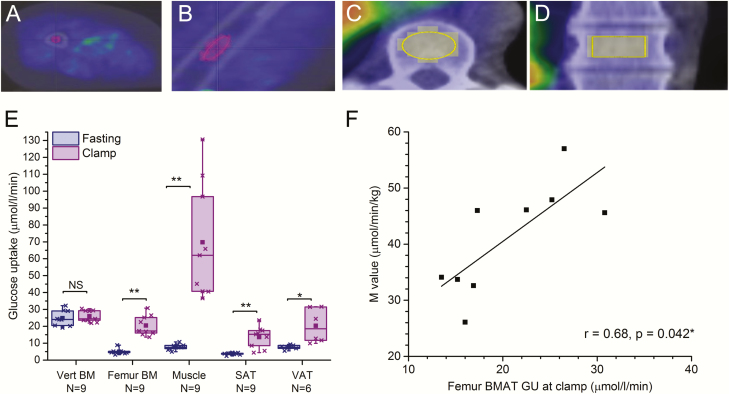
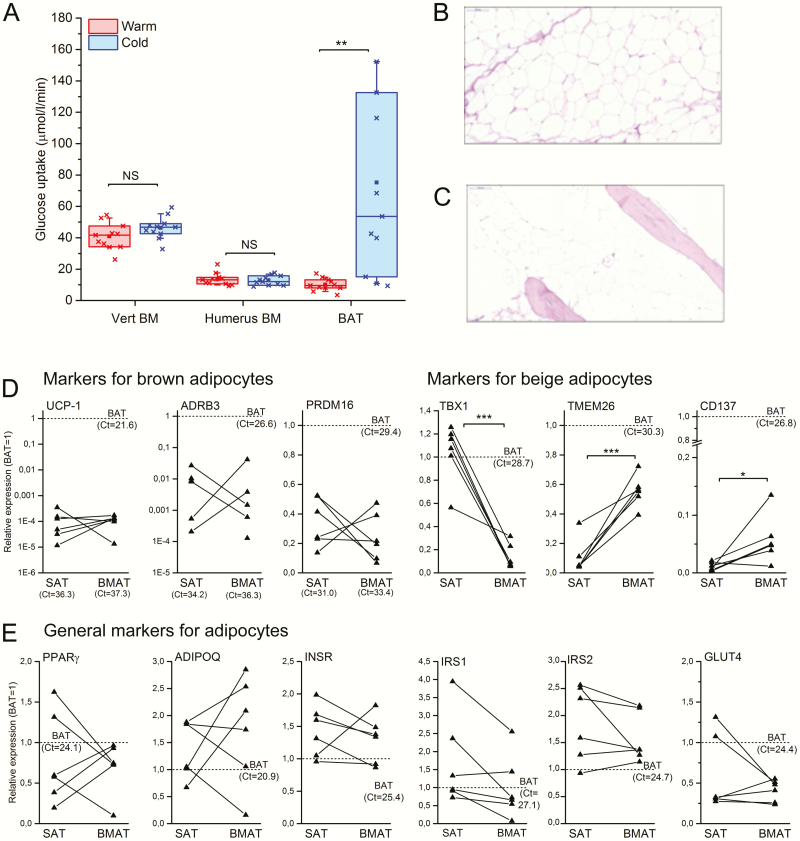
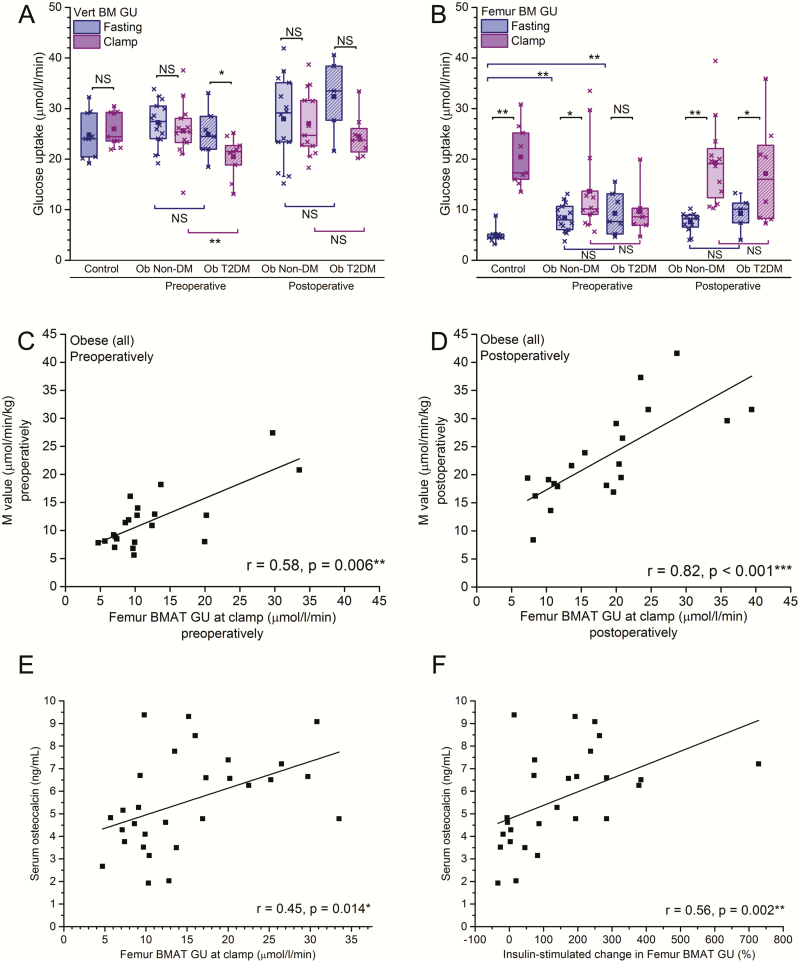
Bone marrow adipose tissue glucose uptake (GU) was assessed in 23 morbidly obese subjects (9 with T2DM) and 9 healthy controls with normal body weight. In addition, GU was assessed in another 11 controls during cold exposure. Bone marrow adipose tissue samples for molecular analyses were collected from non-DM patients undergoing knee arthroplasty.
INTERVENTION(S): Obese subjects were assessed before and 6 months after bariatric surgery and controls at 1 time point.
We used positron emission tomography imaging with 2-[18F]fluoro-2-deoxy-D-glucose tracer to characterize GU in femoral and vertebral BMAT. Bone marrow adipose tissue molecular profile was assessed using quantitative RT-PCR.
Insulin enhances GU in human BMAT. Femoral BMAT insulin sensitivity was impaired in obese patients with T2DM compared to controls, but it improved after bariatric surgery. Furthermore, gene expression analysis revealed that BMAT was distinct from brown and white adipose tissue.
Bone marrow adipose tissue is a metabolically active, insulin-sensitive and molecularly distinct fat depot that may play a role in whole body energy metabolism.
成年长骨中的骨髓富含脂肪组织,但骨髓脂肪细胞的功能在很大程度上尚不清楚。我们着手阐明人类骨髓脂肪组织(BMAT)的代谢和分子特征。
我们的目的是确定BMAT是否为胰岛素敏感组织,以及肥胖或2型糖尿病(T2DM)时胰岛素敏感性是否改变。
这是一项横断面和纵向研究。
该研究在临床研究中心进行。
评估了23例病态肥胖受试者(9例患有T2DM)和9例体重正常的健康对照者的骨髓脂肪组织葡萄糖摄取(GU)。此外,在寒冷暴露期间评估了另外11例对照者的GU。从接受膝关节置换术的非糖尿病患者中收集用于分子分析的骨髓脂肪组织样本。
对肥胖受试者在减肥手术前和术后6个月进行评估,对对照者在1个时间点进行评估。
我们使用2-[18F]氟-2-脱氧-D-葡萄糖示踪剂的正电子发射断层扫描成像来表征股骨和椎骨BMAT中的GU。使用定量RT-PCR评估骨髓脂肪组织分子谱。
胰岛素增强人类BMAT中的GU。与对照组相比,患有T2DM的肥胖患者的股骨BMAT胰岛素敏感性受损,但减肥手术后有所改善。此外,基因表达分析显示BMAT与棕色和白色脂肪组织不同。
骨髓脂肪组织是一种代谢活跃、胰岛素敏感且分子特征独特的脂肪库,可能在全身能量代谢中发挥作用。