Mendoza Carlos I, Reguera David
Instituto de Investigaciones en Materiales, Universidad Nacional Autónoma de México, México, Mexico.
Departament de Física de la Matèria Condensada, Universitat de Barcelona, Barcelona, Spain.
Elife. 2020 Apr 21;9:e52525. doi: 10.7554/eLife.52525.
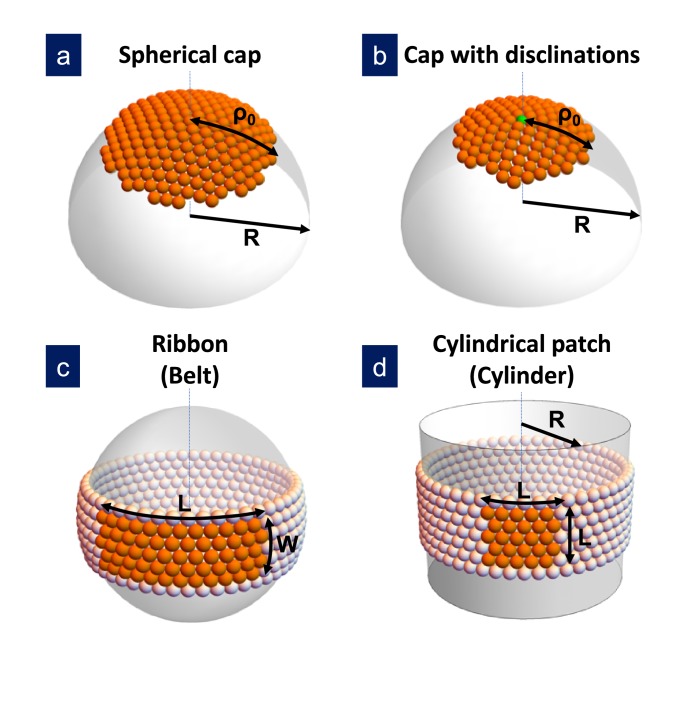
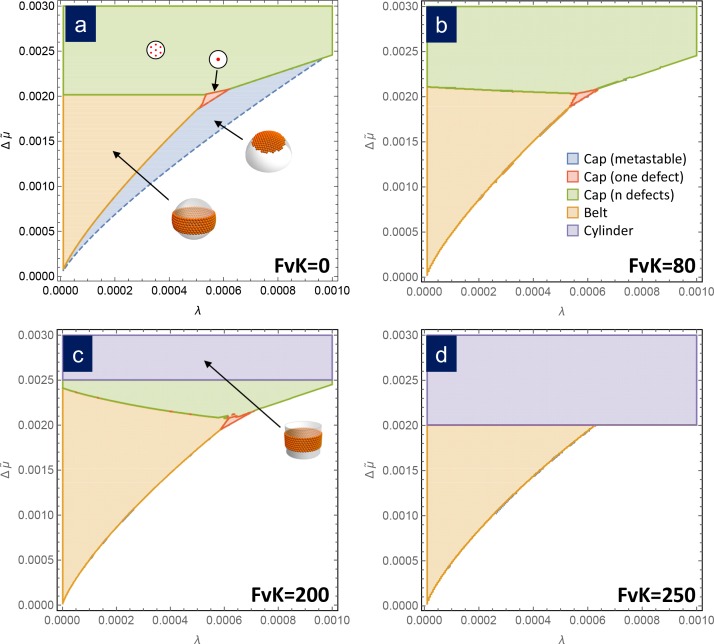
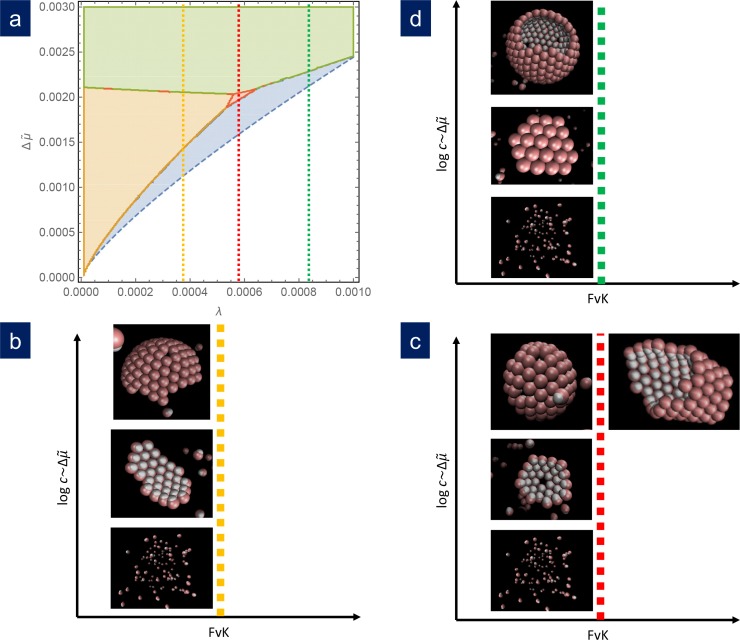
The successful assembly of a closed protein shell (or capsid) is a key step in the replication of viruses and in the production of artificial viral cages for bio/nanotechnological applications. During self-assembly, the favorable binding energy competes with the energetic cost of the growing edge and the elastic stresses generated due to the curvature of the capsid. As a result, incomplete structures such as open caps, cylindrical or ribbon-shaped shells may emerge, preventing the successful replication of viruses. Using elasticity theory and coarse-grained simulations, we analyze the conditions required for these processes to occur and their significance for empty virus self-assembly. We find that the outcome of the assembly can be recast into a universal phase diagram showing that viruses with high mechanical resistance cannot be self-assembled directly as spherical structures. The results of our study justify the need of a maturation step and suggest promising routes to hinder viral infections by inducing mis-assembly.
封闭蛋白壳(或衣壳)的成功组装是病毒复制以及用于生物/纳米技术应用的人工病毒笼生产中的关键步骤。在自组装过程中,有利的结合能与生长边缘的能量成本以及由于衣壳曲率产生的弹性应力相互竞争。结果,可能会出现诸如开放衣壳、圆柱形或带状壳等不完整结构,从而阻碍病毒的成功复制。利用弹性理论和粗粒度模拟,我们分析了这些过程发生所需的条件及其对空病毒自组装的意义。我们发现,组装的结果可以重铸为一个通用相图,表明具有高机械抗性的病毒不能直接自组装成球形结构。我们的研究结果证明了成熟步骤的必要性,并提出了通过诱导错误组装来阻碍病毒感染的有前景的途径。