Department of Laboratory Medicine, Zhongnan Hospital of Wuhan University, Wuhan, China.
Department of Laboratory Medicine, Union Hospital, Tongji Medical College, Huazhong University of Science and Technology, Wuhan, China.
Metabolism. 2020 Jun;107:154243. doi: 10.1016/j.metabol.2020.154243. Epub 2020 Apr 19.
The pandemic of coronavirus disease 2019 (COVID-19) has become a global threat to public health. The lipid pathophysiology in COVID-19 is unknown.
In this retrospective longitudinal study, we monitored the serum lipids in 17 surviving and 4 non-surviving COVID-19 cases prior to their viral infections and duration the entire disease courses.
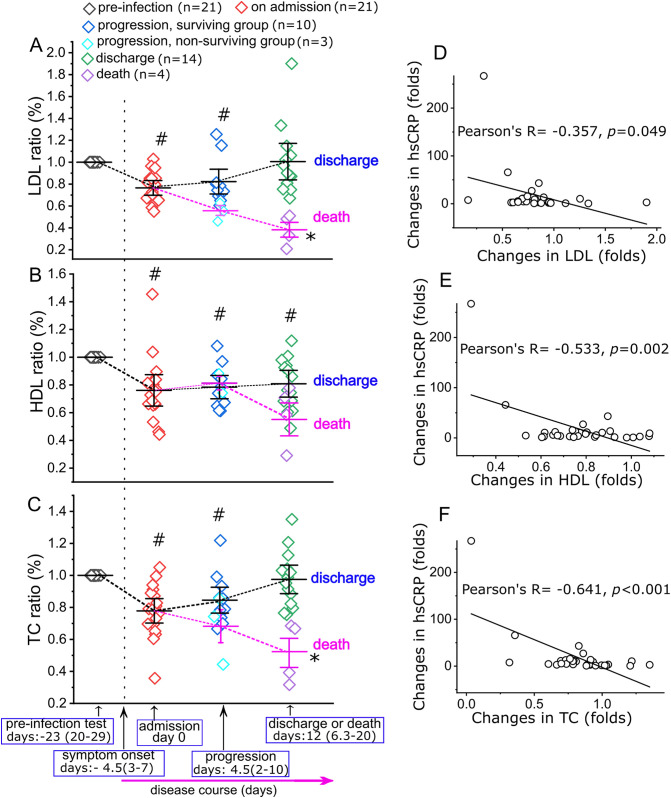
In surviving cases, the low-density lipoprotein (LDL) levels decreased significantly on admission as compared with the levels before infection; the LDL levels remained constantly low during the disease progression and resumed to the original levels when patients recovered (pre-infection: 3.5 (3.0-4.4); on admission: 2.8 (2.3-3.1), p < 0.01; progression: 2.5 (2.3-3.0); discharge: 3.6 (2.7-4.1); median (IQR), in mmol/L). In non-surviving patients, LDL levels showed an irreversible and continuous decrease until death (1.1 (0.9-1.2), p = 0.02 versus the levels on admission). The ratio changes of LDL levels inversely correlated with ratio changes of high-sensitivity C-reactive protein levels. Logistic regression analysis showed increasing odds of lowered LDL levels associated with disease progression (odds ratio: 4.48, 95% IC: 1.55-12.92, p = 0.006) and in-hospital death (odds ratio: 21.72, 95% IC: 1.40-337.54, p = 0.028).
LDL levels inversely correlated to disease severities, which could be a predictor for disease progress and poor prognosis.
2019 年冠状病毒病(COVID-19)大流行已成为全球公共卫生的威胁。COVID-19 的脂质病理生理学尚不清楚。
在这项回顾性纵向研究中,我们监测了 17 例幸存和 4 例非幸存 COVID-19 病例在病毒感染之前和整个疾病过程中的血清脂质。
在幸存病例中,与感染前相比,入院时的低密度脂蛋白(LDL)水平显着降低;在疾病进展过程中,LDL 水平持续较低,当患者康复时恢复到原始水平(感染前:3.5(3.0-4.4);入院时:2.8(2.3-3.1),p <0.01;进展时:2.5(2.3-3.0);出院时:3.6(2.7-4.1);中位数(IQR),mmol/L)。在非存活患者中,LDL 水平呈不可逆和持续下降,直至死亡(1.1(0.9-1.2),p = 0.02 与入院时的水平相比)。LDL 水平的比值变化与高敏 C 反应蛋白水平的比值变化呈负相关。逻辑回归分析显示,LDL 水平降低与疾病进展(优势比:4.48,95%置信区间:1.55-12.92,p = 0.006)和住院期间死亡(优势比:21.72,95%置信区间:1.40-337.54,p = 0.028)相关的几率增加。
LDL 水平与疾病严重程度呈负相关,这可能是疾病进展和预后不良的预测指标。