Department of Family Medicine, Faculty of Medicine, Ramathibodi Hospital, Mahidol University, Praram VI Road, Rachathevee, Bangkok 10400, Thailand.
Department of Clinical Epidemiology and Biostatistics, Ramathibodi Hospital, Mahidol University, Praram VI Road, Rachathevee, Bangkok 10400, Thailand.
Nutrients. 2020 Apr 15;12(4):1088. doi: 10.3390/nu12041088.
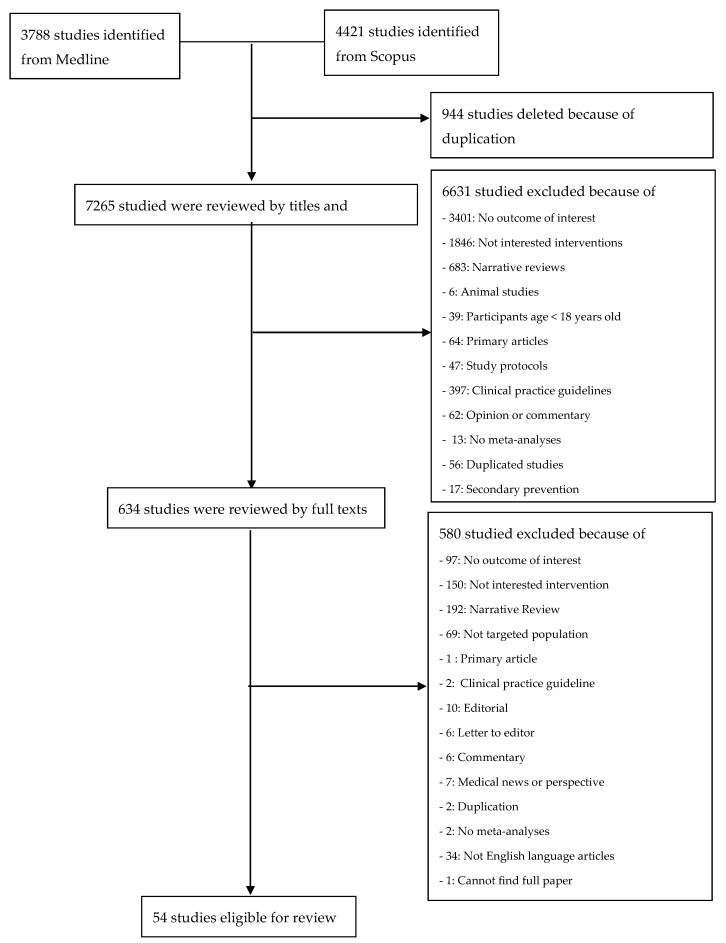
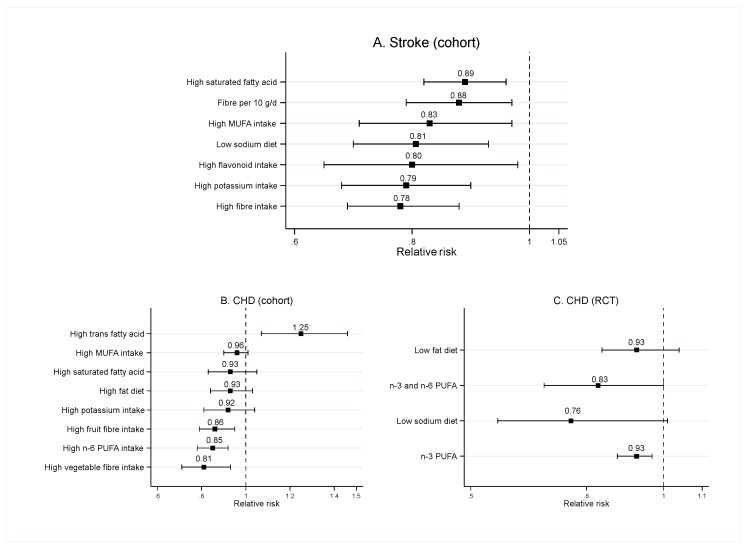
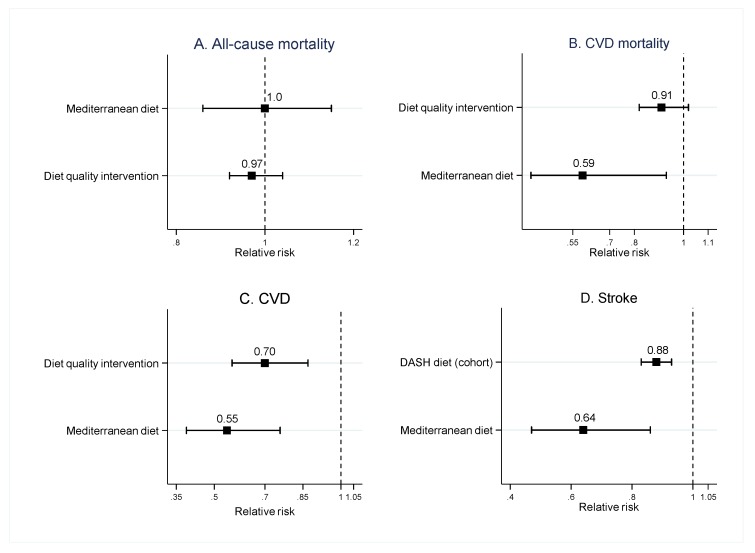
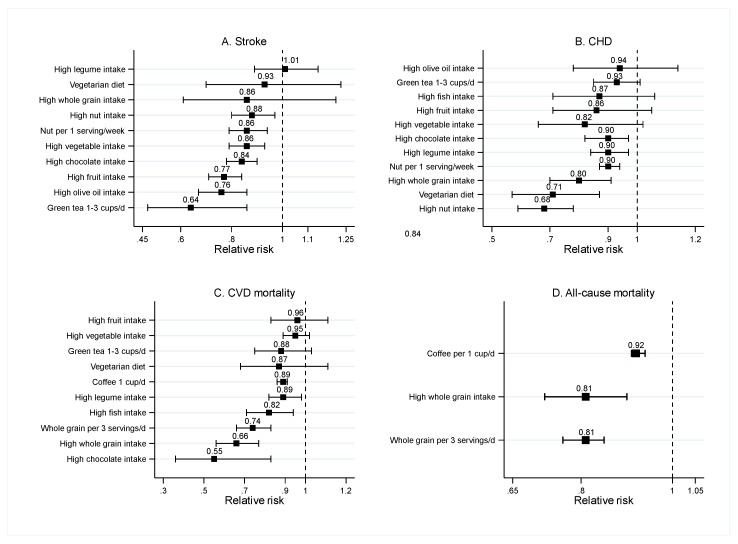
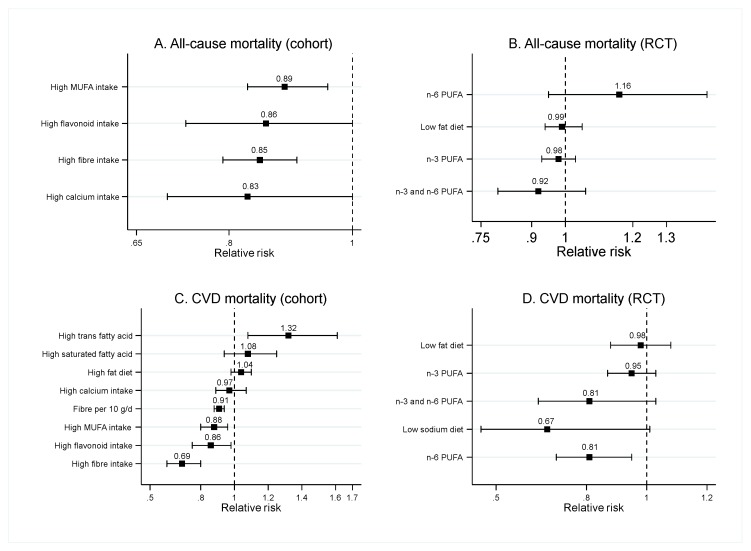
Unhealthy diet is a significant risk factor for cardiovascular diseases (CVD). Therefore, this umbrella review aims to comprehensively review the effects of dietary factors, including dietary patterns, food groups, and nutrients on CVD risks. Medline and Scopus databases were searched through March 2020. Systematic reviews with meta-analyses (SRMA) of randomized controlled trials (RCTs) or observational studies measuring the effects of dietary factors on CVD risks were eligible. Fifty-four SRMAs, including 35 SRMAs of observational studies, 10 SRMAs of RCTs, and 9 SRMAs of combined RCT and observational studies, were included for review. Findings from the SRMAs of RCTs suggest the significant benefit of Mediterranean and high-quality diets for lowering CVD risk, with pooled risk ratios (RRs) ranging from 0.55 (95%CI: 0.39-0.76) to 0.64 (95%CI: 0.53-0.79) and 0.70 (95%CI: 0.57-0.87), respectively. For food nutrients, two SRMAs of RCTs found that high intake of n-3 polyunsaturated fatty acid (PUFA) significantly reduced CVD risks, with pooled RRs ranging from 0.89 (95%CI: 0.82, 0.98) to 0.90 (95%CI: 0.85-0.96), while evidence of efficacy of n-6 PUFA and combined n-3 and n-6 PUFA were inconsistent. Moreover, results from the SRMAs of RCTs did not find a significant benefit of a low-salt diet and low total fat intake for CVD prevention. For food groups, results from the SRMAs of cohort studies suggest that high intakes of legumes, nuts, and chocolate, as well as a vegetarian diet significantly reduced the risk of coronary heart disease, with pooled RRs of 0.90 (95%CI: 0.84-0.97), 0.68 (95%CI: 0.59-0.78), 0.90 (95%CI: 0.82-0.97), and 0.71 (95%CI: 0.57-0.87), respectively. Healthy dietary patterns had a significant benefit for CVD prevention. With the substitutional and synergistic interactions between different food groups and nutrients, dietary recommendations for CVD prevention should be focused more on healthy dietary patterns than single food groups or nutrients.
不健康的饮食是心血管疾病 (CVD) 的一个重要危险因素。因此,本综述旨在全面评估饮食因素,包括饮食模式、食物组和营养素对 CVD 风险的影响。通过 Medline 和 Scopus 数据库检索截至 2020 年 3 月的系统评价和荟萃分析 (SRMA)。纳入了测量饮食因素对 CVD 风险影响的随机对照试验 (RCT) 或观察性研究的系统评价和荟萃分析。共纳入 54 项 SRMA,其中 35 项为观察性研究的 SRMA,10 项为 RCT 的 SRMA,9 项为 RCT 和观察性研究的 SRMA。RCT 的 SRMA 结果表明,地中海饮食和高质量饮食对降低 CVD 风险有显著益处,汇总风险比 (RR) 范围分别为 0.55 (95%CI: 0.39-0.76) 至 0.64 (95%CI: 0.53-0.79) 和 0.70 (95%CI: 0.57-0.87)。对于食物营养素,两项 RCT 的 SRMA 发现,高摄入 n-3 多不饱和脂肪酸 (PUFA) 可显著降低 CVD 风险,汇总 RR 范围分别为 0.89 (95%CI: 0.82, 0.98) 至 0.90 (95%CI: 0.85-0.96),而 n-6 PUFA 和 n-3 和 n-6 PUFA 联合的有效性证据不一致。此外,RCT 的 SRMA 结果并未发现低盐饮食和低总脂肪摄入对 CVD 预防有显著益处。对于食物组,队列研究的 SRMA 结果表明,大量摄入豆类、坚果和巧克力以及素食可显著降低冠心病风险,汇总 RR 分别为 0.90 (95%CI: 0.84-0.97)、0.68 (95%CI: 0.59-0.78)、0.90 (95%CI: 0.82-0.97)和 0.71 (95%CI: 0.57-0.87)。健康的饮食模式对 CVD 预防有显著益处。不同食物组和营养素之间存在替代和协同作用,因此 CVD 预防的饮食建议应更侧重于健康的饮食模式,而不是单一的食物组或营养素。