Piha-Paul Sarina A, Hann Christine L, French Christopher A, Cousin Sophie, Braña Irene, Cassier Phillippe A, Moreno Victor, de Bono Johann S, Harward Sara Duckworth, Ferron-Brady Geraldine, Barbash Olena, Wyce Anastasia, Wu Yuehui, Horner Thierry, Annan Meg, Parr Nigel J, Prinjha Rabinder K, Carpenter Christopher L, Hilton John, Hong David S, Haas Naomi B, Markowski Mark C, Dhar Arindam, O'Dwyer Peter J, Shapiro Geoffrey I
University of Texas MD Anderson Cancer Center, Houston, TX.
Johns Hopkins University School of Medicine, Baltimore, MD.
JNCI Cancer Spectr. 2019 Nov 6;4(2):pkz093. doi: 10.1093/jncics/pkz093. eCollection 2020 Apr.
Bromodomain and extra-terminal domain proteins are promising epigenetic anticancer drug targets. This first-in-human study evaluated the safety, recommended phase II dose, pharmacokinetics, pharmacodynamics, and preliminary antitumor activity of the bromodomain and extra-terminal domain inhibitor molibresib (GSK525762) in patients with nuclear protein in testis (NUT) carcinoma (NC) and other solid tumors.
This was a phase I and II, open-label, dose-escalation study. Molibresib was administered orally once daily. Single-patient dose escalation (from 2 mg/d) was conducted until the first instance of grade 2 or higher drug-related toxicity, followed by a 3 + 3 design. Pharmacokinetic parameters were obtained during weeks 1 and 3. Circulating monocyte chemoattractant protein-1 levels were measured as a pharmacodynamic biomarker.
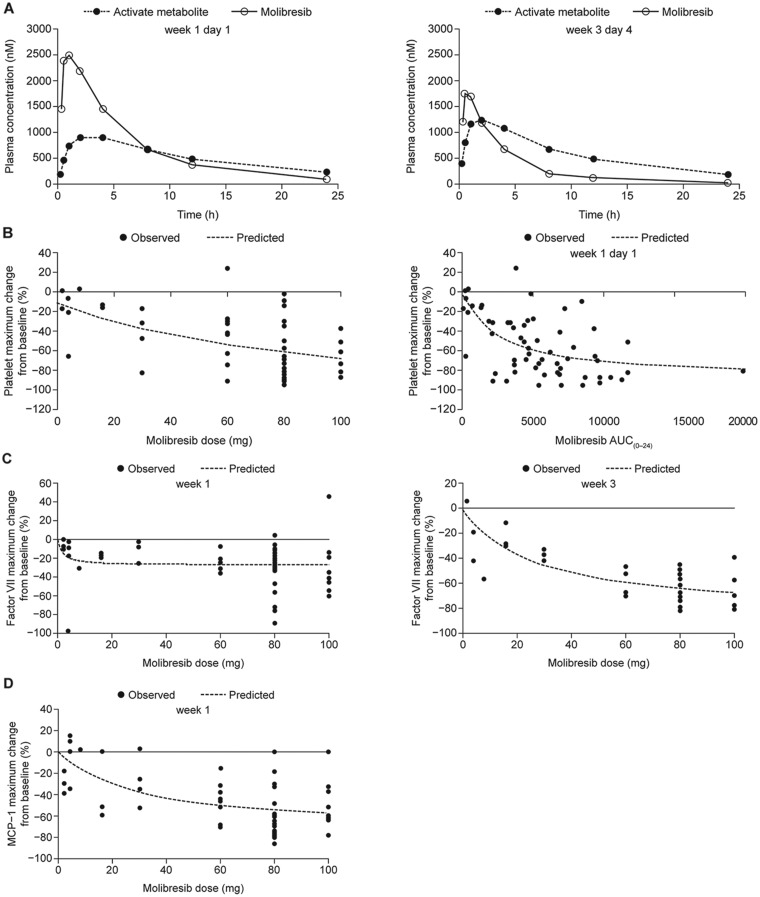
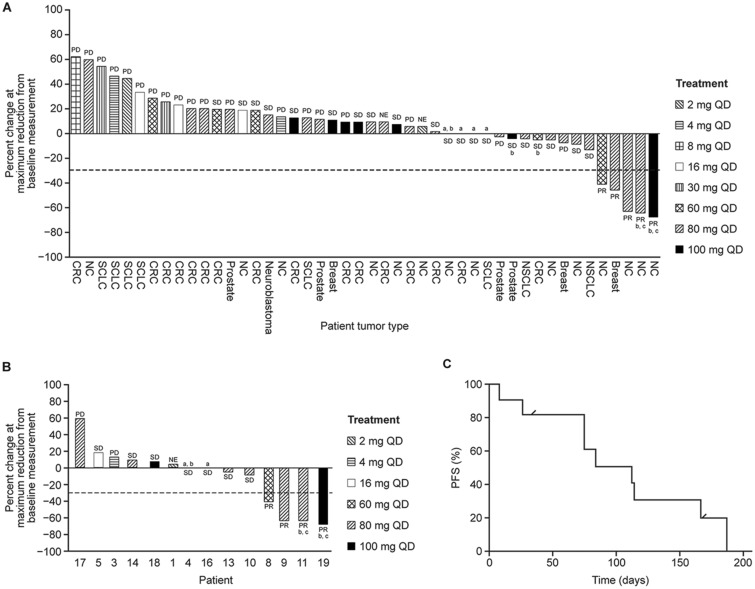
Sixty-five patients received molibresib. During dose escalation, 11% experienced dose-limiting toxicities, including six instances of grade 4 thrombocytopenia, all with molibresib 60-100 mg. The most frequent treatment-related adverse events of any grade were thrombocytopenia (51%) and gastrointestinal events, including nausea, vomiting, diarrhea, decreased appetite, and dysgeusia (22%-42%), anemia (22%), and fatigue (20%). Molibresib demonstrated an acceptable safety profile up to 100 mg; 80 mg once daily was selected as the recommended phase II dose. Following single and repeat dosing, molibresib showed rapid absorption and elimination (maximum plasma concentration: 2 hours; t: 3-7 hours). Dose-dependent reductions in circulating monocyte chemoattractant protein-1 levels were observed. Among 19 patients with NC, four achieved either confirmed or unconfirmed partial response, eight had stable disease as best response, and four were progression-free for more than 6 months.
Once-daily molibresib was tolerated at doses demonstrating target engagement. Preliminary data indicate proof-of-concept in NC.
溴结构域和额外末端结构域蛋白是很有前景的表观遗传抗癌药物靶点。这项首次人体研究评估了溴结构域和额外末端结构域抑制剂莫利西布(GSK525762)在睾丸核蛋白(NUT)癌(NC)和其他实体瘤患者中的安全性、推荐的II期剂量、药代动力学、药效学及初步抗肿瘤活性。
这是一项I期和II期开放标签剂量递增研究。莫利西布每日口服一次。进行单患者剂量递增(从2mg/d开始),直至出现首例2级或更高等级的药物相关毒性,随后采用3+3设计。在第1周和第3周获取药代动力学参数。测量循环单核细胞趋化蛋白-1水平作为药效学生物标志物。
65例患者接受了莫利西布治疗。在剂量递增期间,11%的患者出现剂量限制毒性,包括6例4级血小板减少症,均发生在莫利西布剂量为60-100mg时。任何等级最常见的治疗相关不良事件为血小板减少症(51%)和胃肠道事件,包括恶心、呕吐、腹泻、食欲减退和味觉障碍(22%-42%)、贫血(22%)和疲劳(20%)。莫利西布在高达100mg的剂量下显示出可接受的安全性;选择每日一次80mg作为推荐的II期剂量。单次和重复给药后,莫利西布显示出快速吸收和消除(最大血浆浓度:2小时;半衰期:3-7小时)。观察到循环单核细胞趋化蛋白-1水平呈剂量依赖性降低。在19例NC患者中,4例达到确认或未确认的部分缓解,8例最佳反应为病情稳定,4例无进展超过6个月。
每日一次的莫利西布在显示靶点作用的剂量下耐受性良好。初步数据表明在NC中有概念验证。