MRC Cognition and Brain Sciences Unit, University of Cambridge, Cambridge, UK.
King Fahad Medical City, Riyadh, Saudi Arabia.
Brain. 2020 May 1;143(5):1541-1554. doi: 10.1093/brain/awaa074.
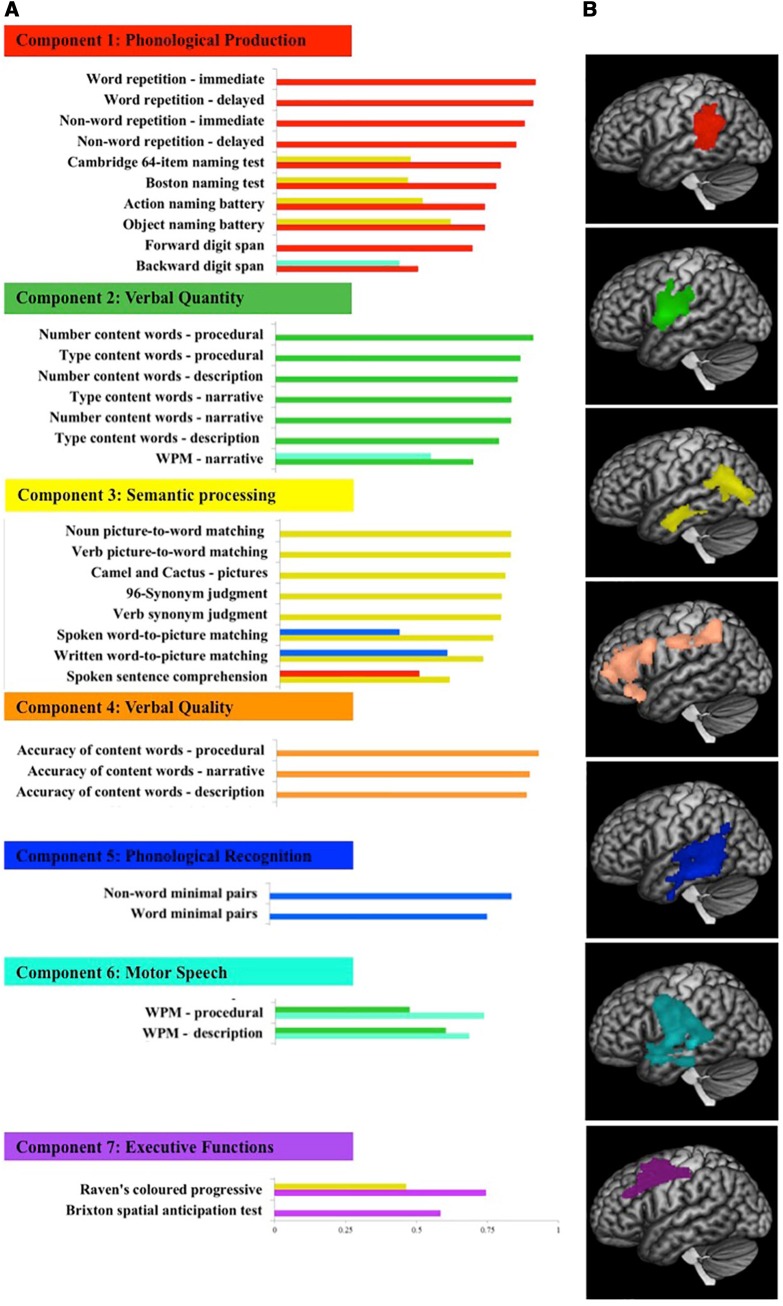
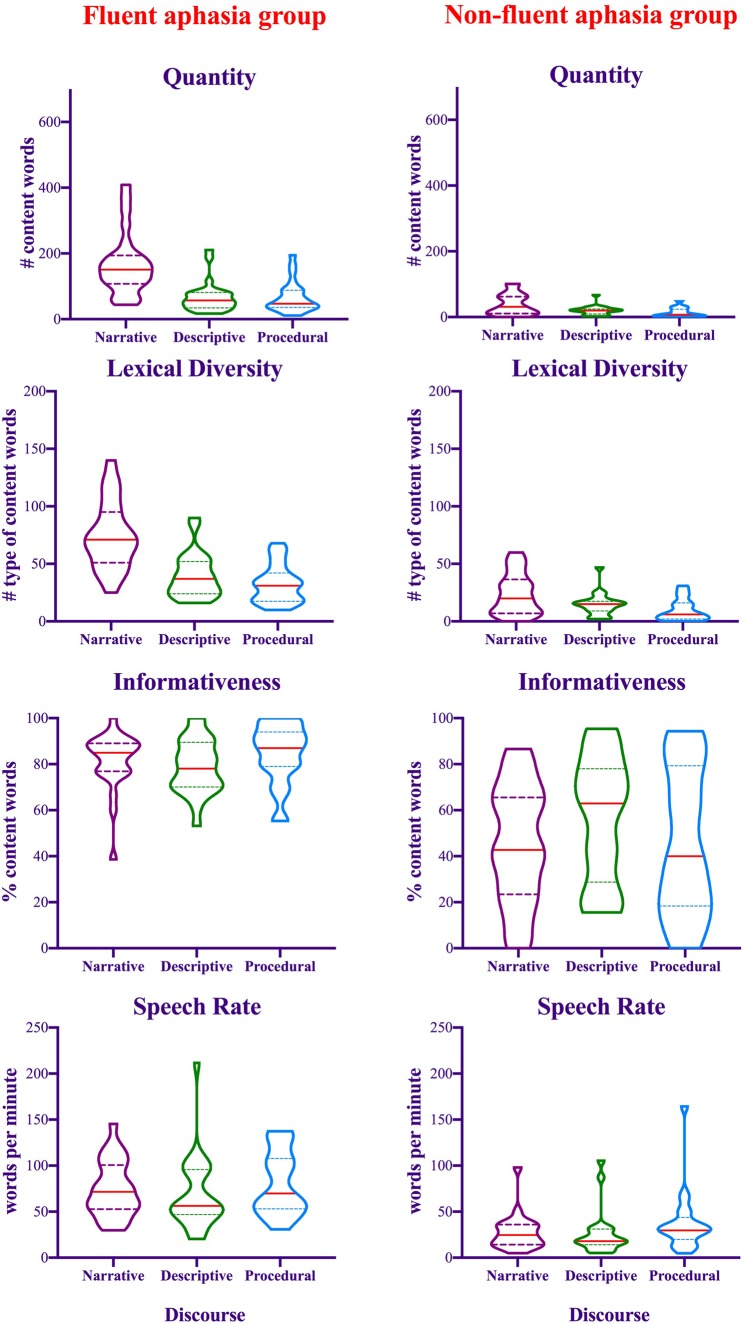
The clinical profiles of individuals with post-stroke aphasia demonstrate considerable variation in the presentation of symptoms. Recent aphasiological studies have attempted to account for this individual variability using a multivariate data-driven approach (principal component analysis) on an extensive neuropsychological and aphasiological battery, to identify fundamental domains of post-stroke aphasia. These domains mainly reflect phonology, semantics and fluency; however, these studies did not account for variability in response to different forms of connected speech, i.e. discourse genres. In the current study, we initially examined differences in the quantity, diversity and informativeness between three different discourse genres, including a simple descriptive genre and two naturalistic forms of connected speech (storytelling narrative, and procedural discourse). Subsequently, we provided the first quantitative investigation on the multidimensionality of connected speech production at both behavioural and neural levels. Connected speech samples across descriptive, narrative, and procedural discourse genres were collected from 46 patients with chronic post-stroke aphasia and 20 neurotypical adults. Content analyses conducted on all connected speech samples indicated that performance differed across discourse genres and between groups. Specifically, storytelling narratives provided higher quantities of content words and lexical diversity compared to composite picture description and procedural discourse. The analyses further revealed that, relative to neurotypical adults, patients with aphasia, both fluent and non-fluent, showed reduction in the quantity of verbal production, lexical diversity, and informativeness across all discourses. Given the differences across the discourses, we submitted the connected speech metrics to principal component analysis alongside an extensive neuropsychological/aphasiological battery that assesses a wide range of language and cognitive skills. In contrast to previous research, three unique orthogonal connected speech components were extracted in a unified model, reflecting verbal quantity, verbal quality, and motor speech, alongside four core language and cognitive components: phonological production, semantic processing, phonological recognition, and executive functions. Voxel-wise lesion-symptom mapping using these components provided evidence on the involvement of widespread cortical regions and their white matter connections. Specifically, left frontal regions and their underlying white matter tracts corresponding to the frontal aslant tract and the anterior segment of the arcuate fasciculus were particularly engaged with the quantity and quality of fluent connected speech production while controlling for other co-factors. The neural correlates associated with the other language domains align with existing models on the ventral and dorsal pathways for language processing.

脑卒中后失语症患者的临床特征在症状表现上存在很大差异。最近的失语症研究试图通过对广泛的神经心理学和失语症测试进行多元数据驱动方法(主成分分析)来解释这种个体差异,以确定脑卒中后失语症的基本领域。这些领域主要反映了语音、语义和流畅性;然而,这些研究并没有考虑到对不同形式的连贯言语的反应的可变性,即话语类型。在本研究中,我们首先检查了三种不同话语类型之间的数量、多样性和信息量的差异,包括一种简单的描述性类型和两种自然的连贯言语形式(叙事故事和程序话语)。随后,我们在行为和神经水平上首次对连贯言语产生的多维性进行了定量研究。我们从 46 名慢性脑卒中后失语症患者和 20 名神经典型成年人中收集了描述性、叙事性和程序性话语类型的连贯言语样本。对所有连贯言语样本进行的内容分析表明,不同话语类型和组间的表现存在差异。具体来说,与复合图片描述和程序话语相比,叙事故事提供了更多的内容词和词汇多样性。分析还表明,与神经典型成年人相比,无论是流利型还是非流利型失语症患者,在所有话语中言语产生的数量、词汇多样性和信息量都减少了。鉴于话语之间的差异,我们将连贯言语指标与广泛的神经心理学/失语症测试相结合,该测试评估了广泛的语言和认知技能。与之前的研究不同,在一个统一的模型中提取了三个独特的正交连贯言语成分,反映了言语数量、言语质量和运动言语,以及四个核心语言和认知成分:语音产生、语义处理、语音识别和执行功能。使用这些成分进行的基于体素的病变-症状映射提供了证据,表明广泛的皮质区域及其白质连接参与其中。具体来说,左侧额叶区域及其对应的白质束,包括额斜束和弓状束的前段,与流畅连贯言语产生的数量和质量特别相关,同时控制了其他共同因素。与其他语言领域相关的神经相关与语言处理的腹侧和背侧通路的现有模型一致。