University of Buckingham Medical School, Hunter Street, Buckingham, MK18 1EG, UK.
Department of Psychology, Manchester Metropolitan University, Brooks Building, 53 Bonsall Street, Manchester, M15 6GX, UK.
Syst Rev. 2020 Apr 24;9(1):91. doi: 10.1186/s13643-020-01311-y.
The importance of teaching the skills and practice of evidence-based medicine (EBM) for medical professionals has steadily grown in recent years. Alongside this growth is a need to evaluate the effectiveness of EBM curriculum as assessed by competency in the five 'A's': asking, acquiring, appraising, applying and assessing (impact and performance). EBM educators in medical education will benefit from a compendium of existing assessment tools for assessing EBM competencies in their settings. The purpose of this review is to provide a systematic review and taxonomy of validated tools that evaluate EBM teaching in medical education.
We searched MEDLINE, EMBASE, Cochrane library, Educational Resources Information Centre (ERIC), Best Evidence Medical Education (BEME) databases and references of retrieved articles published between January 2005 and March 2019. We have presented the identified tools along with their psychometric properties including validity, reliability and relevance to the five domains of EBM practice and dimensions of EBM learning. We also assessed the quality of the tools to identify high quality tools as those supported by established interrater reliability (if applicable), objective (non-self-reported) outcome measures and achieved ≥ 3 types of established validity evidence. We have reported our study in accordance with the PRISMA guidelines.
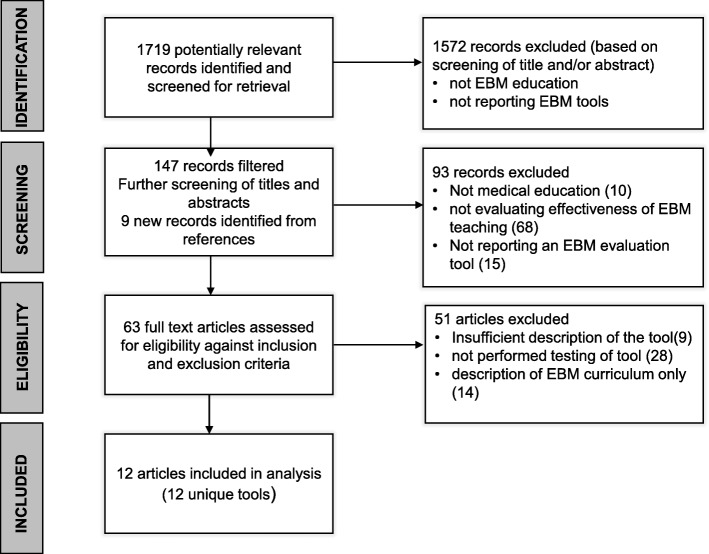
We identified 1719 potentially relevant articles of which 63 full text articles were assessed for eligibility against inclusion and exclusion criteria. Twelve articles each with a unique and newly identified tool were included in the final analysis. Of the twelve tools, all of them assessed the third step of EBM practice (appraise) and four assessed just that one step. None of the twelve tools assessed the last step of EBM practice (assess). Of the seven domains of EBM learning, ten tools assessed knowledge gain, nine assessed skills and-one assessed attitude. None addressed reaction to EBM teaching, self-efficacy, behaviours or patient benefit. Of the twelve tools identified, six were high quality. We have also provided a taxonomy of tools using the CREATE framework, for EBM teachers in medical education.
Six tools of reasonable validity are available for evaluating most steps of EBM and some domains of EBM learning. Further development and validation of tools that evaluate all the steps in EBM and all educational outcome domains are needed.
PROSPERO CRD42018116203.
近年来,医学专业人士掌握循证医学(EBM)技能和实践的重要性稳步增长。随着这一增长,需要评估 EBM 课程的有效性,评估方法是评估五项“A”(询问、获取、评估、应用和评估(影响和绩效))的能力。医学教育中的 EBM 教育者将从现有的评估工具综合集中受益,这些工具可用于评估其教学环境中的 EBM 能力。本研究的目的是提供一个系统的审查和分类法,以评估医学教育中 EBM 教学的已验证工具。
我们搜索了 MEDLINE、EMBASE、Cochrane 图书馆、教育资源信息中心(ERIC)、最佳循证医学教育(BEME)数据库以及 2005 年 1 月至 2019 年 3 月期间发表的检索文章的参考文献。我们介绍了这些工具及其心理测量特性,包括与 EBM 实践的五个领域和 EBM 学习的维度的有效性、可靠性和相关性。我们还评估了工具的质量,以确定高质量的工具,这些工具是由既定的组内信度(如果适用)、客观(非自我报告)结果衡量标准和至少三种已建立的有效性证据支持的。我们按照 PRISMA 指南报告了我们的研究。
我们确定了 1719 篇潜在相关文章,其中 63 篇全文文章根据纳入和排除标准进行了资格评估。最终分析中纳入了 12 篇每篇都有独特的新识别工具的文章。在这 12 个工具中,所有工具都评估了 EBM 实践的第三步(评估),其中 4 个工具仅评估了这一步。这 12 个工具都没有评估 EBM 实践的最后一步(评估)。在 EBM 学习的七个领域中,有 10 个工具评估了知识增益,9 个评估了技能,1 个评估了态度。没有一个涉及对 EBM 教学的反应、自我效能、行为或患者受益。在确定的 12 个工具中,有 6 个工具的质量较高。我们还使用 CREATE 框架为医学教育中的 EBM 教师提供了工具分类法。
有 6 种具有合理有效性的工具可用于评估 EBM 的大多数步骤和 EBM 学习的一些领域。需要进一步开发和验证可评估 EBM 所有步骤和所有教育结果领域的工具。
PROSPERO CRD42018116203。