Department of Biomedical Engineering, Case Western Reserve University, 10900 Euclid Avenue, Cleveland, OH, 44106, USA.
Louis Stokes Cleveland Veterans Affairs Medical Center, 10701 East Boulevard, Cleveland, OH, 44106, USA.
Sci Rep. 2020 Apr 24;10(1):6984. doi: 10.1038/s41598-020-63936-2.
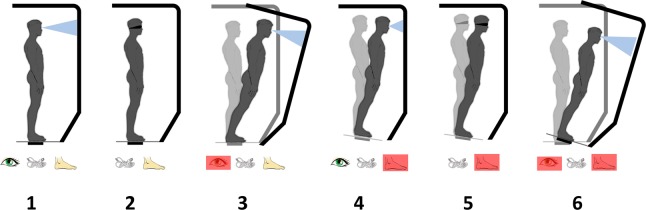
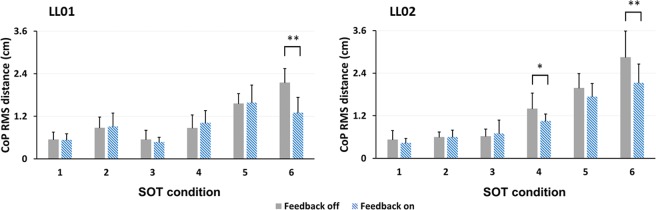
To maintain postural stability, unilateral lower-limb amputees (LLAs) heavily rely on visual and vestibular inputs, and somatosensory cues from their intact leg to compensate for missing somatosensory information from the amputated limb. When any of these resources are compromised, LLAs exhibit poor balance control compared to able-bodied individuals. We hypothesized that restoring somatosensation related to the missing limb via direct activation of the sensory nerves in the residuum would improve the standing stability of LLAs. We developed a closed-loop sensory neuroprosthesis utilizing non-penetrating multi-contact cuff electrodes implanted around the residual nerves to elicit perceptions of the location and intensity of plantar pressures under the prosthetic feet of two transtibial amputees. Effects of the sensory neuroprosthesis on balance were quantified with the Sensory Organization Test and other posturographic measures of sway. In both participants, the sensory neuroprosthesis improved equilibrium and sway when somatosensation from the intact leg and visual inputs were perturbed simultaneously. One participant also showed improvement with the sensory neuroprosthesis whenever somatosensation in the intact leg was compromised via perturbations of the platform. These observations suggest the sensory feedback elicited by neural stimulation can significantly improve the standing stability of LLAs, particularly when other sensory inputs are depleted or otherwise compromised.
为了维持姿势稳定,单侧下肢截肢者(LLAs)严重依赖视觉和前庭输入,以及来自健全肢体的本体感觉线索,以补偿截肢肢体缺失的本体感觉信息。当这些资源中的任何一个受到影响时,LLAs 的平衡控制能力就会比健全人差。我们假设,通过直接激活残肢中的感觉神经来恢复与缺失肢体相关的感觉,会改善 LLAs 的站立稳定性。我们开发了一种闭环感觉神经假体,利用植入残肢周围的非穿透多接触袖套电极来诱发出现在假肢脚下的足底压力的位置和强度的感觉。使用感觉组织测试和其他姿势描记术测量的摆动来定量感觉神经假体对平衡的影响。在两名经胫骨截肢者中,当同时干扰健全肢体的本体感觉和视觉输入时,感觉神经假体改善了平衡和摆动。当通过平台干扰健全肢体的本体感觉时,一名参与者也表现出感觉神经假体的改善。这些观察结果表明,神经刺激引起的感觉反馈可以显著改善 LLAs 的站立稳定性,特别是当其他感觉输入被耗尽或受到其他影响时。