Department of Clinical Pharmacy, Jinshan Hospital Affiliated to Fudan University, Shanghai, 201508, China.
Department of Clinical Pharmacy, Zhongshan Hospital Qingpu Branch Affiliated to Fudan University, Shanghai, 201799, China.
BMC Cardiovasc Disord. 2020 Apr 25;20(1):201. doi: 10.1186/s12872-020-01482-5.
Statin remains a mainstay in the prevention and treatment of cardiovascular diseases. Statin utilization has evolved over time in many countries, but data on this topic from China are quite limited. This study aimed to investigate the changing trends of statins prescription, as well as detail the statin utilization through a successive longitudinal study.
The prescription database was established based on electronic health records retrieved from the hospital information system of Jinshan Hospital, Fudan University from January 2012 to December 2018 in Shanghai, China. The prescription rates and proportions of different statin types and doses among all patients were examined. Sub-analyses were performed when stratifying the patients by age, gender, dose intensity, and preventative intervention.
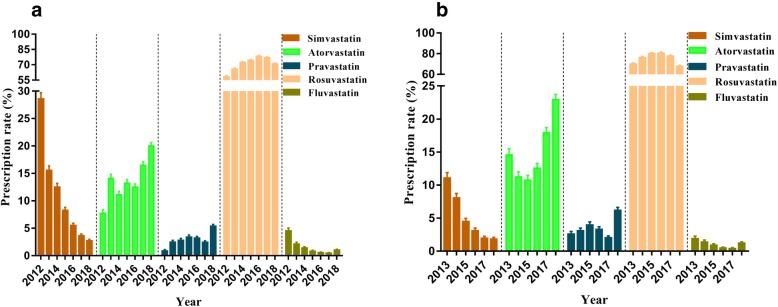
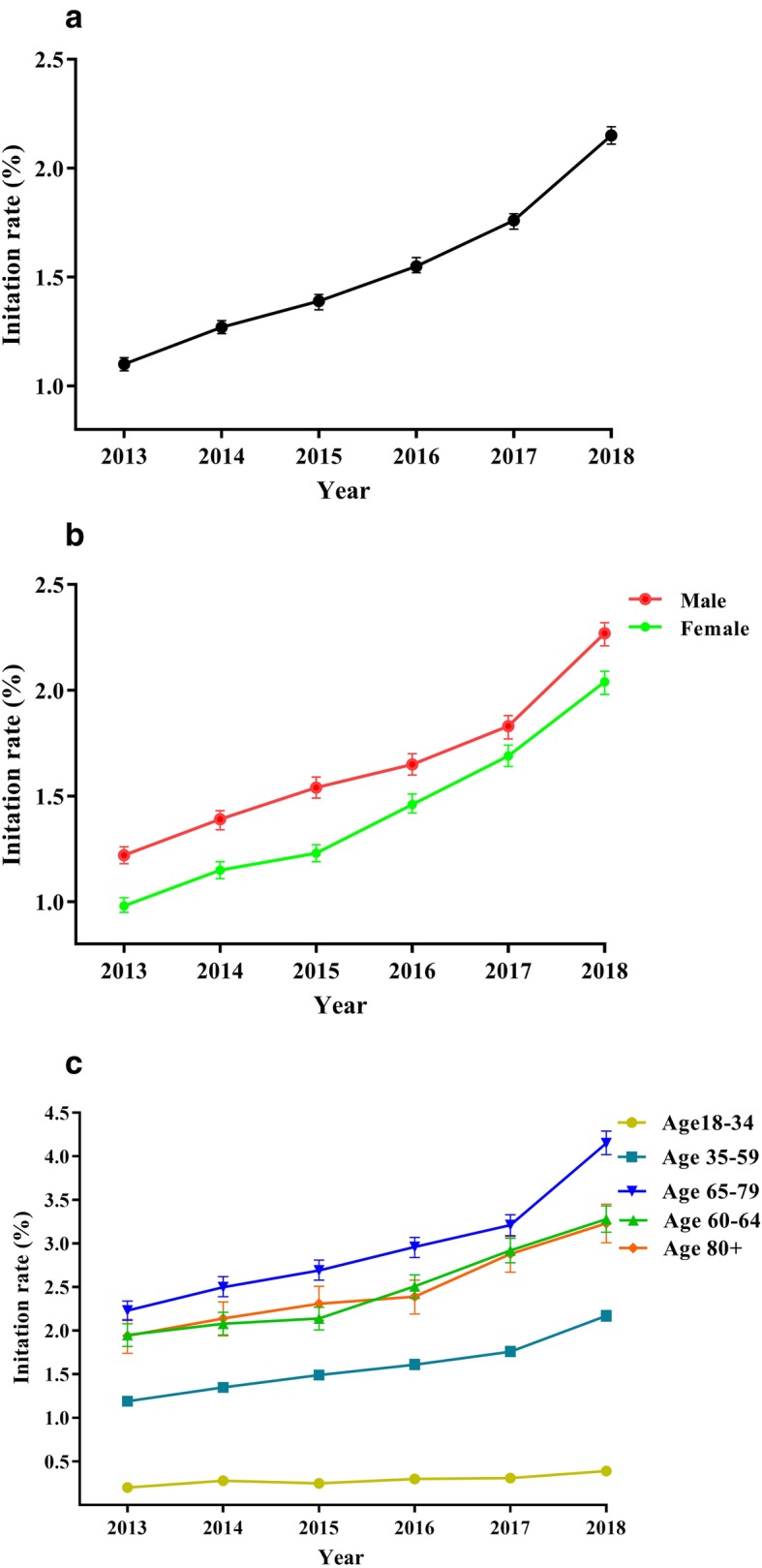
During the study period, a total of 51,083 patients, who were prescribed for statins, were included in this study (mean [SD] age, 59.78 [±13.16] years; 53.60% male, n = 27, 378). The overall statins prescription rate in which patients increased from 2012 (1.24, 95% CI: 1.21-1.27%) to 2018 (3.16, 95% CI: 3.11-3.20%), P < 0.001. Over 90% of patients were given a moderate dose of statins. Patients with a history of coronary and cerebrovascular events (over 32%) were more likely to be prescribed with statins for preventative intervention. Furthermore, our study has witnessed a significant rise in statin therapy in primary and secondary prevention.
In conclusion, statins were frequently prescribed and steadily increased over time in our study period. There were also changes in statin drug choices and dosages. A coordinated effort among the patient, clinical pharmacist, stakeholders and health system is still needed to improve statin utilization in clinical practice in the future.
他汀类药物仍然是预防和治疗心血管疾病的主要药物。在许多国家,他汀类药物的使用随着时间的推移而演变,但来自中国的这方面数据相当有限。本研究旨在调查他汀类药物处方的变化趋势,并通过连续的纵向研究详细了解他汀类药物的使用情况。
本研究基于复旦大学附属金山医院医院信息系统(HIS)从 2012 年 1 月至 2018 年 12 月在上海检索的电子健康记录建立了处方数据库。检查了所有患者中不同他汀类药物类型和剂量的处方率和比例。当按年龄、性别、剂量强度和预防干预对患者进行分层时,进行了亚分析。
在研究期间,共纳入 51083 名服用他汀类药物的患者(平均[SD]年龄,59.78[±13.16]岁;53.60%为男性,n=27378)。总体而言,服用他汀类药物的患者处方率从 2012 年(1.24,95%置信区间:1.21-1.27%)增加到 2018 年(3.16,95%置信区间:3.11-3.20%),P<0.001。超过 90%的患者接受了中等剂量的他汀类药物。有冠心病和脑血管事件史的患者(超过 32%)更有可能因预防干预而服用他汀类药物。此外,我们的研究还见证了他汀类药物治疗在一级和二级预防中的显著增加。
总之,在我们的研究期间,他汀类药物经常被开处方,并随着时间的推移而稳步增加。他汀类药物药物选择和剂量也发生了变化。未来仍需要患者、临床药师、利益相关者和卫生系统之间的协调努力,以改善临床实践中的他汀类药物利用。