Department of Microbiology, Queen Mary Hospital, Hong Kong Special Administrative Region, China; Infection Control Team, Queen Mary Hospital, Hong Kong West Cluster, Hong Kong Special Administrative Region, China.
Infection Control Team, Queen Mary Hospital, Hong Kong West Cluster, Hong Kong Special Administrative Region, China.
J Infect. 2020 Jul;81(1):107-114. doi: 10.1016/j.jinf.2020.04.024. Epub 2020 Apr 23.
Face mask usage by the healthy population in the community to reduce risk of transmission of respiratory viruses remains controversial. We assessed the effect of community-wide mask usage to control coronavirus disease 2019 (COVID-19) in Hong Kong Special Administrative Region (HKSAR).
Patients presenting with respiratory symptoms at outpatient clinics or hospital wards were screened for COVID-19 per protocol. Epidemiological analysis was performed for confirmed cases, especially persons acquiring COVID-19 during mask-off and mask-on settings. The incidence of COVID-19 per million population in HKSAR with community-wide masking was compared to that of non-mask-wearing countries which are comparable with HKSAR in terms of population density, healthcare system, BCG vaccination and social distancing measures but not community-wide masking. Compliance of face mask usage in the HKSAR community was monitored.
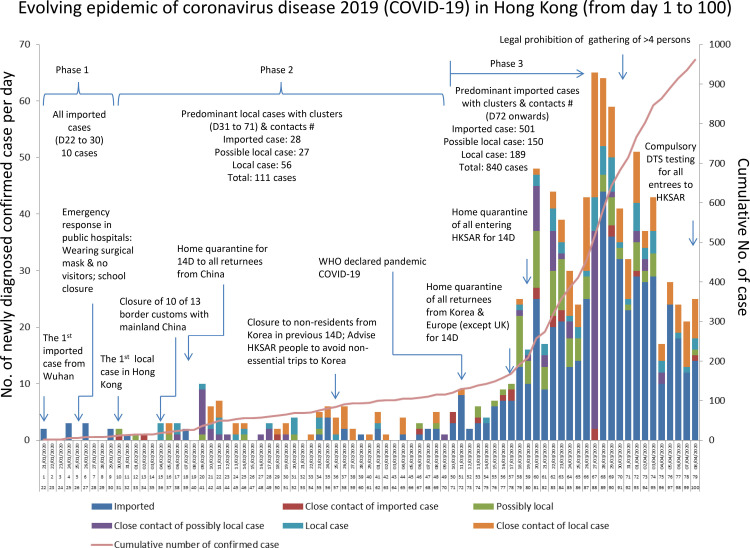
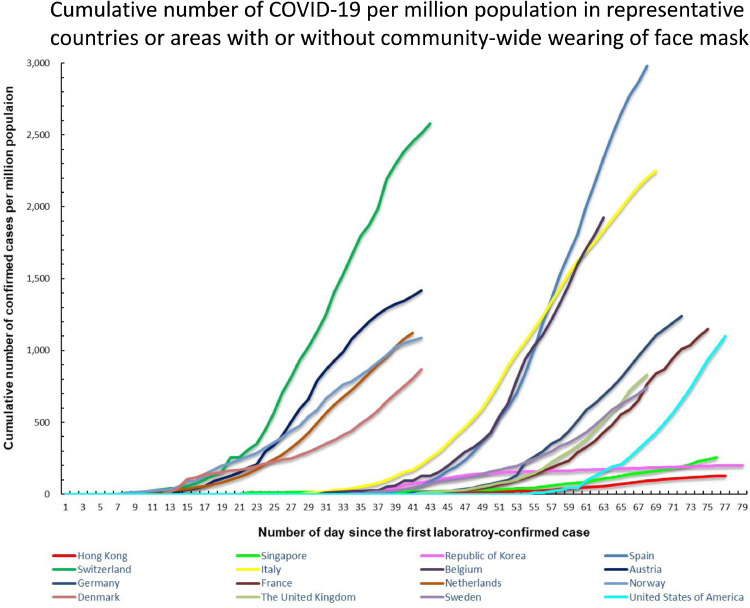
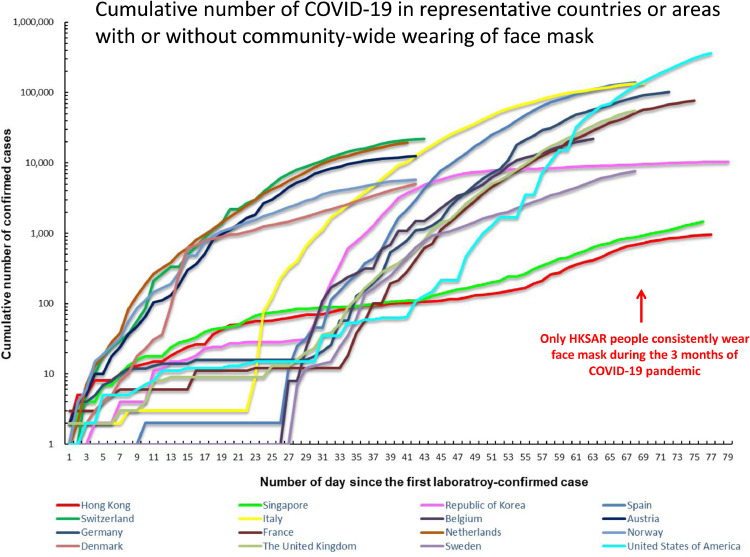
Within first 100 days (31 December 2019 to 8 April 2020), 961 COVID-19 patients were diagnosed in HKSAR. The COVID-19 incidence in HKSAR (129.0 per million population) was significantly lower (p<0.001) than that of Spain (2983.2), Italy (2250.8), Germany (1241.5), France (1151.6), U.S. (1102.8), U.K. (831.5), Singapore (259.8), and South Korea (200.5). The compliance of face mask usage by HKSAR general public was 96.6% (range: 95.7% to 97.2%). We observed 11 COVID-19 clusters in recreational 'mask-off' settings compared to only 3 in workplace 'mask-on' settings (p = 0.036 by Chi square test of goodness-of-fit).
Community-wide mask wearing may contribute to the control of COVID-19 by reducing the amount of emission of infected saliva and respiratory droplets from individuals with subclinical or mild COVID-19.
健康人群在社区中使用口罩以减少呼吸道病毒传播的风险仍然存在争议。我们评估了在香港特别行政区(香港特区)内全面使用口罩控制 2019 年冠状病毒病(COVID-19)的效果。
根据协议,在门诊或病房就诊的有呼吸道症状的患者均接受 COVID-19 的筛查。对确诊病例进行了流行病学分析,特别是在口罩摘下和戴口罩环境中感染 COVID-19 的人。与香港特区人口密度、医疗保健系统、卡介苗接种和社会隔离措施相当但不全面戴口罩的国家相比,香港特区全面戴口罩的情况下 COVID-19 的每百万人发病率。监测了香港特区社区内口罩使用的合规情况。
在最初的 100 天内(2019 年 12 月 31 日至 2020 年 4 月 8 日),香港特区共确诊 961 例 COVID-19 患者。香港特区的 COVID-19 发病率(每百万人 129.0 例)明显低于西班牙(2983.2 例)、意大利(2250.8 例)、德国(1241.5 例)、法国(1151.6 例)、美国(1102.8 例)、英国(831.5 例)、新加坡(259.8 例)和韩国(200.5 例)(p<0.001)。香港特区公众的口罩使用率为 96.6%(范围为 95.7%至 97.2%)。与工作场所“戴口罩”环境中仅发现 3 例相比,我们在娱乐性“口罩取下”环境中观察到 11 例 COVID-19 聚集性病例(卡方检验拟合优度,p=0.036)。
全面佩戴口罩可能通过减少有症状或轻症 COVID-19 患者呼出的受感染唾液和呼吸道飞沫的量,有助于控制 COVID-19。