Municipal Centre of Disease Control and Prevention of Qingdao, Qingdao Institute of Prevention Medicine, Qingdao, Shandong Province, China.
Department of Paediatrics, Faculty of Medicine, The Chinese University of Hong Kong, Hong Kong, China.
Sci Total Environ. 2020 Aug 1;728:138812. doi: 10.1016/j.scitotenv.2020.138812. Epub 2020 Apr 22.
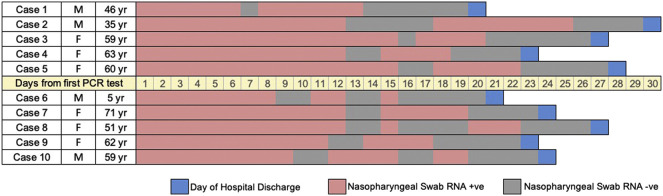
Factors associated with negative conversion of SARS-CoV-2 RNA in hospitalized patients have not yet been systematically determined. We conducted a retrospective cohort study of COVID-19 patients in Qingdao, China. Both univariate and multivariate analysis were performed to identify independent factors for time to viral RNA negative conversion. Data on patients with re-detectable viral RNA after showing negative on RT-PCR test (intermittent negative status) were also analyzed. A total of 59 patients confirmed with COVID-19 were included in this study, with a median duration of 1 (interquartile range, IQR: 0-2) day from symptom onset to hospital admission. Median communicable period (from first day of positive nucleic acid test to first day of consecutive negative results) was 14 (IQR: 10-18) days, and 7 (IQR: 6-10) days for 10 patients with intermittent negative results. Age older than 45 years (hazard ratio, HR: 0.378; 95% confidence interval, CI: 0.205-0.698) and chest tightness (HR: 0.290; 95%CI: 0.091-0.919) were factors independently affecting negative conversion of SARS-CoV-2 RNA. Headache (odds ratio: 7.553; 95%CI: 1.011-28.253) was significantly associated with intermittent negative status, with a predicted probability of 60%. Older age and chest tightness were independently associated with delayed clearance of SARS-CoV-2 RNA in hospitalized patients. These predictors would provide a new perspective on early identification of patients with prolonged viral shedding and facilitate optimal isolation protocols and treatment strategies.
与住院患者 SARS-CoV-2 RNA 阴转相关的因素尚未得到系统确定。我们在中国青岛开展了一项针对 COVID-19 患者的回顾性队列研究。采用单因素和多因素分析来确定病毒 RNA 阴转时间的独立影响因素。对 RT-PCR 检测结果呈阴性后再次检测到病毒 RNA(间歇性阴性状态)的患者数据也进行了分析。本研究共纳入 59 例确诊 COVID-19 患者,从发病到入院的中位时间为 1 天(四分位距:0-2 天)。中位传染期(从首次核酸检测阳性到连续 2 次阴性结果的第一天)为 14 天(四分位距:10-18 天),10 例间歇性阴性结果患者的传染期为 7 天(四分位距:6-10 天)。年龄大于 45 岁(风险比:0.378;95%置信区间:0.205-0.698)和胸闷(风险比:0.290;95%置信区间:0.091-0.919)是影响 SARS-CoV-2 RNA 阴转的独立因素。头痛(比值比:7.553;95%置信区间:1.011-28.253)与间歇性阴性状态显著相关,其预测概率为 60%。年龄较大和胸闷与住院患者 SARS-CoV-2 RNA 清除延迟独立相关。这些预测因素为早期识别病毒持续排出时间较长的患者提供了新视角,并有助于优化隔离方案和治疗策略。