Department of Translational Research and New Technologies in Medicine and Surgery, University of Pisa, Via Roma 55, 56126 Pisa, Italy.
I.R.C.C.S. Neuromed, Via Atinense 18, 86077 Pozzilli, Italy.
Int J Mol Sci. 2020 Apr 24;21(8):3028. doi: 10.3390/ijms21083028.
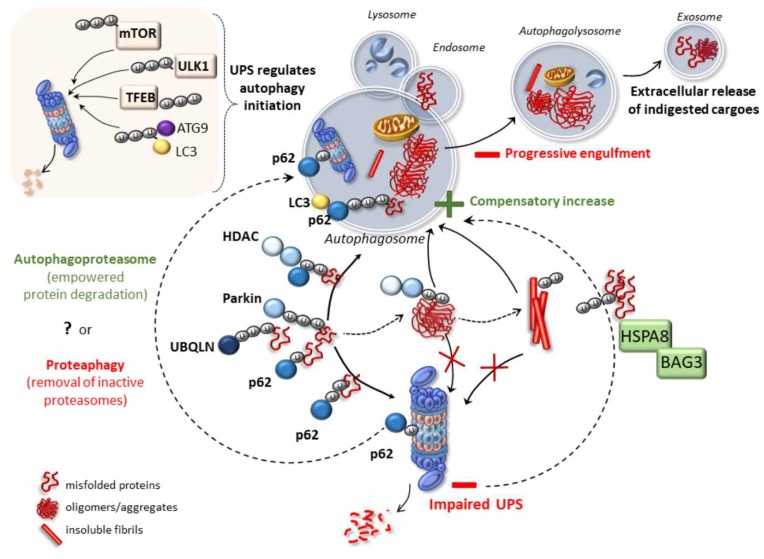
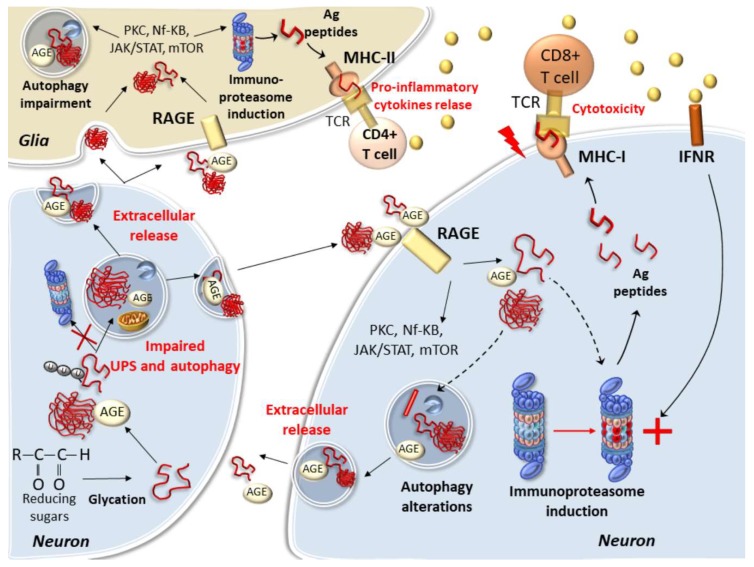
Alterations in autophagy and the ubiquitin proteasome system (UPS) are commonly implicated in protein aggregation and toxicity which manifest in a number of neurological disorders. In fact, both UPS and autophagy alterations are bound to the aggregation, spreading and toxicity of the so-called prionoid proteins, including alpha synuclein (α-syn), amyloid-beta (Aβ), tau, huntingtin, superoxide dismutase-1 (SOD-1), TAR-DNA-binding protein of 43 kDa (TDP-43) and fused in sarcoma (FUS). Recent biochemical and morphological studies add to this scenario, focusing on the coordinated, either synergistic or compensatory, interplay that occurs between autophagy and the UPS. In fact, a number of biochemical pathways such as mammalian target of rapamycin (mTOR), transcription factor EB (TFEB), Bcl2-associated athanogene 1/3 (BAG3/1) and glycogen synthase kinase beta (GSk3β), which are widely explored as potential targets in neurodegenerative proteinopathies, operate at the crossroad between autophagy and UPS. These biochemical steps are key in orchestrating the specificity and magnitude of the two degradation systems for effective protein homeostasis, while intermingling with intracellular secretory/trafficking and inflammatory pathways. The findings discussed in the present manuscript are supposed to add novel viewpoints which may further enrich our insight on the complex interactions occurring between cell-clearing systems, protein misfolding and propagation. Discovering novel mechanisms enabling a cross-talk between the UPS and autophagy is expected to provide novel potential molecular targets in proteinopathies.
自噬和泛素蛋白酶体系统 (UPS) 的改变通常与蛋白质聚集和毒性有关,这些改变在许多神经退行性疾病中表现出来。事实上,UPS 和自噬的改变都与所谓的朊病毒样蛋白的聚集、扩散和毒性有关,包括α-突触核蛋白 (α-syn)、淀粉样β (Aβ)、tau、亨廷顿蛋白、超氧化物歧化酶-1 (SOD-1)、TAR-DNA 结合蛋白 43 kDa (TDP-43) 和融合肉瘤蛋白 (FUS)。最近的生化和形态学研究对此进行了补充,重点关注自噬和 UPS 之间发生的协调、协同或补偿相互作用。事实上,许多生化途径,如哺乳动物雷帕霉素靶蛋白 (mTOR)、转录因子 EB (TFEB)、Bcl2 相关抗凋亡基因 1/3 (BAG3/1) 和糖原合酶激酶 β (GSk3β),作为神经退行性蛋白病的潜在靶点得到了广泛的研究,它们在自噬和 UPS 之间的交叉路口发挥作用。这些生化步骤是协调两个降解系统特异性和幅度的关键,以实现有效的蛋白质内稳态,同时与细胞内分泌/运输和炎症途径交织在一起。本文讨论的发现旨在增加新的观点,这些观点可能进一步丰富我们对细胞清除系统、蛋白质错误折叠和传播之间复杂相互作用的理解。发现允许 UPS 和自噬之间交叉对话的新机制,有望为蛋白病提供新的潜在分子靶点。