Division of Experimental Medicine, Department of Medicine, McGill University, Glen Site Pavilion E, 1001 Boulevard Decarie, Montreal, Quebec, H4A 3J1, Canada.
Centre for Translational Biology, Research Institute of McGill University Health Centre, Glen Site Pavilion E, 1001 Boulevard Decarie, Montreal, Quebec, H4A 3J1, Canada.
Biol Direct. 2020 Apr 28;15(1):8. doi: 10.1186/s13062-020-00260-9.
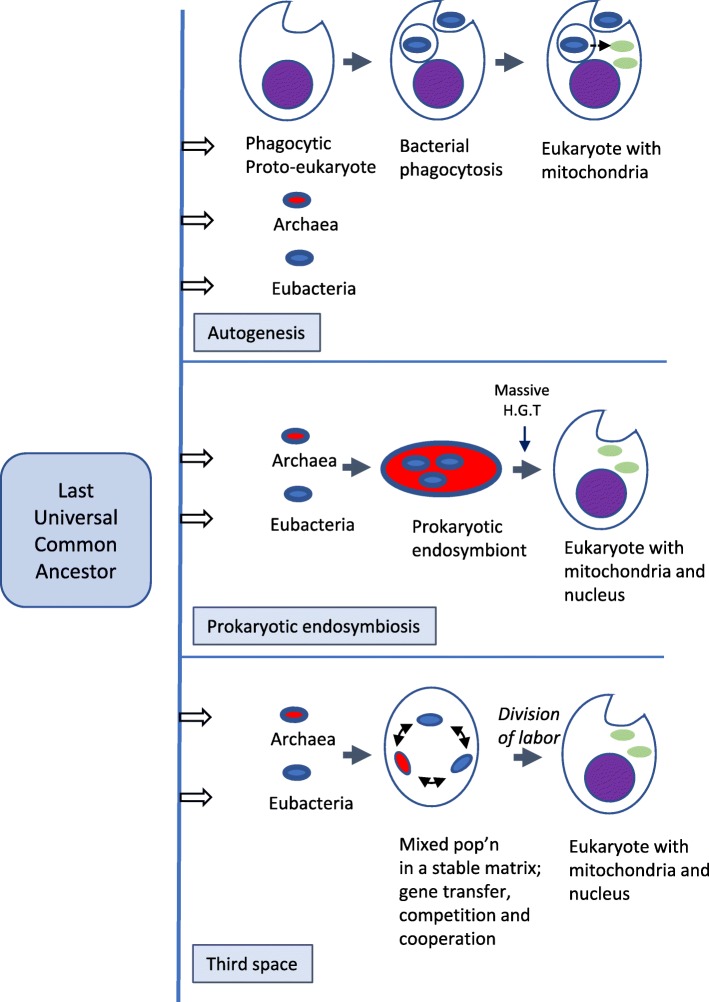
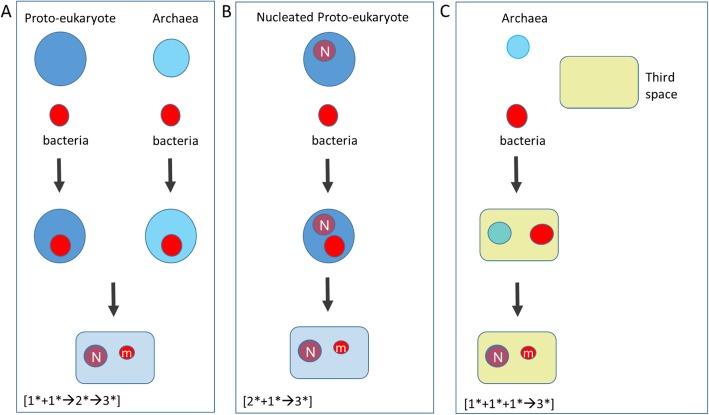
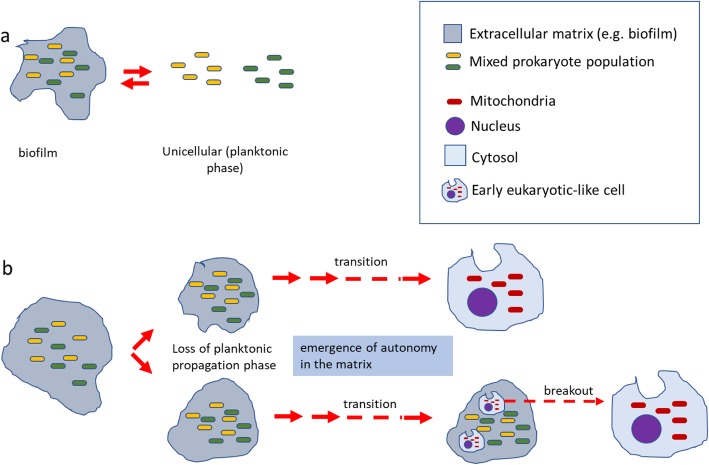
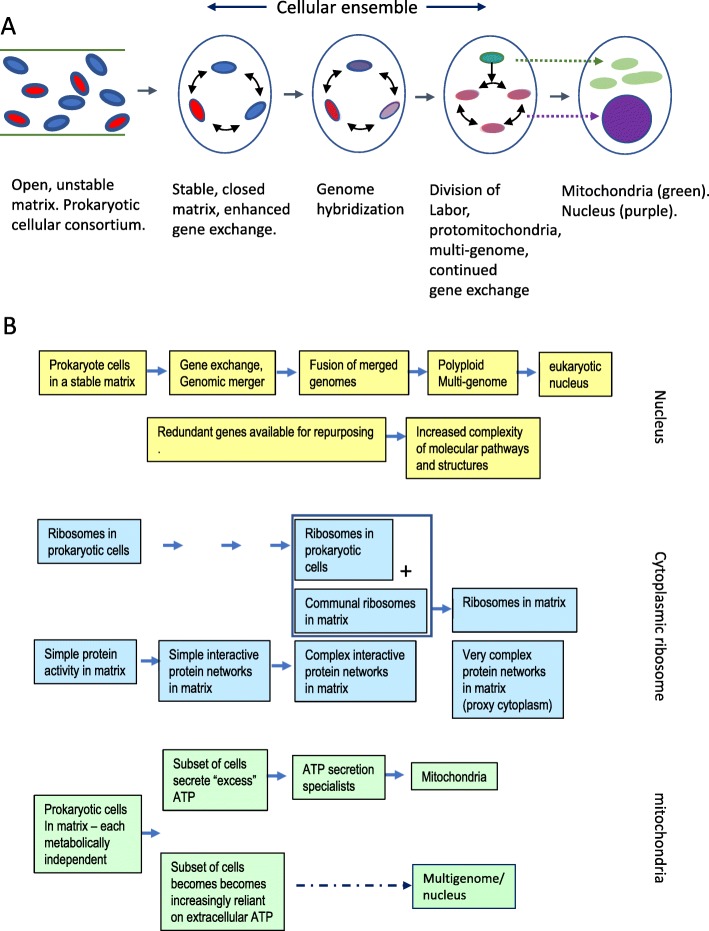
Two apparently irreconcilable models dominate research into the origin of eukaryotes. In one model, amitochondrial proto-eukaryotes emerged autogenously from the last universal common ancestor of all cells. Proto-eukaryotes subsequently acquired mitochondrial progenitors by the phagocytic capture of bacteria. In the second model, two prokaryotes, probably an archaeon and a bacterial cell, engaged in prokaryotic endosymbiosis, with the species resident within the host becoming the mitochondrial progenitor. Both models have limitations. A search was therefore undertaken for alternative routes towards the origin of eukaryotic cells. The question was addressed by considering classes of potential pathways from prokaryotic to eukaryotic cells based on considerations of cellular topology. Among the solutions identified, one, called here the "third-space model", has not been widely explored. A version is presented in which an extracellular space (the third-space), serves as a proxy cytoplasm for mixed populations of archaea and bacteria to "merge" as a transitionary complex without obligatory endosymbiosis or phagocytosis and to form a precursor cell. Incipient nuclei and mitochondria diverge by division of labour. The third-space model can accommodate the reorganization of prokaryote-like genomes to a more eukaryote-like genome structure. Nuclei with multiple chromosomes and mitosis emerge as a natural feature of the model. The model is compatible with the loss of archaeal lipid biochemistry while retaining archaeal genes and provides a route for the development of membranous organelles such as the Golgi apparatus and endoplasmic reticulum. Advantages, limitations and variations of the "third-space" models are discussed. REVIEWERS: This article was reviewed by Damien Devos, Buzz Baum and Michael Gray.
两种看似不可调和的模型主导着真核生物起源的研究。在一种模型中,无线粒体的原真核生物自发地从所有细胞的最后一个普遍共同祖先中出现。原真核生物随后通过吞噬细菌获得线粒体祖先。在第二种模式中,两个原核生物,可能是古菌和细菌细胞,进行了原核内共生,宿主内的物种成为线粒体祖先。这两种模型都有局限性。因此,人们一直在寻找真核细胞起源的替代途径。通过考虑基于细胞拓扑学的从原核生物到真核生物的潜在途径类别,解决了这个问题。在确定的解决方案中,有一种称为“第三空间模型”的模型尚未得到广泛探索。在这里提出了一个版本,其中一个细胞外空间(第三空间)作为古菌和细菌混合种群的细胞质替代品,“融合”为一个过渡复合物,而不需要必需的内共生或吞噬作用,并形成一个前体细胞。初生核和线粒体通过分工而分化。第三空间模型可以容纳类似于原核生物的基因组的重新组织为更类似于真核生物的基因组结构。具有多个染色体和有丝分裂的核作为该模型的自然特征出现。该模型与古菌脂质生物化学的丧失兼容,同时保留古菌基因,并为诸如高尔基体和内质网等膜细胞器的发展提供了途径。讨论了“第三空间”模型的优势、局限性和变体。
Damien Devos、Buzz Baum、Michael Gray