Department of Proteomics and Signal Transduction, Max Planck Institute of Biochemistry, 82152 Martinsried, Germany.
Mol Cell Proteomics. 2020 Jul;19(7):1076-1087. doi: 10.1074/mcp.R120.001971. Epub 2020 Apr 28.
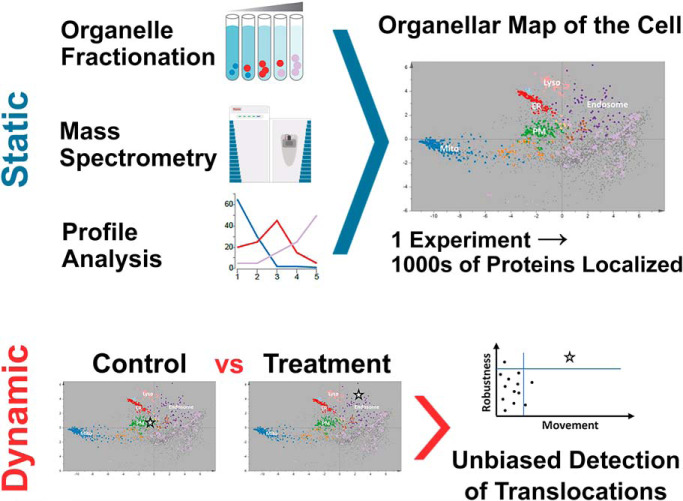
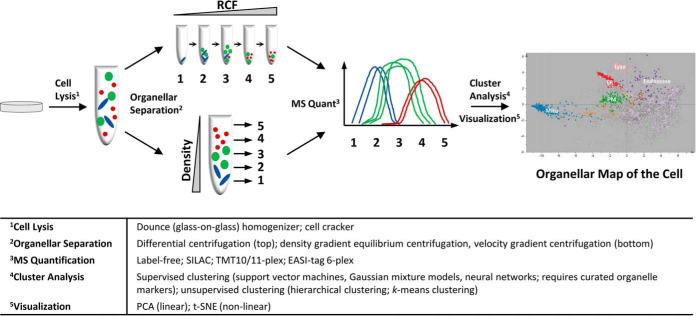
Protein subcellular localization is an essential and highly regulated determinant of protein function. Major advances in mass spectrometry and imaging have allowed the development of powerful spatial proteomics approaches for determining protein localization at the whole cell scale. Here, a brief overview of current methods is presented, followed by a detailed discussion of organellar mapping through proteomic profiling. This relatively simple yet flexible approach is rapidly gaining popularity, because of its ability to capture the localizations of thousands of proteins in a single experiment. It can be used to generate high-resolution cell maps, and as a tool for monitoring protein localization dynamics. This review highlights the strengths and limitations of the approach and provides guidance to designing and interpreting profiling experiments.
蛋白质亚细胞定位是蛋白质功能的一个基本且高度调控的决定因素。质谱和成像技术的重大进展使得在全细胞尺度上确定蛋白质定位的强大空间蛋白质组学方法得以发展。本文简要概述了当前的方法,然后详细讨论了通过蛋白质组学分析进行细胞器绘图。这种相对简单但灵活的方法由于能够在单个实验中捕获数千种蛋白质的定位而迅速流行起来。它可用于生成高分辨率细胞图谱,并作为监测蛋白质定位动力学的工具。本文综述了该方法的优缺点,并为设计和解释分析实验提供了指导。