Tuberculosis and Leprosy Control and Prevention unit, Oromia Health Bureau, Addis Ababa, Ethiopia.
Department of Public Health, Institute of Health Sciences, Wollega University, Nekemte, Ethiopia.
PLoS One. 2020 Apr 29;15(4):e0232468. doi: 10.1371/journal.pone.0232468. eCollection 2020.
Tuberculosis (TB) is a leading cause of death among infectious agents, ranking above HIV/AIDS. Though much effort has been done, Ethiopia remained one of those countries which share the greatest burden of TB. Evaluating the TB treatment outcome is one method of TB control measures. Therefore, the aim of the current study was to assess TB treatment outcome and its determinants under directly observed treatment short courses in Adama City, Central Ethiopia.
An institutional based cross sectional study was conducted in all public and private health facilities of Adama city from March 1st 2016 to December 31st, 2016. The data were entered and analyzed by using SPSS version 21.0 statistical software. The results were presented using descriptive statistics. Univariate and multivariate logistic regression model was used to evaluate the potential determinants of unsuccessful treatment outcome.
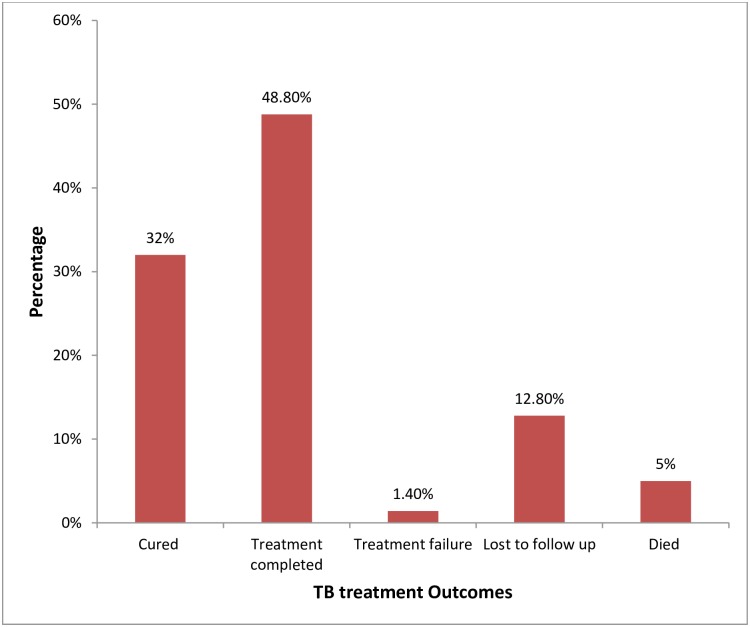
Among 281 patients evaluated, 90(32%) were cured, 137(48.8%) have completed the treatment, 4(1.4%) were treatment failure, 36(12.8%) were lost to follow up, and 14 (5%) died. The overall treatment success rate was 80.8%. Age 15-24 (Adjusted odds ratio (AOR): 4.97; 95% Confidence interval (CI): 1.13-21.90), distance less than 5 kilometers from treatment center (AOR: 3.1; 95% CI: 1.42-6.77), being seronegative for human immunodeficiency virus (HIV) (AOR: 20.38; 95% CI: 7.80-53.24) were associated with successful TB treatment outcome.
The treatment outcome of all forms tuberculosis patients in Adama city was unsatisfactory when referred with the national pooled estimate of 86% and WHO 2030 international target of ≥90%. Thus, enhancing client supervision, treatment monitoring; and working on provision TB treatment services at nearby health facilities should be a priority concern to improve the success rate of treatment outcome. Further studies are also recommended to explore important factors which were not examined by current study.
结核病(TB)是传染病死亡的主要原因,排在艾滋病病毒/艾滋病之上。尽管已经做出了很多努力,但埃塞俄比亚仍然是结核病负担最重的国家之一。评估结核病治疗结果是结核病控制措施之一。因此,本研究旨在评估在埃塞俄比亚阿达玛市直接观察治疗短期疗程下的结核病治疗结果及其决定因素。
2016 年 3 月 1 日至 2016 年 12 月 31 日,在阿达玛市所有公立和私立卫生机构进行了一项基于机构的横断面研究。数据由 SPSS 版本 21.0 统计软件输入和分析。结果采用描述性统计方法表示。采用单变量和多变量逻辑回归模型评估治疗结果不成功的潜在决定因素。
在 281 例接受评估的患者中,90 例(32%)治愈,137 例(48.8%)完成治疗,4 例(1.4%)治疗失败,36 例(12.8%)失访,14 例(5%)死亡。总治疗成功率为 80.8%。年龄在 15-24 岁之间(调整优势比(AOR):4.97;95%置信区间(CI):1.13-21.90)、距离治疗中心小于 5 公里(AOR:3.1;95%CI:1.42-6.77)、人类免疫缺陷病毒(HIV)血清阴性(AOR:20.38;95%CI:7.80-53.24)与结核病治疗成功相关。
当参照全国 86%的综合估计数和世卫组织 2030 年 90%的国际目标时,阿达玛市所有形式结核病患者的治疗结果并不令人满意。因此,加强对患者的监督、治疗监测,并在附近的卫生机构提供结核病治疗服务,应成为提高治疗成功率的优先事项。还建议进行进一步的研究,以探讨当前研究未检查的重要因素。