Department of Pharmacy, College of Health Sciences, Wollega University, Nekemte, Ethiopia.
PLoS One. 2018 Oct 26;13(10):e0206227. doi: 10.1371/journal.pone.0206227. eCollection 2018.
Although it is a preventable and treatable disease, tuberculosis remains a major medical and public health problem throughout the world. The control and elimination of tuberculosis is currently challenged by the development and spread of antituberculosis drug resistance. The resistance is often correlated to the absence of properly implemented control measures that lead to poor treatment outcomes. Therefore, the aim of the current study was to assess poor treatment outcomes and its determinants among tuberculosis patients in selected health facilities in East Wollega zone, Western Ethiopia.
A five-year retrospective cross-sectional study design was employed. Data were collected from patients' medical record from January to March 2017. Data were entered and analyzed using SPSS version 20. Descriptive statistics were used to generate and summarize frequencies. Univariate and multivariate logistic regression analysis were used to associate the potential determinants of poor treatment outcomes.
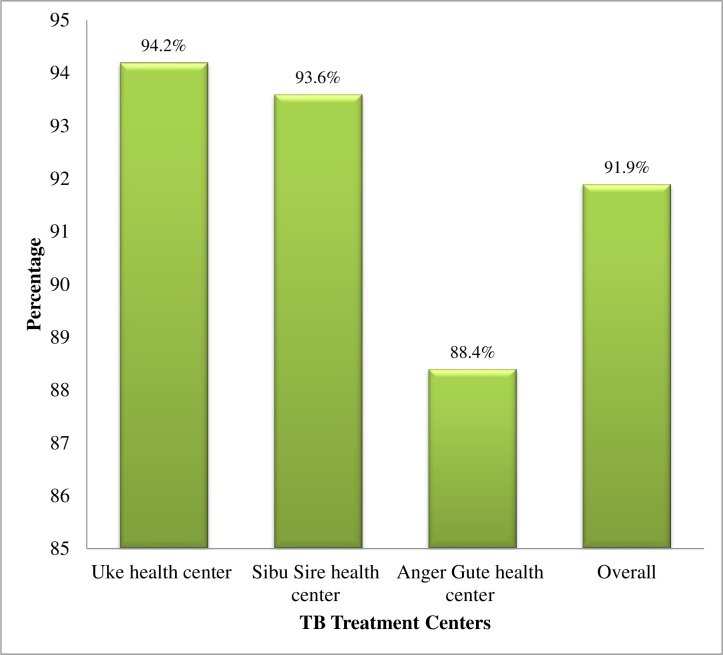
From 995 patients with documented treatment outcomes, 58.9% were males with a mean age of 31.9±16.3 years and 58% lived in rural areas. Majorities of cases (95.7%) were newly treated ones. Nearly half of the cases had extrapulmonary tuberculosis and 6.8% were co-infected with HIV. Nearly three-quarter of patients had completed their treatment while 17.2%, 2.9%, 4.8%, 0.4% patients were cured, defaulted, died, and failed, respectively. The overall treatment success rate was 91.9%. Being treated in Anger Gute health center (adjusted odds ratio (AOR): 2.27; 95% confidence interval (CI): 1.18-4.38); male (AOR: 1.81; 95% CI: 1.06-3.10); lived in rural areas (AOR: 1.73; 95% CI: 1.02-2.91); previously treated (AOR: 2.72; 95% CI: 1.16-6.39) and unknown HIV status (AOR: 4.56; 95% CI: 1.98-10.50) were determinants of poor treatment outcomes.
The current treatment success rate was exceeded the recommended target. However, special attention and strict follow up is required for tuberculosis patients with high risk of unsuccessful treatment outcomes including male, rural resident, previously treated and unknown in HIV status patients throughout their treatment periods.
尽管结核病是一种可预防和可治疗的疾病,但它仍是全球范围内的一个重大医学和公共卫生问题。结核病的控制和消除目前面临着抗结核药物耐药性的发展和传播的挑战。耐药性通常与未实施适当的控制措施有关,这些措施导致治疗结果不佳。因此,本研究的目的是评估在埃塞俄比亚西部东沃莱加地区选定卫生设施中结核病患者的不良治疗结局及其决定因素。
采用五年回顾性横断面研究设计。数据来自 2017 年 1 月至 3 月期间患者的病历。使用 SPSS 版本 20 输入和分析数据。描述性统计用于生成和总结频率。单变量和多变量逻辑回归分析用于关联不良治疗结局的潜在决定因素。
在有记录治疗结局的 995 名患者中,58.9%为男性,平均年龄为 31.9±16.3 岁,58%居住在农村地区。大多数病例(95.7%)为新发病例。将近一半的病例患有肺外结核病,6.8%合并感染 HIV。近四分之三的患者完成了治疗,而分别有 17.2%、2.9%、4.8%、0.4%的患者治愈、失访、死亡和失败。总体治疗成功率为 91.9%。在 Anger Gute 卫生中心接受治疗(调整后的优势比(AOR):2.27;95%置信区间(CI):1.18-4.38);男性(AOR:1.81;95%CI:1.06-3.10);居住在农村地区(AOR:1.73;95%CI:1.02-2.91);既往治疗(AOR:2.72;95%CI:1.16-6.39)和未知 HIV 状态(AOR:4.56;95%CI:1.98-10.50)是不良治疗结局的决定因素。
目前的治疗成功率超过了推荐的目标。然而,需要特别关注和严格随访具有治疗结局不成功高风险的结核病患者,包括男性、农村居民、既往治疗和 HIV 状态未知的患者,在整个治疗期间都需要关注。