Center for Food Safety and Applied Nutrition, U.S. Food and Drug Administration, College Park, Maryland, United States of America.
Consultant, Buenos Aires, Argentina, United States of America.
PLoS One. 2020 Apr 30;15(4):e0231393. doi: 10.1371/journal.pone.0231393. eCollection 2020.
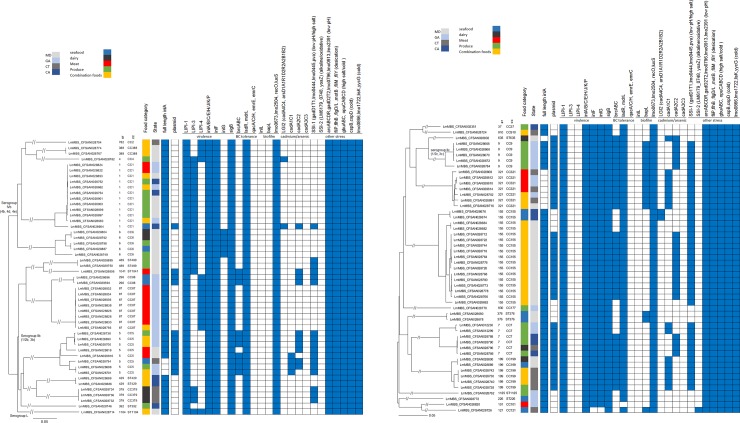
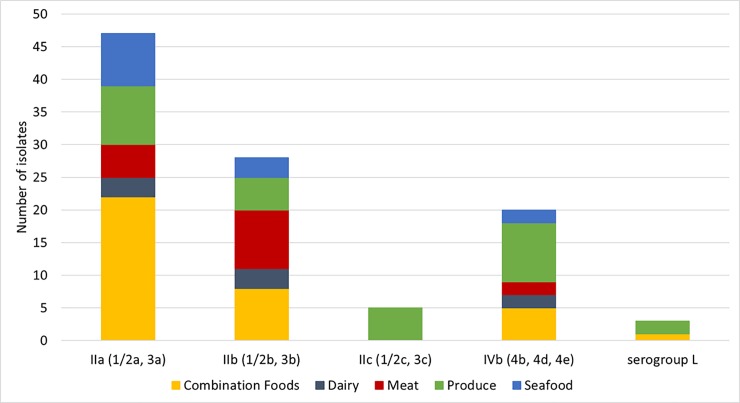
Whole genome sequencing (WGS) was performed on 201 Listeria monocytogenes isolates recovered from 102 of 27,389 refrigerated ready-to-eat (RTE) food samples purchased at retail in U.S. FoodNet sites as part of the 2010-2013 interagency L. monocytogenes Market Basket Survey (Lm MBS). Core genome multi-locus sequence typing (cgMLST) and in-silico analyses were conducted, and these data were analyzed with metadata for isolates from five food groups: produce, seafood, dairy, meat, and combination foods. Six of 201 isolates, from 3 samples, were subsequently confirmed as L. welshimeri. Three samples contained one isolate per sample; mmong the 96 samples that contained two isolates per sample, 3 samples each contained two different strains and 93 samples each contained duplicate isolates. After 93 duplicate isolates were removed, the remaining 102 isolates were delineated into 29 clonal complexes (CCs) or singletons based on their sequence type. The five most prevalent CCs were CC155, CC1, CC5, CC87, and CC321. The Shannon's diversity index for clones per food group ranged from 1.49 for dairy to 2.32 for produce isolates, which were not significantly different in pairwise comparisons. The most common molecular serogroup as determined by in-silico analysis was IIa (45.6%), followed by IIb (27.2%), IVb (20.4%), and IIc (4.9%). The proportions of isolates within lineages I, II, and III were 48.0%, 50.0% and 2.0%, respectively. Full-length inlA was present in 89.3% of isolates. Listeria pathogenicity island 3 (LIPI-3) and LIPI-4 were found in 51% and 30.6% of lineage I isolates, respectively. Stress survival islet 1 (SSI-1) was present in 34.7% of lineage I isolates, 80.4% of lineage II isolates and the 2 lineage III isolates; SSI-2 was present only in the CC121 isolate. Plasmids were found in 48% of isolates, including 24.5% of lineage I isolates and 72.5% of lineage II isolates. Among the plasmid-carrying isolates, 100% contained at least one cadmium resistance cassette and 89.8% contained bcrABC, involved in quaternary ammonium compound tolerance. Multiple clusters of isolates from different food samples were identified by cgMLST which, along with available metadata, could aid in the investigation of possible cross-contamination and persistence events.
对从美国食品网(FoodNet)27389 个零售冷藏即食(RTE)食品样本中的 102 个样本中回收的 201 株单核细胞增生李斯特菌(Listeria monocytogenes)分离株进行了全基因组测序(WGS)。进行了核心基因组多位点序列分型(cgMLST)和计算机分析,并对来自五个食品组的分离株的元数据进行了分析:农产品、海鲜、乳制品、肉类和组合食品。来自 3 个样本的 201 个分离株中的 6 个随后被确认为 L. welshimeri。3 个样本各含有 1 个分离株;在包含 2 个分离株的 96 个样本中,有 3 个样本各含有 2 种不同的菌株,93 个样本各含有重复的分离株。在去除 93 个重复的分离株后,根据序列类型,剩余的 102 个分离株被划分为 29 个克隆复合体(CC)或单倍型。最常见的 5 个 CC 是 CC155、CC1、CC5、CC87 和 CC321。根据食品组的每个克隆的 Shannon 多样性指数,从乳制品的 1.49 到农产品的 2.32 不等,在两两比较中没有显著差异。通过计算机分析确定的最常见分子血清型是 IIa(45.6%),其次是 IIb(27.2%)、IVb(20.4%)和 IIc(4.9%)。谱系 I、II 和 III 内的分离株比例分别为 48.0%、50.0%和 2.0%。89.3%的分离株存在全长 inlA。51%的谱系 I 分离株和 30.6%的谱系 I 分离株存在李斯特菌致病性岛 3(LIPI-3)和 LIPI-4。34.7%的谱系 I 分离株、80.4%的谱系 II 分离株和 2 个谱系 III 分离株存在应激生存岛 1(SSI-1);SSI-2 仅存在于 CC121 分离株中。48%的分离株存在质粒,包括谱系 I 分离株的 24.5%和谱系 II 分离株的 72.5%。在携带质粒的分离株中,100%至少携带一个镉抗性盒,89.8%携带 bcrABC,参与季铵化合物耐受。通过 cgMLST 确定了来自不同食品样本的多个分离株簇,这些簇与可用的元数据一起,可以帮助调查可能的交叉污染和持续事件。